The white South African refugees are victims of Trump’s hallucination about an imaginary genocide

The topic of genocide is not something I would have chosen for myself as an object of deep investigation. My late Armenian grandfather was a survivor of the 1915 genocide, and he would sometimes talk about his experiences. I never pushed the subject, always allowing him to volunteer information about that traumatic event, if he so wished.

Talking about that genocide, and comparing and contrasting it to similarly unspeakable crimes in the twentieth century, is a topic familiar to diasporan Armenians. This month, I found out that I have a high level official who is exercising his tremendous intellectual capacities on a similar subject – US President Donald Trump.

He is unable to sleep at nights apparently, riddled with anxiety about an ongoing genocide – that of the Afrikaners, the white South African farmers whose land is being seized by a relentlessly furious campaign by the black-majority government in Pretoria. Huge numbers of these farmers are being systematically exterminated, so we are told.

There is just one problem with the white genocide of Afrikaners – it is not happening. But its imaginary status does not deter our fearless Trump, and his colleagues in paranoid delusions Elon Musk and JD Vance, from taking actions based on such an illusion. After all, collective illusions are powerful things – when enough people believe them, they can have violent consequences.

The white genocide conspiracy theory involves more than just manufactured anxieties about the Afrikaners. It is an overarching worldview of racial resentment, alleging that ethnic minorities are ‘invaders’, brought to Anglophone and European nations by ‘traitorous’ elites (and that usually signifies the Jews) as demographic battering rams. Overpopulating their new domestic homeland, they eventually turn the white population into a beleaguered minority.

The origins of that racial paranoia resides with the so-called Great Replacement theory, as elaborated by French writer Renaud Camus. He codified a disparate yet interrelated series of racially resentful ideologies, which opposed the efforts of nonwhite peoples at decolonisation.

Let’s not stay in Europe – at the turn of the nineteenth and twentieth centuries, Australian politicians such as Edmund Barton (our first prime minister) stated that the new Australian federation was a necessary political unification project. Why? To avoid being swamped by nonwhite, particularly Asian, immigration.

Charles Pearson, Anglo-Australian academic and writer, expressed his anxiety (in 1892) that the white population would one day wake up and find themselves outnumbered and outgunned by nonwhite immigrants. Perhaps current UK prime minister Keir Starmer was channeling Pearson (and Enoch Powell) when he spoke of Britain becoming an island full of strangers.

Let’s get back to South Africa. The Afrikaners, descendants of the Dutch settlers who settled there from the 1600s onwards, benefited from the system of apartheid (apartness). Monopolising control of the land, they helped (along with the English settlers) to establish a rigidly stratified society based on race.

The end of apartheid in 1994 did not bring about ecological justice – while white South Africans make up only 7.8 percent of the population, they still own 72 percent of the arable land. Hardly evidence of a systematic campaign of racially motivated elimination.

Is crime a problem in South Africa? Yes, sadly it is. Are white farmers being singled out for oppression and extermination? No, they are not. There is no evidence that Afrikaner farmers are disproportionately affected by violent crime. In fact, the black African community is most adversely affected by the incidence of crime.

Indeed, the African National Congress (ANC) banked on a singular strategy in 1994 which they hoped would correct the injustices of apartheid – the creation of a black capitalist entrepreneurial class. That is certainly one strategy, adopted by numerous governments around the world in the immediate aftermath of the Eastern bloc’s dissolution. However, creating a new capitalist class proved inadequate in confronting and rectifying the deep seated economic inequities of the apartheid era in South Africa.

Multiple white South African commentators have rubbished the Trump administration’s claims of white Afrikaner genocide. Elon Musk, himself a scion of privilege, no doubt spread the ‘white genocide’ claim in his social media posts, resentful about the demise of formal apartheid.

Indeed, the Trump administration has vociferously rejected refugees from nonwhite nations – Haitians, Somalis, Afghans, Salvadorans – are having their applications for sanctuary strongly rejected, and immigrants in the US being rounded up and deported. The 59 Afrikaners who arrived by a government-provided airplane are the recipients of generosity because they are white.

Trump is sending an unmistakable message to the world; his solidarity extends only to those who are white. Sanctuary is reserved for white racial brethren.

If the MAGA cult was so concerned about stopping a genocide, then they could certainly take decisive action towards that goal. What am I talking about? Trump could immediately cease all armaments sales and military contracts with the Israeli military. The latter is conducting a genocidal war against the Palestinians of Gaza.

Civilians are being deliberately targeted by Israeli soldiers, hospitals and schools are being bombed, and food aid is being purposely withheld. Famine looms as a real possibility in Gaza, with all the humanitarian consequences that this catastrophe raises.

If anyone requires advice about how to survive the white genocide in South Africa, look no further than an article by Ryan Cooper, a white South African who grew up in a remote black homeland, a Bantustan, set up by the apartheid regime in the 1960s. Such homelands were created by the apartheid authorities along tribal lines, enforcing the relocation and tribal segregation of the black population.

The Bantustans were dignified with the title homeland, but in reality were reservations to which the black African populations were confined.

Cooper explained his tactics for surviving in Bophuthataswana. an isolated Bantustan in the north of South Africa. Living with a black host family, as the only white person for miles, he adopted the following cunning strategy for survival, live and mix freely among black Africans, make friendly with them, and catch public transport with them.

This elaborate and deceptively crafty approach to living enabled Cooper to survive the relentlessly hostile terrain of black South Africa. Hiding in plain sight, he was able to avoid the worst excesses of his black African friends, neighbours, colleague and counterparts. There is a lesson in that for all of us.

This year, the 80th anniversaries of World War 2 events can teach us lessons about politics today

The National Geographic magazine is not the first place you would think of as having anything related to modern history or politics. However, you would be mistaken – there is a large History and Culture section of the magazine. In the May issue, there is a detailed summary of Operation Paperclip, which began in 1945.

Operation Paperclip was a covert mission, initiated and organised by US intelligence, to secretly transport and settle numerous German rocket scientists in the United States. These scientists, heavily involved in the military programmes of Nazi Germany, worked in the American space and military industries.

Their membership of the SS, their use of forced labour in concentration camps, was quietly swept under the carpet. The name Paperclip came from an identifiable paper clip earmarking the files examining these scientists.

Nazi rocket scientist Wernher von Braun – image courtesy of Encyclopaedia Britannica

One of the most famous of these German scientists was Wernher von Braun, (1912 – 1977) an engineer and rocket scientist who led the creation of the so-called V-2 ballistic missile. This ‘vengeance weapon’ was used to target British cities in the last years of the war. Slave labourers from concentration camps, built to accommodate the needs of the rocket program, died in their thousands from overwork, starvation and disease.

In a cruel irony, more people died extracting the raw materials required for building these rockets than the civilians killed in Britain due to V-2 attacks. Braun’s passion for ballistic missiles helped fuel the space ambitions of NASA.

You may find more details about the specifics of this operation here.

This year marks the 80th anniversary of the end of World War 2. Numerous commemorative activities, presentations and ceremonies were held across the world. One of the most important of these was the May 9 Victory Day parade in Moscow. Multiple heads of state attended the parade on that day, marking the decisive contribution of the USSR in the defeat of Nazi Germany.

Other writers have examined in great detail the incredible sacrifices of the Soviet people, including 300 000 Armenians, in breaking the back of the Nazi war machine. I will not go into the details of the extraordinary and heroic efforts of the Red Army here. What I can anticipate though, is the screaming objection by Western commentators, indoctrinated in the Hollywood-Longest Day-Guns of Navarone-Saving Private Ryan fan club version of history – what about the Western contribution to the Nazi defeat?

This question is important, though it is deployed in a cynical fashion. It is not asked out of genuine interest in the Anglo-American-Canadian contribution to the war effort, but to distract us from the complicity of imperialist powers in accommodating and encouraging the rise of Nazi power.

Large corporations in the United States and Britain, while wary of Nazi designs on Western Europe, were definitely encouraging Hitler to build a German empire in the European east – a project involving the invasion of the Soviet Union. Hitler himself made no secret of the fact that Eastern Europe constituted German lebensraum (living space), in much the same fashion that white settlers in the United States expanded West. The tactics used to expel the indigenous people of the American West were adapted by Nazi Germany to exterminate the Slavs and Jews of the European East.

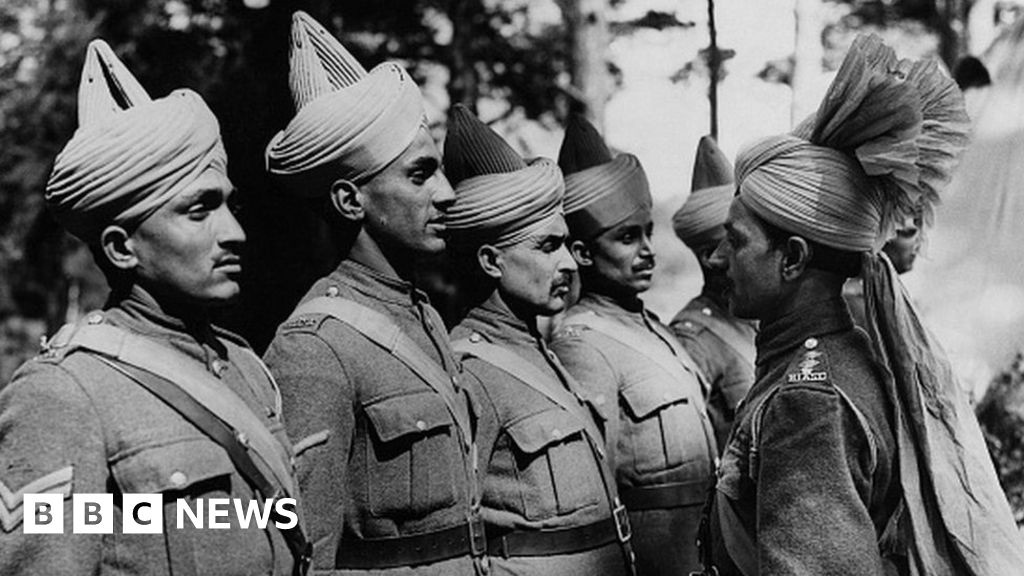
What about Britain’s undeniable effort to defeat Nazi Germany? There is no question regarding the courage and determination of the English people facing the Nazi blitz, but they were hardly standing alone. Gary Younge, sociology professor at the University of Manchester, writes that millions of nonwhite people from the far flung territories of the British empire, volunteered to fight for Britain.

Millions from India, (and the Indian subcontinent), sub-Saharan Africa, Jamaica, the Caribbean nations, Kenya, North African Arab-speaking nationalities – the British fight against fascism was multicultural. They have never received their VE Day, and their contribution has been written out of the history books.

Indian soldiers in World War 2 – image courtesy of the BBC

While Europeans were ecstatically celebrating their newly-won freedom on VE Day 1945, another scenario unfolded in the former French colony of Algeria. France had been occupied by Nazi Germany, and it had signed, along with the other Allied powers, the Atlantic Charter, a document that stipulated that occupied nations in Europe had the right to self-determination.

Well, the Algerians for one, decided that the principle of self-determination applies to them. Protesting peacefully, they were met with French gunfire. 45 000 Algerian were killed over the course of May and June. The French army, backed up by armed French settlers, launched a campaign of terrifying violence against the Algerians, using low level bombings, massacres and torture of anti colonial Algerians.

Clearly, the lauded principle of self determination did not apply to the darker skinned nationalities of the French and British empires. As we all now know, the former French territory of Vietnam waged a stubborn battle for independence after 1945. Where the French failed, the Americans stepped in.

April 30 was the 50th anniversary of the liberation of Saigon from American occupation. A hard fought campaign of resistance to colonial rule, the Vietnamese paid the price for American unwillingness to learn the lessons of colonial history.

Actually, in a way, the United States did learn from history. Closing its doors to European Jewish refugees during the war, Washington and Ottawa opened their doors to provide sanctuary for fleeing Nazi war criminals.

How about, this time around, we remember those who have been forgotten amidst the manufactured nostalgia surrounding World War 2. The prisoners of Buchenwald concentration camp were overjoyed to see American troops approaching their location in April 1945. The American soldiers were confronted by scenes of unimaginable horror and cruelty. But it would be a mistake to say that US forces liberated Buchenwald.

It was the prisoners who liberated themselves in Buchenwald. Forming underground action committees, and taking matters into their own hands, they bravely rose up and disarmed their fascist captors. Their heroism and collective spirit, even in such an inhumane and horrific place, could not be extinguished.

Gary Younge provides a cautionary observation for our times. It would be a perverse irony if the ideological descendants of ultranationalist and fascist parties, currently polling strongly across European nations, were to regain power through the ballot box 80 years after being defeated on the battlefield.

When elite sportspeople are exceptional on the field, but lousy human beings, we can call them out but still admire their prowess

What are we to do when an elite sport player, musician or artist – outstanding in their particular field – turns out to be an obnoxious a*sehole in life?

A few years back, I wrote about the legendary chess player the late Bobby Fischer (1943 – 2008). A child prodigy at chess, he defeated his Soviet counterpart in the 1950s, thus earning his place in the pantheon of chess greats. However, as a person, he turned out to be a bigot, contemptuously sneering at anyone who disagreed with him.

Should we continue to admire a person who, while outstanding as a sportsperson or musician, is an obnoxious lout in life?

Let’s begin with baseball. I tried baseball in high school, and was never any good at it. I probably hit only 20 percent of the pitches I faced. Hitting a home run was a rarity. To top it off, I got more interested in squash, and so my incipient baseball career came to an end before it even started.

Baseball is not that big in Australia, in comparison to the Major Leagues in the United States. I never fully understood all the statistics of baseball playing – and I still do not. However, I can appreciate the ability of fans to accumulated vast and complex baseball data sets in their minds. I also think that elite baseball players are worthy of admiration.

Ty Cobb (1886 – 1961) was an exceptional baseball player, the absolute greatest of his generation. His baseball achievements hit record levels, and remained so for decades.

His approach to the game was one of tactical aggression, unafraid to confront his opponents absolutely head-on. Undeterred by threats from fans, he pursued baseball with an unmatched intensity, stealing bases, a steely-eyed gaze, anticipating his opponents’ moves and countering them. He was able to think quickly and decisively under pressure. Fearless and strong, he would deliberately crash into the opposing fielders at the bases, sparking numerous confrontations that became a hallmark of his career.

He was also an antisemite and obnoxious person, described by his friends and colleagues as a ‘son of a b*tch.’ Known for a hair-trigger temper, he was abusive and obnoxious to waiters, porters, hotel staff, his intimate partners and certainly towards other baseball players. Loudly and frequently disparaging his slightly younger contemporary, George ‘Babe’ Ruth, Cobb reserved a special hatred for Ruth’s superb hitting and sporting abilities.

Nicknamed the Bambino, Babe Ruth was a portly, stocky man, who grew up in relative poverty. Attending a reformatory school, nothing in his academic records suggested that he would amount to anything out of the ordinary. Preferring drinking and carousing to baseball training, there was no indication yet of his sporting abilities.

Yet, in his first season as a professional base baller, in 1920, Ruth scored an amazing 54 home runs for the New York Yankees. Ruth displayed a remarkable intelligence and resilience on the baseball field. Making decisions under intense pressure, he worked out the tactics of his opponents and decided how to outsmart them.

Elite sportspeople can be both physically adept, and intelligent in their field. Ruth confounded the stereotype of ‘great at sport, dumbo at academics.’ We have all confronted the ‘sports jock’ archetype – excelling in football, for instance, but barely passing their school subjects. In fact, to be an elite competitor, you need not just physical strength, but mental agility and flexibility.

Let’s change tack here….why am I talking about this particular subject now? The topic above – appreciating sport or music produced by scoundrels – has resurfaced in recent days.

American rapper and musician Kanye West (or Ye as he prefers to be know) is no stranger to controversy. A talented rapper with a global following, his gradual descent into mental health problems is no secret. His political deterioration into a MAGA-aligned far rightist has been the subject of analysis in the past. I have written about his antisemitic and ignorant recycling of conspiratorial misinformation previously.

Earlier this month, West released a single called ‘Heil Hitler’ from his forthcoming album. Praising the Nazi leader and architect of the Holocaust, West’s song is a mishmash of antisemitic outbursts and juvenile profanities. Identifying himself as a fellow traveler of Nazi ideology, West has been dropped by major music companies. His song, while also dropped from streaming platforms, nevertheless remains in circulation through AI-generated versions.

The song’s cover illustration resembles a swastika. The song ends with excerpts from a speech by Hitler. West is increasingly resembling an emotionally and mentally unhinged person. His narcissistic selfishness was previously excused on the grounds that he is a brilliant musician. His legions of fans either ignored or rationalised his outbursts.

However, West has now chosen to occupy a position in the foul cesspit of the MAGA cult’s ultra-libertarian and fanatical ‘America First’ nationalism. Trump, Musk, Vance, and the swamp of fascistic social media influencers have taken their toll on West, and now they are hailing their new musical recruit to their ideology.

It is not everyday that a black man, and an influential one at that, sings the same tune as MAGA – the modern day updated version of the Klan. It is only a small step from white hoods to red MAGA hats.

West needs help with his mental health issues, plus an extensive education in the history of racism, the American civil war, the Holocaust, and settler colonialism.

We would do well to remember, and learn from, the example of Jackie Robinson (1919 – 1972). An African American baseball champion who broke through the colour line, he maintained his integrity while never backing down against bigotry. Today’s American MAGA administration would have kept Robinson out of the Major Leagues, given the chance.

The Great Gatsby turns 100, the cutting of museums and libraries, and excluding the public from education

This year marks the 100th anniversary of The Great Gatsby, a classic American novel. Taught in high schools and universities across the Anglophone nations, its message of financial opulence hiding dark secrets is still relevant in Trump’s United States.

There were numerous exhibitions and commemorative activities held in April this year, celebrating the publication of The Great Gatsby one hundred years ago. There are multiple themes and leitmotifs in that book, and it deserves to be hailed as the great American novel. F Scott Fitzgerald, the author, already had two commercially successful novels under his belt. The Great Gatsby, however, was not a financial success initially.

The exhibitions and literary events commemorating the book come at a difficult time for writers, libraries and museums in the US today. The Trump administration, under the guise of saving money, has issued numerous executive orders cutting the federal government’s funding of public libraries, museums and educational institutions. Trump himself has been compared to Gatsby, a nouveau riche hustler who equates financial success with possessing an ethical compass.

The main character of the novel, Jay Gatsby, is an enormously wealthy man. He hosts lavish cocktail parties, sumptuous gatherings and social events at his mansion at West Egg, New York. Beneath the glitz and glamour, there is a dark story; Gatsby, originating from an impoverished background, made his wealth through bootlegging and other criminal activities. Desiring nothing else than the love of the rich and already married Daisy Buchanan, Gatsby longs to be accepted by ‘old’ money families.

Indeed, if there is an Australian counterpart to Gatsby, it is convicted criminal and former NSW politician Eddie Obeid. The latter used his position and connections to amass a fortune in property development and real estate speculation. Charged and convicted of corruption and financial misconduct, he made a statement during the trial that indicates his personality.

During one of many heated exchanges with the prosecuting lawyer, Obeid remarked “I’ve spent more money than you have made in your entire lifetime.” He said that statement with pride, as if it is an accomplishment. The parallels with the Trumpian obsession with wealth are apparent. Nothing else matters except financial accumulation.

Obeid’s sneering remark reminded me of Jay Gatsby, the man for whom wealth is the ultimate measure of success. Reminds me of Trump for that matter. F Scott Fitzgerald, when asked why he wrote the novel, stated:

The idea that we’re the greatest people in the world because we have the most money in the world is ridiculous. Wait until this wave of prosperity is over! Wait ten or fifteen years! Wait until the next war in the Pacific, or against some European combination!

Indeed, Jonah Raskin, in his article examining the Gatsby novel, states that class consciousness comes through in this book by Fitzgerald. The novel is set in the Roaring Twenties, when success seemed unstoppable, Fitzgerald wrote a kind of warning for his fellow Americans. Seduced by the seeming and superficial allure of capitalism, he was indicating that there was an emptiness and vacuity at the heart of this system.

There is one criticism that Raskin makes of the book – the near total absence of working class characters. Sure, there are servants, cleaners, the chatty motor mechanic. However, the great mass of workers, without whom any economic success would be impossible, are conspicuously absent in Fitzgerald’s tale.

Earlier, I alluded to the Trump administration’s sustained attacks on public libraries and museums. The executive order to gut funding from the Institute of Museum and Library Services (IMLS) may not appear to be that harmful at first glance. The IMLS is responsible for funding and maintaining the thousands of libraries and museums across the nation.

Formed in 1996 out of a merger of existing government departments, the IMLS has had legislative bipartisan support throughout its existence until today. This institution, while handing out grants, is not just a funding body. It helps poor and isolated rural and urban working class communities of diverse backgrounds to access books, audiovisual materials, internet connections, educational presentations and adult education courses.

The US Congress allocated $266.7 million for the IMLS in the 2024 fiscal year. That is quite a chunk of money, to be sure. However, that figure constitutes 0.003 percent of the federal budget. Cutting that amount would save 75 cents per person. In contrast, the US military budget for fiscal year 2024 was $842 billion.

Cutting the financial support for the IMLS will mean the closure of educational programs for rural communities, the stopping of internet access and drinking water for isolated communities in the largely rural state of New Mexico, and the elimination of educational avenues for young people. In fact, it will be harder for students to come by a copy of The Great Gatsby, which is still in demand 100 years after its publication.

I have not touched upon all the knowledge capital that will be lost should museums go under. They are a trusted and easily accessible venue of scientific knowledge. A treasure trove of scientific information and communication will be gutted should the IMLS close its doors.

Just a brief note here regarding the frontal assault by the MAGA cult on books that the Trump administration deems to fall within the purview of Diversity, Equality and Inclusion (DEI). While we are quick to point an accusatory finger at communist or socialist governments that we feel are censoring books not aligned with official political ideology, let’s take a brief look at the free-market fundamentalism sweeping the US.

The US military, in line with Trump’s directives to remove books which promote DEI, one book that has been purged is Memorializing the Holocaust by Professor Janet Jacobs. Is this book so frightening, its subject matter so disturbing, that future US soldiers do not have the courage or resilience to read it? Perhaps the hyper masculine MAGA cult is too weak and sensitive (snowflakes perhaps?) to handle the difficult issues pertaining to the Holocaust.

Libraries and museums are not just something nice to have, but are part and parcel of what an educated and informed citizenry require. I think that is what today’s Gatsbys, the financial oligarchs of the MAGA cult, find absolutely terrifying.