We have all heard about Marco Polo (1254 – 1324) the Venetian/Italian traveller and explorer, but how many of us know about the Moroccan Ibn Battuta (1304 – 1368/69)? The latter travelled more extensively than Polo, and got deeply involved in the social and political fabric of the societies and cultures through which he travelled.
First, let’s start with a bit of context, so we can understand why it is important to understand the achievements of the medieval Moroccan scholar. It is an indication of our cultural insularity that we in Australia, similarly to other Anglophone societies, begin our understanding of history with European explorers. Vasco de Gama, Magellan, Van Diemen, Columbus, Cook – European ships form the essential core of our historical knowledge.
That is fine as far as it goes, but it does leave us with a very blinkered view of humanity’s origins and interconnections. It is not wrong to read about Marco Polo or Columbus, but we should stop elevating them into unparalleled heroes whose achievements have no equal.
To explain the story of Ibn Battuta, we have to understand that the medieval world did not consist solely of Crusades and Viking raiders. The Islamic world was a vast, culturally diverse and scientifically engaged society. Innovations from philosophy to mathematics were emerging.
Ibn Battuta, born in Tangiers, Marrakesh (today in Morocco), was a judge and scholar in the Marinid sultanate. The latter was a Berber Muslim polity in North Africa.
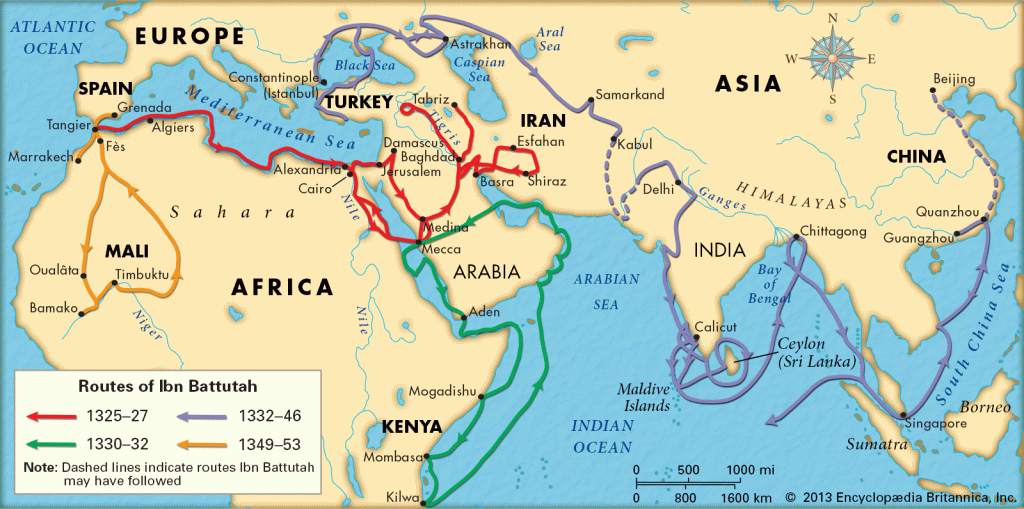
In June 1325, he set out for the Hajj, the pilgrimage to Mecca. He desired to see other cultures and peoples – he would not return to Morocco for another 29 years. While most people in medieval times did not leave the villages in which they were born, Ibn Battuta traveled extensively, going as far as Bukhara and Samarkand, Central Asia – ancient intellectual centres today in the nation of Uzbekistan.
His journeying was not just a travelogue, important though that was. He immersed himself in the cultures and peoples he encountered. Traveling through Tunisia, Algeria, Egypt, Mogadishu (Somalia), East Africa, Anatolia (Turkey), his writings detailed the local languages and customs of the people with which he interacted.
His writings and observations are those of what in modern times we would call a sociologist. Collected into a book called the Rihla (the formal title is A Masterpiece to Those Who Contemplate the Wonders of Cities and the Marvels of Traveling) his observations provide a unique insight into the 14th century Islamic world. Not only did he write about cuisine and dress, he recorded information about gender relations, socioeconomic practices, holidays and artistic output.
For instance, he noted that in Anatolia (modern day Turkey), women frequently traveled and worked with men, rode horses, fought as soldiers, and participated in cultural life. Anatolia was divided into various principalities at the time, and was known as the Land of Rum (Rome).
Going on to Yemen, Oman and India, Ibn Battuta eventually reached the territories of the Mongol Khanates. He established cooperative relations with the Mongols, traveled to India, Sri Lanka and the Maldives, and survived being shipwrecked off the coast of Calcutta. Journeying through Bengal and Burma, he reached China as well. Going south to Sumatra, he was one of the first people to record the expansion of Islam into the Malay Archipelago.
On his return journey, he ventured through Iran, Iraq and the Kingdom of Mali. Back in his native Morocco, he remained in Tangiers where he recorded his experiences, and died in 1368/69.
Overall, he had traveled 117 000 kilometres over an expanse of territory that today consists of at least 50 countries. He traveled by ship, camel, donkey, caravan and horse.
Here is a simplified map of his travel journey
The purpose of this explanation is not to disparage or ignore the achievements of the European explorers (who are more accurately described as conquistadors). The purpose is to widen our horizons, and realise that intercultural connections are vital if we are to solve our problems as a civilisation.
If you wish to admire Ferdinand Magellan or Captain James Cook, please do so; no-one can stop you. Please realise that nonwhite or non-European civilisations have accomplished remarkable achievements, and these should not be dismissed or disparaged. Indeed, knowledge of the Islamic world’s pioneering scientific and cultural accomplishments can help us to better understand what is worth preserving in European civilisation – presuming the latter is worth saving.
Ibn Battuta’s travelogue, the Rihla, is an unsurpassed premodern work of density and scope. It contains observations and insights of multiple cultures, from the Mongol Golden Horde, to the Anatolian Turkic people, to the Malian empire – insights and first-hand accounts unequalled by his contemporaries. The Islamic world he documented was a culturally diverse universalist society, held together by scholars, judges, scientists, philosophers as well as traders and merchants.
We have the opportunity to go beyond simplistic stereotypes and muddled thinking about other cultures.
 Antipodean Atheist