We all know about Marco Polo and European ships, but we should learn about the incredible journey of Ibn Battuta

We have all heard about Marco Polo (1254 – 1324) the Venetian/Italian traveller and explorer, but how many of us know about the Moroccan Ibn Battuta (1304 – 1368/69)? The latter travelled more extensively than Polo, and got deeply involved in the social and political fabric of the societies and cultures through which he travelled.

First, let’s start with a bit of context, so we can understand why it is important to understand the achievements of the medieval Moroccan scholar. It is an indication of our cultural insularity that we in Australia, similarly to other Anglophone societies, begin our understanding of history with European explorers. Vasco de Gama, Magellan, Van Diemen, Columbus, Cook – European ships form the essential core of our historical knowledge.

That is fine as far as it goes, but it does leave us with a very blinkered view of humanity’s origins and interconnections. It is not wrong to read about Marco Polo or Columbus, but we should stop elevating them into unparalleled heroes whose achievements have no equal.

To explain the story of Ibn Battuta, we have to understand that the medieval world did not consist solely of Crusades and Viking raiders. The Islamic world was a vast, culturally diverse and scientifically engaged society. Innovations from philosophy to mathematics were emerging.

Ibn Battuta, born in Tangiers, Marrakesh (today in Morocco), was a judge and scholar in the Marinid sultanate. The latter was a Berber Muslim polity in North Africa.

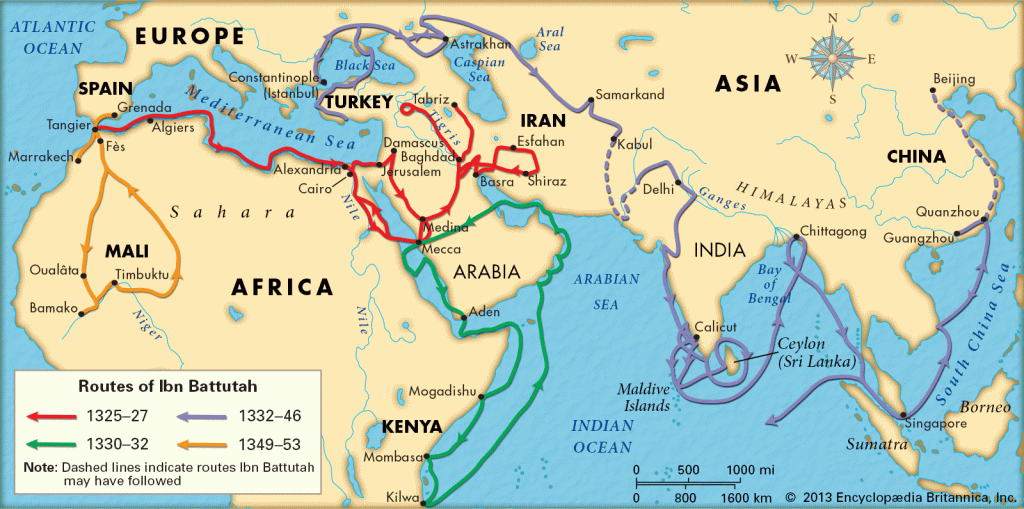
In June 1325, he set out for the Hajj, the pilgrimage to Mecca. He desired to see other cultures and peoples – he would not return to Morocco for another 29 years. While most people in medieval times did not leave the villages in which they were born, Ibn Battuta traveled extensively, going as far as Bukhara and Samarkand, Central Asia – ancient intellectual centres today in the nation of Uzbekistan.

His journeying was not just a travelogue, important though that was. He immersed himself in the cultures and peoples he encountered. Traveling through Tunisia, Algeria, Egypt, Mogadishu (Somalia), East Africa, Anatolia (Turkey), his writings detailed the local languages and customs of the people with which he interacted.

His writings and observations are those of what in modern times we would call a sociologist. Collected into a book called the Rihla (the formal title is A Masterpiece to Those Who Contemplate the Wonders of Cities and the Marvels of Traveling) his observations provide a unique insight into the 14th century Islamic world. Not only did he write about cuisine and dress, he recorded information about gender relations, socioeconomic practices, holidays and artistic output.

For instance, he noted that in Anatolia (modern day Turkey), women frequently traveled and worked with men, rode horses, fought as soldiers, and participated in cultural life. Anatolia was divided into various principalities at the time, and was known as the Land of Rum (Rome).

Going on to Yemen, Oman and India, Ibn Battuta eventually reached the territories of the Mongol Khanates. He established cooperative relations with the Mongols, traveled to India, Sri Lanka and the Maldives, and survived being shipwrecked off the coast of Calcutta. Journeying through Bengal and Burma, he reached China as well. Going south to Sumatra, he was one of the first people to record the expansion of Islam into the Malay Archipelago.

On his return journey, he ventured through Iran, Iraq and the Kingdom of Mali. Back in his native Morocco, he remained in Tangiers where he recorded his experiences, and died in 1368/69.

Overall, he had traveled 117 000 kilometres over an expanse of territory that today consists of at least 50 countries. He traveled by ship, camel, donkey, caravan and horse.

Here is a simplified map of his travel journey

The purpose of this explanation is not to disparage or ignore the achievements of the European explorers (who are more accurately described as conquistadors). The purpose is to widen our horizons, and realise that intercultural connections are vital if we are to solve our problems as a civilisation.

If you wish to admire Ferdinand Magellan or Captain James Cook, please do so; no-one can stop you. Please realise that nonwhite or non-European civilisations have accomplished remarkable achievements, and these should not be dismissed or disparaged. Indeed, knowledge of the Islamic world’s pioneering scientific and cultural accomplishments can help us to better understand what is worth preserving in European civilisation – presuming the latter is worth saving.

Ibn Battuta’s travelogue, the Rihla, is an unsurpassed premodern work of density and scope. It contains observations and insights of multiple cultures, from the Mongol Golden Horde, to the Anatolian Turkic people, to the Malian empire – insights and first-hand accounts unequalled by his contemporaries. The Islamic world he documented was a culturally diverse universalist society, held together by scholars, judges, scientists, philosophers as well as traders and merchants.

We have the opportunity to go beyond simplistic stereotypes and muddled thinking about other cultures.

The search for lost continents and technologically advanced ancient civilisations is fascinating, but Atlantis is still fictional

Geologists and archaeologists are constantly looking for lost continents and civilisations. The allure of discovering a long lost ancient civilisation is particularly appealing. The glory that accompanies the discovery of lost continents and peoples is seductive. But please, stop searching for Atlantis – it is not real.

Geologists have only this year confirmed that they have found a long submerged continent – Zealandia, most of which is under water.

Initially proposed by scientists in 1995, this continent, also known as Te Riu-a-Māui or Tasmatis, broke away from Gondwana millions of years ago. After thirty years of painstaking investigation, scientists have confirmed the location and size of this submerged continent.

That is exciting news – finding a lost continent only adds to our sense of wonder regarding the Earth. You know what is still fictional after centuries? Atlantis.

This mythical continent, (and its associated putative advanced civilisation) first conceived as a morality tale by the Greek philosopher Plato, was meant as a metaphorical warning about the dangers of hubris. After approximately 2300 years since its initial appearance in literature, the myth of Atlantis has inspired countless theories and speculations about its location and nature.

We have had false starts over the centuries…..

There are multiple sites around the world that have been nominated as the site of the mythical Atlantis. Rather than address each one of these claims (which have been comprehensively rejected) let’s examine the common generalised pattern of each claim. A geographic feature, be they concentric circles, a hitherto unidentified mountain or underwater structure, is located. Geologists and archaeologists try to explain said structure.

If their explanations have any gaps or leave doubts unresolved, the Atlantis enthusiasts step up, and lay claim to the structure or site. Proposing that an ancient and technologically advanced civilisation is responsible for creating said structure, Atlantis pops up as an equivalent god-of-the-gaps fallacy.

Undersea technologies are indispensable in identifying long lost cities, continents and peoples. Numerous sites across the Atlantic, the Mediterranean and even Antarctica have been proposed as sites of the mythological Atlantis. Natural processes produce harmonious, orderly structures all the time. From snowflakes to complex hydrocarbons, material and metabolic systems produce what we see as ‘orderly’ structures throughout the natural world.

What was Plato driving at when he first wrote about Atlantis thousands of years ago?

Plato’s discussion of Atlantis is contained in two of his dialogues; Timaeus and Critias. Plato was a philosopher, but he was a distinctly political thinker. His Socratic dialogues were concerned with constructing an ideal, just state. His discussion came with warnings about hubris; the arrogant belief that the society in you live is invincible and the best.

Plato was using the myth of Atlantis as a cautionary historical tale: a long lost utopia that was catastrophically destroyed by its own sense of hubris. In the Critias dialogue, for instance, Plato relates what the ancient Egyptians told Solon the Greek ruler from generations ago, and what he then relayed to Plato’s grandfather – a hearsay parable about an advanced semi-maritime civilisation that tried to conquer the world, but failed when it battled Athens.

Certainly, Plato knew about the giant rivals of the Greeks, the Persians, and Carthaginians. He constructed a metaphorical tale on the demise of ancient Atlantis as a modern day warning for his fellow Greek politicians and philosophers.

Explaining catastrophes that befall strong, seemingly invincible empires was a preoccupation of Athenian philosophy. Plato’s description was part of this ongoing dialogue, not a specific geological or archaeological reference.

The philosophers of Ancient Greece were certainly aware of the demise of Minoan civilisation, a Bronze Age society that flourished on the island of Crete. Its longstanding prosperity, followed by a cataclysmic collapse, was still being discussed in Athens. Archaeologists and geologists have confirmed the existence of Minoan civilisation – no need to keep searching for the fictional Atlantis.

The fact that we are only gradually realising that there were culturally and technologically sophisticated civilisations and peoples outside the Western canon makes us search for these long-vanished cultures.

Sub-Saharan Africa, indigenous nations in the Americas and Australia, ancient India and China – all have their archaeological mysteries and unresolved questions. They have also contributed, each in their own way, to a greater understanding of ourselves and the cosmos. Pursuing a fictional Atlantean civilisation is not just harmless fun, it is derailing attempts at genuine intercultural understanding.

No, not every person who believes in Atlantis is racist. This belief in a superior ancient culture is deployed to divert our attention from the very real cultural and scientific contributions of civilisations from the nonwhite world.

The romantic allure of ancient worlds kept book sales going in the pre-Internet age. Currently, social media recycles and amplifies long-debunked speculations as alternative hypotheses. The mystery of Atlantis will never be completely laid to rest, but it can be rejected in favour of more fruitful searches for lost cultures.

Hicham el-Gherrouj, Nadia Comaneci, star athletes, and politics in sport

Hicham el-Gherrouj is not a household name in Australia, but he should be. A retired athlete, he is considered by sporting commentators to be one of the greatest middle distance runners in the works. His career is an example of resilience and the overcoming of obstacles.

First of all, I say middle distance, but to me, anything beyond 100 metres is long distance. I could run 200 metres when I was young, but only with great exertion, huffing and puffing, and going red in the face from physical exhaustion.

Gherrouj, born in 1974 in Morocco, displayed remarkable courage and persistence in taking on what I consider long distance running – 1500 metres, Gherrouj’s speciality, would take me half a day. The Olympic marathon, where competitors run approximately 42.1 kilometres (26 miles and 385 yards in the imperial measurement) is not a run, that is deportation to me.

In the 1996 Atlanta summer Olympics, Gherrouj experienced a dramatic incident, one which would impact him greatly. Running alongside his fellow athletes in the 1500 metre race, he was accidentally tripped by Algeria’s Noureddine Morceli, with only 400 metres left to go.

Morcelli had been a staunch rival of Gherrouj’s, and was a multiple world record holder in middle distance running.

Gherrouj, collapsing, nevertheless got up and finished the race. He quickly retreated from the main athletic arena, and broke down in tears. His career as an athlete appeared to be over.

Gherrouj, while in the depths of inconsolable despair, was handed a mobile phone. It was the Moroccan King, Hassan II, on the phone. The king expressed his admiration for Gherrouj, and said that the latter was the pride of the Moroccan nation.

That call lifted Gherrouj’s spirits. He never looked back. He went on to defeat all his competitors, establishing world records, winning gold medals, and retiring as a sporting champion of his nation in 2006. From Moroccan sands to Olympic glory, Gherrouj’s example is still an inspiration to athletes today.

It is important to remember and understand the experiences of high profile athletes, and how they are handled in the media.

Nadia Comaneci, the Romanian-American gymnast, was a superstar of the Romanian gymnastics team in the 1970s and 80s. A showcase for the Eastern bloc’s athletes and sporting programmes, her score of a perfect 10 at the 1976 Montreal Olympics was a coup for Ceausescu’s administration in Romania.

Born in 1961, Comaneci showed exceptional talent from a young age, and won numerous European gymnastic competitions before going on to compete for her country at the international level.

Awarded the Hero of Socialist Labour medal, Comaneci’s star was cemented as one of the greats for Romanian sport. In 1989, she, along with several others, did the unthinkable. She defected to the West, and was welcomed in the United States. This journey to asylum seeking freedom was undertaken in the days when imperialist nations welcomed high profile defections, especially from Communist nations, for their propaganda value.

Comaneci was not the only one to defect in November 1989. Her trainers, Bela and Mary Karolyi, also defected. A body blow to the Ceausescu’s government’s credibility, Comaneci’s defection was widely publicised in the West as an example of the indomitable human yearning for freedom from tyrannical regimes.

The Karolyis were soon recruited into the American gymnastics team, and through their training methods, were responsible for the US team’s first ever gold medal in all-round gymnastics by one of their star students, Mary Lou Retton, The latter won the gold medal for her nation at the 1984 Los Angeles Olympics.

In recent years, the training methods of gymnastics coaches has come under renewed scrutiny, especially with regard to the treatment of underage girls. Stories of physical and verbal abuse, diet policing to the point of starvation, and aberrant use of medical treatment have all been alleged. Whether there is any truth to these allegations, I do nor know, and cannot comment.

There were no such questions raised in 1984, when the US team were happily accepting the gold medal in women gymnastics by Retton. Her success was hailed in the media, and Retton’s image became a marketable commodity.

What I do see is the vitriolic campaign of hatred directed at a particular underage girl, at least since 2022, Russian figure skater Kamila Valieva. A sporting prodigy in the world of figure ice skating, her ascent has been marred by a vicious and sustained media attack on her person as a ‘Russian cheat.’

Valieva, an Olympic and world champion, was fifteen in 2022. Yet her tender years did not stop a relentless and hurtful effort of humiliation on the part of the corporate media. It is difficult enough for adults to handle the scrutiny and excessive pressure of media attention. A fifteen year old girl, talented and resilient as Valieva is, would be incapable of handling the pointedly accusatory campaign of vilification directed against her as a purported ‘cheat.’

The Court of Arbitration for Sport (CAS) found that Valieva did not actually cheat. The prohibited substance found in her system, a particular heart medication, was the result of accidental contact, not wilful cheating. Yet, after her success in the 2022 Beijing Olympics, the accusations against her flowed, and the tsunami of hostile press coverage followed.

The medication in question, trimetazadine, is for people with heart problems, not young athletes. Such a medication would cause heart palpitations in a young, healthy person, hardly a motivating factor for a figure skating champion who requires nerves of steel in the heat of competition.

Politics intersecting with sport can be an ugly business. Geopolitical hostility to Moscow has resulted in targeting an innocent person, Kamila Valieva. How about we respect athletes for their achievements, and not use them as pawns in geopolitical conflicts.

Emergency preparedness plans require long term commitment

Create an emergency preparedness plan.

This question, while highly important, is a bit vague. The kind of emergency that we are facing determines the kind of preparedness planning required.

What does that mean?

Working as a technical writer over the last 30 years, I have had to produce emergency procedures documents. The Australian financial industry is subject to myriad regulations and safety procedures. The Australian Prudential Regulatory Authority (APRA), created by legislation in 1998, oversees the implementation of risk management procedures by Australian authorised deposit-taking institutions.

The APRA has a standard, CPS 230, Operational Risk Management. This requires that your business institution have a plan in place to continue operations in the event of major disruptions or disasters. Identifying and managing your operational risks requires preparation, and that means having procedures – an emergency plan – in place. What happens when there is a fire, flooding, another pandemic, which severely degrades the capability of your institution to function?

Preparing for such emergencies requires preparation and planning.

Let’s step outside the world of business for a minute, and ask ourselves a question – what happens when private business creates a sociopolitical and environmental problem? Do governments have an emergency plan in place for those kinds of problems?

Why do I ask these questions? A long awaited report in Britain was released only earlier this year. A prolonged enquiry into the dilapidated and failing system of Britain’s waterway regulations and sewage management, the Cunliffe report, this review provides a damning indictment of the privatised water sector in Britain.

For instance, not only have water bills increased for households across Britain, major effusions of untreated sewage are dumped into waterways around the nation. Water stations and equipment are neglected, the companies that run water services, such as Thames Water, are facing bankruptcy, and the mega gallons of effluent in Britain’s rivers pose a significant health risk.

Basically, Britain’s waterways are turning to shit. Why do I use that vulgar colloquialism? The conclusion of an article in Prospect Magazine, which reviews the impact of privatisation on the provision of water and filtration services is ‘How our water went to shit.’

You may find a map of the waterways in England and Wales filled with untreated sewage.

During the prime ministership of Thatcher’s UK conservatives, privatisation of public services, such as water provision, was promoted as a way to revitalise a decrepit sector of the economy. Instead, privatisation has produced leaking pipes, rivers unfit to swim in, and gallons of untreated sewage spilling into waterways.

If a business model fails to provide basic services to the public, then we can reasonably conclude that that particular business model is a failure. It is time for emergency measures, renationalising the water companies to revamp failing infrastructure and respond to the public health threat of unsanitary drinking water.

I am old enough to remember the April 1986 Chernobyl nuclear disaster, and the response of the Soviet authorities. The latter were lambasted in the corporate media not only for their alleged incompetence in running a nuclear reactor, but also for their allegedly slow and ineffective response to that serious emergency. If they cannot protect their own citizens from nuclear fallout, so we were told, how can we trust Moscow’s ability to handle other serious ecological disasters?

Whether Moscow’s response to the Chernobyl nuclear accident was adequate or not, I do not know, and is outside the scope of this article. I do know that if the business sector creates an environmental and medical emergency, such as failing to provide clean safe drinking water, then questions must be asked if the guilty parties will be brought to account.

In capitalist societies, the profits are privatised, but the risks and harmful consequences are socialised – the tab is picked up by the public.

Emergency preparedness is not something that can be built up overnight. Planning is essential, to be sure. However, adequate responses to climate emergencies takes decades of information gathering and public investment.

We have all read news about the flash floods which occurred earlier this year in Texas. Flash flooding is nothing new in Texas, and the authorities responded as best they could. Sadly, there was loss of lives, including children, in the recent flooding disaster.

I would like to highlight a measure, long proposed by scientists, engineers and climate experts, which would increase the ability of the relevant authorities to respond and manage such disasters.

For decades, Congressional lawmakers (both Republican and Democrat) have rejected demands to install adequate flood warning gauges and systems across the major waterways and rivers in the United States.

Stream gauges, the necessary equipment to monitor flooding in waterways, are crucial in gathering and providing advance warnings of rising floodwaters. The absence of such gauges is not front page news, but constitutes a serious gap in flood emergency management.

The Trump administration, in the name of saving money, is cutting back funding for climate change and weather forecasting systems even further. Reducing such warning systems will only dilute the capacity of emergency response services to adequately prepare and address these kinds of worsening climate induced disasters.

When we lose the ability to protect life, property, biodiversity, agricultural resources and drinking water from disasters, then it is time to abandon the economic model that prioritises private profits over the public health and hygiene.

Scour the news for an entirely uninteresting story. Consider how it connects to your life. Write about that.

Scour the news for an entirely uninteresting story. Consider how it connects to your life. Write about that.

The game of cricket is completely uninteresting to me. That is the first observation. The nation of Zimbabwe is absolutely foreign to me. I have never been there, and I do not know as Zimbabweans.

Why am I explaining all this? The performance of the Zimbabwean cricket team, playing against England in May this year, was a source of immense joy for me personally. Why? I am not a cricket fan, nor am I Zimbabwean.

I am always overjoyed when small nations, especially those that have experienced trauma and prolonged suffering, find success in the field of sport. I am happy for diasporan communities, who live with a sense of melancholic disconnection from their homeland, when they confront nations that have traditionally dominated professional sport.

England is a cricketing powerhouse, its team one of the most successful in the world. In the days of the British empire, cricket was exported to its colonies. Constructing a cultural identity based on the imperial power is a necessary concomitant to empire-expansion. Empires have never relied on force alone to control their subjugated populations.

Cementing cultural and ideological links with the imperial centre of power is a vital prop for reinforcing colonial power. Winning the consent of the governed through sport and culture is just as important as projecting imperialist military power.

Zimbabwe, formerly Rhodesia, learnt cricket from the English. Its team has not played against England since 2003. The economic and social problems of Zimbabwe are widely known. Media coverage of that nation’s economic travails is motivated perhaps more so by British sour grapes over the loss of their former colony, rather than pure humanitarian considerations for Zimbabwe’s farming and poor communities.

Playing a Test match against England in Nottingham earlier this year, the game was an occasion for Zimbabweans resident in England to come together and celebrate. Hundreds of Zimbabwean flags fluttered proudly, cuisine from the mother country was available at impromptu stalls, and songs rang out from the passionate crowd.

The Chevrons, the Zimbabwean cricket team, were roundly defeated by England. The latter’s experience in cricket showed. However, that did not diminish the carnival and community spirit of the Zimbabweans in attendance.

While the Chevrons were resoundingly trounced this time around, they will learn from their defeat, improve their skills, and bounce back the next time. I am quite certain they will recover from their initial heartbreak to achieve supreme successes in the future.

In the meantime, I will be cheering them on from Sydney.

German rearmament, the Flensburg government, employing ex-Nazis and the myth of the good Wehrmacht

Sometimes, it is the seeming footnotes in modern history that turn out to contain the most important lessons.

Adolf Hitler committed suicide in April 1945, but that was not the end of his government. His successor, Grand Admiral Karl Doenitz, relocated the German government to Flensburg, in the north of the country near the Danish border. Lasting about three weeks, his administration controlled only isolated patches of territory, what with the Soviets and American forces rapidly closing in on the Third Reich.

Winston Churchill, British PM, had a plan – to recognise the Flensburg administration. Why? So that all the millions of demobilised German soldiers of the Wehrmacht could be reconstructed into a new fighting force. His objective? To launch an attack on the Soviet Union. Two distinct yet related plans were drawn up for that purpose; codenamed Operation Unthinkable.

Churchill, while opposed to Nazi tyranny, maintained that the real threat was Soviet Bolshevism. The Wehrmacht, its soldiers overwhelmed by successive defeats, could be reconstituted as a fighting machine, footsoldiers in a new Cold War. But there was a problem; the German army was guilty of horrendous war crimes, and its senior officers were being arrested and charged for multiple offences.

Eisenhower, the Supreme commander of Allied forces in Europe, vehemently rejected Churchill’s proposal. The Flensburg government, already reduced to rump status, could barely be considered a credible authority given that it was basically a continuation of the criminal Nazi regime. Collapsing in a heap by the end of May 1945, it was officially dissolved in June by the victorious powers.

Rehabilitating former Wehrmacht officers, while officially rejected, was revived in a way by the 1950s. West Germany, occupied by the western powers, could be turned into a military bastion against the Communist East. That objective, demanded by the exigencies of the Cold War, dovetailed nicely with a domestic West German project initiated by former Nazi military officers – the rehabilitation of the ‘clean Wehrmacht.’

Rearming West Germany was going to be difficult, given the memories of the monstrous crimes of the Holocaust and ethnic cleansing perpetrated by the Nazi military. Former Wehrmacht officers, as well as civilian personnel in the West German bureaucracy, began the myth of the ‘good Wehrmacht’, German soldiers reluctantly carrying out the orders of the Fuehrer and his inner circle.

German officers were noble, motivated by patriotism and love of homeland – the SS and Gestapo were made the alibis of a nation. In 1950, invited by then West German chancellor Konrad Adenauer, a meeting of former Wehrmacht officers issued the Himmelrod memorandum. A forty page document, this statement exonerated the German military of its crimes, laid the blame for the genocide of the European Jews at Hitler’s door, and elaborated the intent of the German military to rearm.

In this objective, they found a surprising ally in US President Dwight Eisenhower. The latter made clear his respect and admiration for the German officer corps, unsullied by the worst crimes of the Nazi regime. By placing a strong distinction between the German military hierarchy and the Nazi party echelons, Eisenhower assisted in cultivating a collective amnesia regarding the German military’s criminal conduct and massacres, especially in the war against the Soviet Union.

The Himmelrod memorandum was so named after the 12th century monastery where the attendees met. If the honour and reputation of the German military was restored, and the stains of the Holocaust and mass slaughter of ethnic minorities removed, then the US and Britain could supply the West German military with all the armaments they needed. A new bulwark against the Soviet bloc was born.

One of the thousands of Wehrmacht officers rehabilitated and put in charge of West Germany’s rearmament programme was General Hans Speidel (1897 – 1984). Chief of staff of Field Marshal Erwin Rommel, Speidel had a long and fruitful career carrying out the Nazi military’s mission in occupied Europe.

While conspiring with the coup plotters in the July 1944 scheme to assassinate Hitler, he was unaware of the actual bombing of Hitler’s headquarters. Using his connections with the anti-Hitler officers as anti-Nazi credentials, Speidel surrendered to Allied troops at the conclusion of the war.

One of the post-war architects of West Germany’s rearmament, Speidel along with his former Wehrmacht colleagues, waged an incessant propaganda campaign to rehabilitate the honour of the German army. Here was a German officer, ready and willing to be used as a weapon against the Soviets in the Cold War.

In May 1955, the West German state was officially declared as having the authority of a sovereign state – the Federal Republic of Germany. Its armed forces were now known as the Bundeswehr.

Speidel’s efforts in rearming Germany, and aligning with NATO, were handsomely rewarded. In 1957, barely twelve years after the end of the Second World War, Speidel was appointed commander in chief of NATO Allied forces in Central Europe. Speidel was one of numerous officers who managed the integration of the Bundeswehr, the reconstituted armed forces of West Germany, into the NATO command structure.

Why is all this relevant today?

Current German chancellor Friedrich Merz announced, earlier this year, that Germany will embark on a massive rearmament programme, with thousands of new troops to be recruited for a confrontation with Russia. European nations, such as Germany, will increase their proportion of GDP on military spending to five percent of the national budget. Merz pledged that Germany will have the strongest conventional forces in Europe.

In a way, Churchill’s original proposal for the Flensburg government as a militarised sledgehammer against Russia is coming to fruition.

Hulk Hogan, the propaganda value of wrestlemania, and Yurik Vardanyan, the athletic weightlifter

Hulk Hogan, arguably the world’s most famous professional wrestler and showman simp for American imperial power, died earlier this month. A fixture on our TV screens, his larger-than-life persona encapsulated the decaying rot at the heart of American political and social culture. He was MAGA before there was such a term.

There is no doubt that Hogan (his real name was Terry Gene Bollea) was an expert at self-promotion. His talent for turning his individual persona into a marketing brand is exemplary – if you are interested in egomaniacal hyper-competitive individualism. He had support in that area – his willingness to be used as a flag bearing American propaganda tool certainly helped him acquire publicity and media exposure.

For instance, Hogan fought the ‘Iron Sheikh’ in the ring, back in the 1980s. The villain, played by a former bodyguard to the deposed Shah of Iran, represented everything about Iran and the wider Middle East. You see, sheikhs, Arabs, Iranians, all mangled together in one simplistic easy-to-hate stereotype.

Hogan, the fake-tanned, steroid-muscled all American hero, was there to avenge the loss of Iran, avenge the Americans taken hostage in Lebanon, inflicting a heavy defeat on the oil-wealthy Arab sheikhs (never matter than Iranians are Persians and not Arabs) – Hogan’s tree-trunk sized arms did all the talking.

The Iron Sheikh had a signature move very cleverly named the ‘camel clutch.’ See, isn’t that hilarious – Middle Eastern people and camels, do you get it? That move, though proving to be a winner for the Sheikh against lesser opponents, was not enough to stop our hero. Escaping from that vice-like grip, Hogan triumphantly smashed the Iron Sheikh, claiming victory. Let’s not focus on the fact that WWE wrestling is all rehearsed beforehand and scripted.

The crowd chanted ‘USA! USA!’ repeatedly, the villainous Iranian/Arab sheikh was vanquished, and everything was right with the world again.

I never hated Hulk Hogan, even though I was familiar with what he stood for. Hating him would have conferred a certain type of legitimation. Hating him would have meant paying attention to him. Ignoring him was a way of demonstrating that he was beneath contempt.

Over the years, and after his appearance in the Rocky III movie, we got to know the fraudulent and cowardly personality beneath the hype. His racist rants, his scabbing behaviour informing on his wrestling friends when the latter tried to form a union, accusations of domestic violence against him – the carefully staged-managed persona was starting to wear thin.

Carl Beijer, writing in Jacobin magazine, elaborates on the self-absorbed careerist who successfully hid the dark side of his character from the public. A pop culture icon, he did not elevate wrestling from a backwater sport to a national level for love of the game. He did it for his first and only true love – himself.

Later in life, he claimed to have found Jesus, supporting evangelical Christians, and graduated to his last public act – the shouting, shirt-tearing endorsement of the MAGA cult at the 2024 Republican National Convention. Bizarrely, he actually struggled to rip off his shirt. The MAGA cesspit was his true home, reinforcing and celebrating his hyper-competitive individualism as a virtue.

Let me tell you about an incredibly strong, successful athletic weightlifter – Yurik Vardanyan (1956 – 2018). An athlete of small stature, his career as a weightlifter is extraordinary. Competing for his native Soviet Armenia as part of the USSR’s Olympic weightlifting team, he broke records and won gold medals. If anyone wants evidence of his remarkable strength, just take a look at his training regimen. He was able, with a single bound from a standing position, jump over the gymnast vaulting horse multiple times unassisted.

He was the first weightlifter in his category (82.5 kilos) to achieve a cumulative 400 kilogram lift. Awarded the Order of Lenin in 1985, he remained loyal to his nation throughout the difficult times of the Soviet dissolution and accompanying humanitarian chaos of the early 1990s.

He never sought glory or riches for himself, at the expense of his fellow citizens. Passing away in 2018, his funeral was an occasion for sadness, and also respect for his outstanding accomplishments in sport. There was no fanfare, no marketing or branding, no self-promotion during his career. Just a genuine and talented sportsperson dedicated to his chosen sport and his country.

His life is the lesson from which we should be learning.

Kuwait and Panama – two countries that should be in the news on their own merits, not as subjects of US regime change

The two nations mentioned in the title above are separated by geography, culture, language differences and history. One is part of the Arab and Islamic world, the other is part of Latin America. So why combine the two? Because both cases are instructive in the way we in Australia (and in the wider Anglophone community) approach and understand these two distinct nations. Our view of the Global South – and both Kuwait and Panama are part of that informal collective – is informed by the way the Anglo-American imperium treats the Global South community.

In the early 1990s, as American forces built up their military presence in Saudi Arabia for an attack on Iraq, the putative rationale offered by the corporate controlled media was that Iraq had illegally invaded and occupied Kuwait. True enough on the surface, but hardly a convincing reason for the massive military buildup.

Kuwait had actually been part of Iraq for centuries, carved out as a supposedly independent emirate by the British colonial empire in the 1920s. Resistance to the enforced separation of Kuwait from Iraq continued well into the 1930s. The histories of Iraq and Kuwait are inextricably entwined.

The imposition of a British-backed petromonarchy in Kuwait, personified by the Al-Sabah family, continues until today. That is important to note, because during the brief Iraqi military occupation of Kuwait, the major Anglo-American media outlets provided favourable and routine coverage of the ‘resistance’ – those Kuwaitis who supported the Al-Sabah royal family.

We were offered the viewpoint of Kuwaiti royalist supporters, shedding tears (and fake news stories – remember the ‘Iraqis are killing babies in hospital incubators story?) about the terrible privations of Kuwaitis groaning under the weight of foreign occupation.

The Palestinians of Kuwait, who largely occupied a role as a class of workers and servants for Kuwaitis, were expelled en masse for their support of the Iraqi military. Supporting a foreign military is a wrong move to be sure. However, after decades of mistreatment by the Kuwaiti royal authorities, the Palestinians could be forgiven for their all-too-human resentful miscalculation.

After the Iraqi forces were expelled from Kuwait in 1991, that nation basically fell off the radar of the Anglophone media complex. That is interesting, because in recent times, Kuwaiti voices have risen again.

No, not the obsequious and cowardly Kuwaitis begging at the feet of the Al-Sabah royal family and its American supporters, but Kuwaitis like Osamah Al-Abdulrahim, the secretary general of the Kuwaiti Progressive Movement. He gave his evaluation of the current global political and economic situation, which was published in Peoples Dispatch magazine.

He spoke about the decline of imperial hegemony, and the rise of a multilateral order. Why did we not hear the voices of Kuwaitis like him in our corporation-dominated media landscape? His perspective does not align with the massive US propaganda drive – reinforced by a compliant Australian media – to go to war in 1990-91 on false premises.

In the period 1989-91, there was another war that the US waged on false pretences – the regime change operation in Panama. Conducted ostensibly to oust the narco-trafficking regime of Panamanian strongman General Manuel Noriega, the misleadingly named Operation Just Cause was fought to implement a strict capitalist neoliberal regime on Panama.

I wrote about the underlying hypocrisies of the US propaganda drive that accompanied that particular war. Noriega himself was a product of American intelligence activities in that nation, spying on leftist students and activists in his younger days. He actively supported the drug trafficking trade, all done under the watchful eye and connivance of the CIA.

The US military invasion of Panama, we were informed, was done to restore democracy and economic fairness in that nation. Well, that is interesting, because there is a huge movement for democratic change and economic fairness going on right now in Panama.

At least since the beginning of this year, thousands of Panamanian workers, peasants, urban and rural poor are waging an economic and political struggle against the ultrarightist and US-backed government of President Jose Mulino.

Mulino, in his younger days, agitated among the Panamanian oligarchs to support a US invasion of his country in 1989. He has violently suppressed trade unions and labour organisers. His economic policies reward the ultrawealthy at the expense of the working class. His administration works to serve the mining-financial oligarchy, nothing more.

This upsurge of political struggle in Panama has been met with virtual silence in the corporate controlled media. Yes, we have all heard about Trump’s proposal to re-annex the Panama Canal. His proposal has been rebuffed with scorn and derision inside Panama. Other than that, we have heard nothing about what the Panamanian workers and peasants are demanding.

If the media only act as an ideological adjunct of US regime change operations, then they cease to act as journalists and become propagandists. Stenographers for regime change are a dime a dozen. It is time for the media to behave like journalists – as insurgents against the doctrines and abuses of the rich and powerful.

Baseball, cricketing success, and why the sporting accomplishments of athletes from minority communities must be celebrated

The sport of baseball has always been a bit of a mystery to me, with its detailed statistics and multiple leagues of players. The sporting accomplishments of prominent baseballers are definitely worthy of admiration. There is something unique about hitting a home run, and doing it consistently.

Another athletic endeavour requiring skill and stamina with statistical complexities is cricket. Wildly popular in Australia – similarly to other former British colonies – cricket is regarded as a national sport, the cricketing team players as role models for the younger generation (let’s not talk about the cricketers who cheated).

Let’s unpack this subject.

No, I do not want to subscribe to a baseball news feed. There are enough newsletters, substack articles, email subscriptions and multiple online news sources to read. I do not think that anyone gets up in the morning and says ‘I’d like to read another email newsletter on my day off!’

There are numerous statistics in baseball, metrics that measure the success or otherwise of individual players. For instance; Runs batted in (RBI) – is a crucial metric. A batter’s success, runs scored, is measured by counting the plays that allow making a run. This is not just an individual batter knocking the ball out of the park, though that is counted. Let’s say that a batter hits the ball, allowing a player at a forward base to complete to home – that run is credited to the batter.

There are similar statistics in softball and cricket.

Scoring runs is not the only story in American baseball. Overcoming racial discrimination is also an important part of understanding baseball in the US. Making it into the major leagues, becoming an All-Star, is a culturally significant event in the sporting world.

Jackie Robinson, the first African American to play in the major leagues baseball, overcame rigid racial barriers and cultural stereotypes imposed his career. The only other player who arguably faced as much discrimination and ethnic hatred as Robinson was a contemporary of his; Hank Greenberg (1911 – 1986).

Greenberg was Jewish, and Jews were regarded as the ultimate outsiders. Vilified as Christ-killers, Jews were considered an internal threat to the mainstream Anglophone American community. While Jewish people eventually came to be regarded as white in the capitalist racial pyramid, they still faced racial barriers in the wider society.

Nicknamed the ‘Hebrew Hammer’, Greenberg was a strong, competitive, 6 feet 4 inches tall athlete, who won an athletics scholarship to attend college. While he excelled in a number of sports, he shone most brightly in baseball. Playing in the Major Leagues mainly for the Detroit Tigers, he served in the US Army Air Corps in World War 2.

A prodigiously talented batter, he rivalled Babe Ruth in his batting averages.

His courage at the batting plate was matched by his bravery in confronting antisemitic hatred. He is described in The Conversation as the best baseball player you have never heard of. Initially, Greenberg resented being described as the best Jewish baseballer. He wanted to be know as simply a great baseballer. In time, he realised how important it was that his ethnic background was accepted by the wider community. He was one of the few players to support Jackie Robinson publicly.

He was never a religiously devout person, but he embraced and defended his cultural identity as a Jew in a time when antisemitism was rife.

Afghanistan’s cricketing success

Cricket, another sport which requires batters to score runs for their team against a fielding opposition, has a massive worldwide following in the former colonial possessions of the British empire. Afghanistan is one such nation.

The Afghan cricket team has performed exceptionally well; they defeated the Australians in 2024. We like to think that our cricketers are endowed with remarkable superhuman prowess – losing at the hands of nonwhite nations is too horrid an outcome to contemplate. I always cheer for the underdog, in this case, Afghanistan.

Let’s leave aside the defeat of the Australian cricketing superpower to the Afghans, and concentrate on a more important issue.

The Afghani cricketers, who emerged from the refugee camps in Pakistan in the 1980s, are from the majority Pashtun ethnic group. Fleeing the Soviet invasion of Afghanistan in the ‘80s, they absorbed a love of cricket while in exile. The Afghan national team, triumphant on the international stage, is made up exclusively of Pashtuns.

The other ethnicities that make up the Afghan population – Hazaras, Tajiks – are dominating the soccer team. While the cricket is regarded as a national sport, the Taliban regime has largely excluded ethnic minorities from the cricket, and thus exacerbated the ethnic and religious schisms dividing the nation.

While Pashtun refugees mostly fled to Pakistan, where cricket is encouraged, the non-Pashtun refugees fled to Iran and Central Asian states, where soccer is the national sport. From 2001, returning refugees brought their socially inherited particularities with them. This sporting schism is reflected in the makeup of post-2021 Afghanistan, after the Taliban regained state power.

We all know that the Taliban enforces a rigid gender apartheid in sporting and cultural activities. Women are banned from playing cricket. They also enforce an ethnic schism, a kind of Pashtun supremacism at the expense of ethnic minorities. The Afghan soccer team, while ethnically mixed, is not promoted as heavily and consistently as the cricket team.

The spiritually uplifting success of the Afghan cricket team, however, notable, is overshadowed by the ongoing gender and ethnic segregation that divided the Afghan homeland. Let’s work towards a world where sport is not only an avenue of upward social mobility, but a genuinely inclusive level playing field.

What bothers you and why?

What bothers you and why?

There is a vast legion of answers to that question, but let’s focus on a specific issue which fits into this category.

It is irritating to witness migrant communities, whether here in Sydney or in the United States, recycle the bigotry and prejudices of the mainstream Anglophone society onto other, newer ethnic groups. Only a few months ago, I published an article with a question to those Irish Americans who voted for Donald Trump’s MAGA platform.

Trump and his MAGA colleagues have openly expressed their contempt of migrants. His administration has deported (or at least attempting to) thousands of migrants to Latin American nations. He has used the powers of the 1798 Alien Enemies act to deport the people he deems a threat.

The irony is that the 1798 act was passed in order to target Irish Catholics, the latter regarded as the original internal enemy. My sincerest hope is that the MAGA Irish Americans will reconsider their political viewpoints, and recognise that the Trump/Vance team is using the age-old tactic of divide-and-rule.

A few years ago, during Trump’s first term in office, I wrote about the threat of deportation hanging over the Iraqi Assyrian and Chaldean communities. The latter two groups, having supported Trump by regurgitating Islamophobic hatred during the 2016 election, subsequently faced deportation to Iraq and Syria. Their tears of self-pity made for a human-interest story. It also demonstrated their remarkably narrow-minded politics.

No, I am not writing this article as an ‘I told you so’ point-scoring exercise. I am writing in the hope that those migrant communities who supported Trump politically will now re-examine their attitudes in light of the MAGA cult’s unrestrained bigotry.

When migrants arrive in a new country, full of hope and ambition to start a new life, they have to overcome the bigotry of the host community. In the Anglophone nations, nonwhite migrants faced enormous obstacles, and had to overcome them step by step to achieve a level of success.

Once established, the settled communities forget where they came from. Expressing a similar, parallel prejudice against newly arrived migrants only perpetuates a cycle of exclusion and hatred.

No, I am not suggesting that multicultural inclusion and acceptance is impossible – far from it. Overcoming racism and ethnocentric snobbery is a long struggle, and ultimately successful and rewarding.