Multicultural ethnic identity is something my fellow Australians struggle to understand

Being a child of Armenians from Egypt has led to many conversations about ethnic identity with my fellow Australians. They struggle to understand how it can be that my parents, who are ethnically Armenian, were born in Egypt and are Egyptians by birth. A person can have a multicultural background and still be Australian. You can be one, and also be both. Ethnic identity is not a zero sum game.

Perhaps the following will help the readers understand. Meet Isabel Bayrakdarian, a Lebanese-born Canadian operatic soprano. Born in Lebanon to Armenian parents, the family moved to Canada when she was a teenager. A graduate in biomedical engineering, she has dedicated her life to music. An operatic soprano, she has performed in numerous concerts. She currently lives and works in the United States.

She has a multicultural background, and has never repudiated neither her Armenian heritage, nor her Lebanese childhood. Her Canadian adolescence did not stop her from becoming a citizen of the United States.

In Lebanon, Armenians have lived, worked, contributed to the nation, and have intermarried with Lebanese people. They sought sanctuary from genocide, war and famine in the early 1900s. The Lebanese, which was actually part of Syria at the time, welcomed the Armenian refugees, even though Lebanon was experiencing food shortages itself.

They were never told to ‘fit in or fuck off’, or ‘go back to where you come from’ as I have been told on multiple occasions by my less-educated and uninformed fellow Australians.

The Carnegie Endowment for International Peace published an evaluation with which I agree: don’t underestimate Lebanon’s Armenians.

I have been considering this topic of ethnic identity in the diaspora for decades, but its relevance has resurfaced in recent months with the revelations regarding Ghislaine Maxwell. As you are all undoubtedly aware, she was an enabler of the pedophile Epstein. This saga, while consuming vast amounts of attention and media coverage, is not my concern.

Yes of course, I can see that justice for Epstein’s victims is important. But the Epstein network is not of any importance to me, but rather Ghislaine’s father, the late Robert Maxwell.

I became familiar with Maxwell senior, the media mogul, businessman and migrant success story in the 1980s. He died in 1991, apparently of suicide. Whether that is true or not, I do not know. What I do know, and remember distinctly, is his funeral. Why? Maxwell is buried in Israel, and his coffin was draped with the Israeli flag.

His burial spot is important, because it is the Mount of Olives in East Jerusalem. This is a biblically significant place, and is the spot where Jesus ascended to heaven, if you want to believe that story. Maxwell’s funeral was a singularly lavish ceremony, attended by former Israeli prime ministers, Mossad intelligence officers, and dignitaries from the Israeli political establishment.

But wait a minute, Robert Maxwell was a posh-speaking, English educated entrepreneur and friend to British political figures. Buying up huge media corporations, his power and influence would be equaled only by Rupert Murdoch. A former soldier in the British army, his meteoric rise, political connections and economic influence in Britain was legendary. Why is he buried in a sacred place in Israel?

Born in 1923, Maxwell began his life as Czechoslovak-born Jew Jan Ludvig Hyman Binyamin Hoch. Escaping the Nazi occupation of his homeland Czechoslovakia, he joined the British-aligned Czech and Slovak Army. Proving his courage and resourcefulness as a soldier, Hoch began his career, and his multicultural identity, as a British officer and Allied agent.

Maxwell reinvented himself as an upper crust, educated entrepreneur in Britain, speaking with the smooth intonation of a BBC newsreader. He began his financial career as a publisher of scientific papers and journals. Prior to his stewardship, scientific publication was in the doldrums. Heading Pergamon Press, Maxwell transformed the publication of scientific papers into an ultra-lucrative business.

In fact, today’s publish-or-perish culture in scientific journals began as a business model under Maxwell. His imprint however, was not confined to academic publishing. Branching out into media ownership, he became the owner-operator of Britain’s leading newspapers. The late Australian journalist John Pilger, having worked in a Maxwell-owned publication, detailed the inner workings and dictatorial methods of the British-assimilated Maxwell.

Nobody questioned Maxwell’s ethnic identity. No-one demanded that he assign percentages to each of his ethnic components. Are you fifty percent Czech Jewish, fifty percent British? How about one-third for each component? Maybe 70 percent Jewish, 15 percent Czech, 15 percent British? If you regard that exercise as ridiculous, of course it is.

Whatever else he was, it is clear that he was one thing – a crook. He swindled millions of pounds from the pension funds of the 350 or so companies he owned. He was arguably the worst embezzler in Britain’s corporate history.T

There is an episode from Maxwell’s life which sheds light on his national loyalties. In 1948, as an intermediary for the Zionist movement in Israel, Maxwell facilitated the transfer of military aircraft from the new Czechoslovak government to Tel Aviv. The Israelis were attacked by Arab armies in 1948, and aircraft from Maxwell’s native Czechoslovakia provided the fledgling Zionist state with decisive military air power.

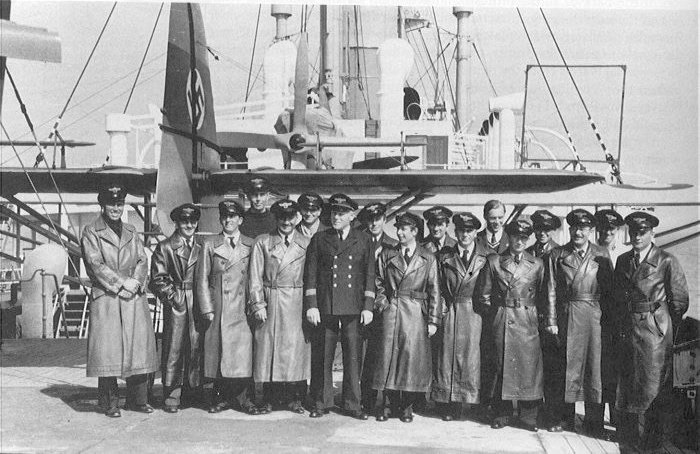
The Czechoslovak authorities provided equipment and training for the new pilots from the Yishuv, the pre-1948 Israeli population and emerging statelet in Palestine. The first pilots trained by the Czechoslovak military arrived in Tel Aviv prior to the May 1948 eruption of the Arab-Israeli war. David Ben-Gurion, speaking in 1968, stated that without Czechoslovak aircraft and armaments, the state of Israel would not have survived.

Maxwell’s identity and loyalties were never questioned by the London authorities. He moved from one ethnic community to another without any interruption.

Ethnic identity is not something that is made up of percentages or proportions. There is no recipe, like baking a cake, with particular ingredients each in its own required portion to contribute in making up the totality. Ethnic identity emerges in practice, with multiple influences and variations.

Yes, we all come from somewhere. It is good to know a person’s ethnic origins. But our identity is not something static, fixed forever in statuesque rigidity. Ethnic identity can change over time, and the ways we express it change as well.

Somali women in the 1970s knew more about politics than today’s readers of the Murdoch press

Every so often, a particular Facebook meme is recycled and recirculated about an important sociopolitical issue that it is worth discussing. To be certain, I ignore the vast majority of Facebook memes. They can be created by anybody calling themselves a digital creator and with a mobile device. Do they all deserve equal attention, let alone a response?

The best way to respond to all of that is denying it attention. Starved of oxygen, memes will normally wither on the vine. However, one meme (actually a series of memes) harping on a particular theme is worth reviewing.

What am I talking about? The recurring meme of women in Iran from the 1960s and 70s wearing westernised dress, bikinis at the beach, and generally sporting the clothing and fashions they liked. The point of such posts is to highlight the contrast between women under the Shah, when they could wear whatever they liked, and today, after the 1979 revolution.

The post-1979 Tehran government forces women to wear the headscarf, or hijab, in public. We are invited to lament; look how bad things are for Iranian women today, as opposed to back then.

You may find examples of such vintage photos here. They are very interesting as historical artefacts. They demonstrate what clothing was predominant in the 1960s in Iran. Please do not use these pictures in a cynical manner to portray the Shah’s time as a golden age of women’s freedom, in contrast to the current Islamic theocratic fashion totalitarianism.

The Murdoch media, which comprises a huge chunk of the dominant corporate media, has a particular hobby horse of enjoining its readers to ‘look how bad things are for women in Muslim societies’. They take a grain of truth, wrap it up in distortions, half-truths and stereotypes. Sadly, millions of readers absorb these contents, which have the same impact on the mind as ultra-processed fast food on our physical health.

Women in Iran have bravely resisted the forcible imposition of the hijab. They have demonstrated tremendous courage in defying the social conservatism of the authorities. No, the wearing of the hijab should not be compulsory, but a matter of personal choice. None of the monotheistic, Abrahamic cousins (Judaism, Christianity and Islam) should be the sole organising principle of an entire society.

Here is something else about Iran that we would do well to understand; currently, 70 percent of graduates in science, mathematics, engineering and technology in Iran are women. Under the western-supported Shah of Iran, female literacy stood at 42%. Today, thanks to the efforts of the revolutionary authorities, that figure stands at 98%.

Does the crime of femicide (female homicide) occur in Iran? Sadly, yes it does. The intentional murder rate of women in Iran stands at 0.59 per 100 000 women. A terrible figure, and each death is an individual tragedy, to be certain. Let us consider the femicide rate in the United States, which is at 2.1 per 100 000 women, and the figure for black and indigenous women murdered is even higher.

Let’s stop with the statistics, because they can get overwhelming, and return to images. I am going to share an image (not created by me), which will highlight a crucial dimension ignored by the Murdoch media; international solidarity.

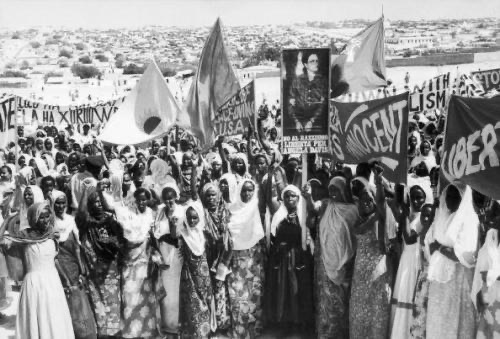
The following is a photograph, taken in 1972, of Somali women in Mogadishu, protesting for the release of African American scholar and activist, Angela Davis:

In this photo, you will see numerous Somali women wearing the headscarf. Somalia was a politically unified nation in 1972, when this picture was taken. Somalia is a Muslim majority nation – and these women in the capital city, Mogadishu, were protesting for the release of black American activist Angela Davis.

But wait a minute, is not Davis a Marxist and feminist, strongly opposed to all forms of religious obscurantism and gender discrimination? What are these women, the majority of whom are Muslim, doing protesting for the freedom of a black Marxist located thousands of miles away? Would not Davis be shouting and screaming for the abolition of the hijab, to liberate these poor, unfortunate oppressed Somali women?

Somali women, back in the 1970s, understood black solidarity and racism. They understood the nature of US imperialism, and the legacy of European colonialism in Africa. They protested not only for the release of Davis, but also in support of Malcolm X and Martin Luther King.

They knew about the struggle for civil rights in the United States, Rosa Parks and Medger Evers. They understood that black Americans fought for the US military in both world wars, only to be rejected and cast aside by their racially segregated society when they returned home.

So please, stop emotionally manipulating the ‘concern’ about Muslim women as a cynical exercise in inciting public opinion for a regime change war in Iran?

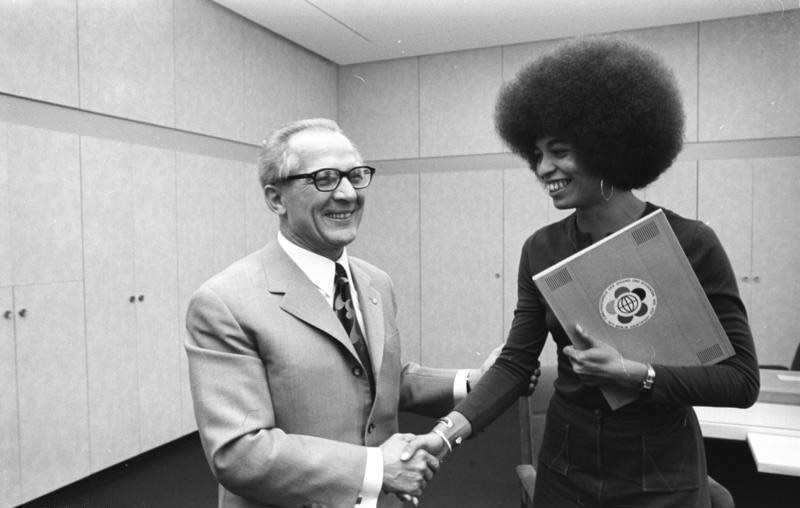
Angela Davis did receive international support for her cause, even from old white men. There was one old, white German speaking head of state who lent his support for Davis; Erich Honecker, the last head of the now-dissolved German Democratic Republic, known as East Germany.

Here they are:

When sharing memes on social media, let’s be aware that what we are doing is making thoughtful connections. The imperialist empire already has its megaphone, shouting its propaganda into our households everyday. How about we use our social media presence not for recycling the empire’s mindset, but for building links of solidarity between communities.

Let’s stop being mouthpieces for the Murdoch media conglomerate. When we examine Iran, or any Muslim majority nation, let’s do so with an open mind, and not the Daily Telegraph-fuelled ‘look how they treat their women’ obnoxious ignorance, backed up by copious amounts of alcohol consumption.