Fortress Europe, deaths at sea, a macabre juxtaposition, and outsourcing immigration detention

Over the course of the past week or so, the world has been transfixed by a macabre juxtaposition; the death of five billionaire occupants of a submersible which imploded at extreme ocean depths, and the mass drowning of at least 500 refugees fleeing war and poverty in the Mediterranean. The titan submersible has received extensive and saturation media coverage; the deaths of the refugees obtained only scant media attention.

It is not often that the New York Times gets something right, but we must give credit where it is due. Richard Perez-Peña correctly observed, “5 deaths at sea gripped the world. Hundreds of others got a shrug.” Not bad for an NYTimes journalist. There is no shortage of commentary highlighting the media disparity; the ultrawealthy deceased from the submersible spent their time and money on deep sea tourism.

The drowned refugees in the Mediterranean were mainly Pakistanis, Syrians, Palestinians, and other nonwhite nationalities fleeing dangerous conditions at home, making a perilous journey for a chance at a better future. Their homelands are impoverished and dangerous precisely because of wars and foreign policies implemented by the richer European and Anglo-majority nations.

Considerable resources were mobilised and joint efforts made to find the doomed Titan submersible. Extensive cooperation between the US and Canadian militaries and coast guards was apparent, as well as the participation of numerous private companies all pitching in with the latest technologies to search for the submersible. Such international collaboration makes evident the fact that we do have the capabilities, up to and including remote operated vehicles (ROVs) to handle maritime disasters.

No such cooperation was forthcoming in relation to the sinking fishing vessel in the Mediterranean. Greek coast guard authorities were tracking the overcrowded ship, but did nothing to save the people on board. The latest refugee drownings are a tragedy, but a preventable one. This is only one in a long line of maritime disasters in the Mediterranean, a predictable consequence of the EU’s anti-refugee policies. They have turned the entire Mediterranean into a militarised zone, making Europe an impregnable fortress.

Ramzy Baroud, writing about the latest refugee deaths, states that only 104 of the estimated 750 refugees were rescued. The authorities pulled dead bodies out of the water off the coast of Pylos, a Greek island, on June 13 and 14. The dates are significant, given that, only a week later – June 20 – the United Nations celebrated World Refugee Day.

Indeed, between 2014 and 2023, as the EU has turned the Mediterranean into a militarised maritime boundary, 23,000 refugees have drowned or gone missing when attempting to cross into Europe. That appalling statistic is particularly ironic; the same imperialist powers who hailed those East Berliners risking life and limb to cross the Berlin Wall, are now vociferously denouncing the refugees who make the perilous journey from their homelands.

The Berlin wall, from 1961 to 1988, became emblematic of Communist tyranny; the escapees were hailed as ordinary people demonstrating extraordinary courage. The East German government was condemned for implementing a shoot-to-kill policy at the wall, and for sealing the borders of the German Democratic Republic (GDR). Hundreds of East Berliners, knowing full well the perils of escape, nevertheless attempted the journey, in search of a better life.

Since at least 2014, the member states of the EU have ratified numerous cross country agreements to erect fortified borders, particularly in Greece and Italy. Turkey, while not an EU member, has cooperated in enforcing a harsh anti-refugee regime, helping to expel asylum seekers from Europe’s southeastern borders. The refugees, mostly from Middle Eastern and African nations, are the victims of today’s fortress mentality.

Migrant shipwrecks, such as the latest one off Pylos island, are not isolated incidents. Moira Lavelle, an independent journalist based in Athens, writes that such tragedies are the result of deliberate political choices. In 2016, the EU signed an agreement with Turkey where refugees – mainly from Syria – would be sheltered in Turkey itself, rather than making it to EU territory. Outsourcing immigration and refugee policing has become the preferred method of dealing with asylum seekers.

Kenan Malik, writing in the Guardian, states that EU countries are paying the poorer sub-Saharan African nations, to keep refugees in their territories. Niger, Libya (or at least rival Libyan militia groups), are being bribed to retain and force refugees back to their place of origin. Incarcerated in makeshift refugee camps in appalling conditions, the EU has implemented a money-for-taking-refugees business model in African nations – the very philosophy of the people smugglers whom the EU governments strenuously condemns.

Dictatorial regimes in African nations, with horrid human rights records, such as Niger or Rwanda, are considered acceptable business partners when it comes to immigration detention. Libya, prior to the 2011 NATO intervention, was a functioning and reasonably developed society. Since that catastrophic intervention, Libya is a shattered society, and rival militia groups compete for control. The EU pays these militias to lock up sub-Saharan African refugees. Torture, rape and murder occur in these squalid camps.

As Malik observes, the EU has sponsored an entire cross-national regime of refugee detention. Prison camps, warehouses and temporary accommodation has become the norm for asylum seekers trapped in this business model. Let’s not forget that Britain, the US and Australia lead the way in the forcible detention of asylum seekers, all the while participating in policies which destroyed societies and thus prompted the outflow of refugees. No matter how much talk-back radio shouts about stopping the boats, or sneering ‘f*ck off, we’re full’, asylum seekers much prefer to live in their country of origin.

Yes, those who died in the Titan submersible should be mourned. Let’s devote equal – even more – attention towards the thousands of nameless victims of fortress Europe and imperialist wars. We need to re-examine and change our own conduct in global affairs.
Novak Djokovic, Brittney Griner, and when sporting issues intersect with politics

There is no question that Novak Djokovic is one of the greatest tennis players in the history of the game. He has equaled – arguably surpassed – the accomplishments of Nadal and Federer. However, we can also make a critique of his political beliefs, without denigrating his achievements. Djokovic was detained by the Australian authorities, in January 2022, for his refusal to vaccinate before entering the country. His detention, at a hotel in Melbourne, garnered a level of sympathy.

The federal circuit and family court struck down the initial ruling canceling Djokovic’s visa. He did not help his cause by testing positive for Covid, and subsequently mingling with photographers and fans. The immigration minister, using archaic provisions of the law, had Djokovic deported. While in detention, Djokovic raised the issue of the mandatory detention of refugees, many of whom have been locked up for years. Djokovic had not raised that comparison prior to his own legal troubles, and has not raised that issue since his release.

While Djokovic was treated unfairly by the Australian Border Force (ABF), the African American bastketballer Brittney Griner, received only hostility and sneering contempt on the part of the corporate media. She experienced an unjust and harsh imprisonment in the midst of international geopolitics. Griner, an Olympic and WNBA champion, was sentenced to nine years in prison for possessing vaping cartridges that had a small amount of vaping hashish oil.

Her sentencing, in February 2022, was driven by political considerations. Moscow wanted to demonstrate that it is tough on drug smugglers. The Kremlin is not exactly sympathetic to the plight of African Americans. In Soviet times, Moscow championed the causes of not only African Americans, but also strongly supported African nations in their struggles against colonialism and racism. Not anymore – the pages of Russian state media are filled with snarling contempt for Black Lives Matter (BLM) and anti racist activists.

Griner served only a few months of her sentence; in December 2022, she was released in a prisoner swap with the United States. Russian arms dealer Viktor Bout was exchanged for Griner’s early release. It is instructive to examine the prisoner exchange, and the attitudes conveyed by the corporate media towards the two individuals concerned.

Viktor Bout, an opportunistic armaments dealer, was demonised as the hyperbolic ‘merchant of death’ in the 2005 film Lord of War. To be sure, Bout’s criminal activities were motivated purely by individual greed and callous indifference to human suffering. But to denounce him as a uniquely malicious actor is the height of hyperbole.

The Watson Institute at Brown University released a study earlier this year that shows the post 9/11 US war on terror has forcibly displaced millions around the world, and undermined the ability of societies to maintain their citizens’ wellbeing. That hardly indicates any concern for human life on the part of the US government. If anyone deserves the moniker ‘merchant of death’, it is the senior personnel of the US military-industrial complex.

Griner’s return to the US, rather than being welcomed as a triumph of diplomacy, was contemptuously dismissed as an unequal and unwanted exchange. Griner, apparently, is an unworthy victim, not of the same standing as ‘hero-spy’ Paul Whelan, who remains imprisoned in the Russian federation. Sputnik news, showing its vitriolic underbelly, sneered that Griner was a ‘black lesbian drug addict’, with Moscow clinching a favourable exchange.

Griner had made comments in the past supportive of the antiracism protests in the immediate aftermath of George Floyd’s killing. She made critical observations regarding racism in the police force. It is these sentiments which explain the level of hostility directed against her upon her release from Russian incarceration. Accused of ‘hating America’ – in spite of her impressive sporting achievements representing her country – Griner returned home to family and friends.

Djokovic can refuse the vaccination for Covid if he wants, but his refusal, like that of the antivaccine lobby, is that of the privileged. Nyadol Nyuon, a human rights advocate, wrote that it is the perverse height of privilege to choose to avoid a vaccine in a wealthy nation, while there are millions in less developed nations dying while waiting for the vaccine.

The antivaccine fearmongering does take in genuinely concerned people. But the danger, as Nyuon states, is to elevate fears and misinformation to the level of valid scientific reasoning. Djokovic’s refusal is the equivalent of a toddler’s tantrum, couching his rejection in the language of ‘combating oppression’ and ‘defending liberty’.

There have been other Australian sportspeople who have rebelled against authority. A breakaway segment of Australian cricketers, defying the orders of the Australian cricket authority, toured apartheid South Africa in the 1980s. Speaking out in favour of individual liberty, the rebel cricket tour defied the anti-apartheid movement, the latter demanding a complete ban on sporting events in a racially segregated South Africa.

Djokovic quickly returned to the lucrative tennis circuit; the refugees are still languishing in detention centres in Australia. Kareem Abdul-Jabbar, former professional basketball player and sports commentator, highlighted the fact that individual decisions have consequences. Unvaccinated players should be removed from teams, he stated. Speaking about the importance of reaching the vaccine hesitant in minority communities, he said that it is imperative to demonstrate the vaccine’s effectiveness and overcome the mistrust of government initiatives among ethnic minority groups.

Djokovic used his status to elevate vaccine hesitancy based on fear and ignorance. Rather than address vaccine hesitation for the purpose of overcoming mistrust, he used his position to enable the already privileged to hide behind the language of ‘oppression’. Brittney Griner deserves our support, because she was the victim of actual oppression.

The Unabomber, hostility to technological civilisation and celebrity villainy

There are times when the death of a person serves as a bookending to a particular chapter of history. It signifies the passing not of an era as such, but an evolving epoch which blends into our times. Such is how we can understand the death by suicide of Ted Kacyznski, known to the world through the media-manufactured celebrity villainy label of the Unabomber. He had terminal cancer, and was transferred to a prison medical facility shortly prior to his death at age 81.

Kaczynski was an outstanding student in mathematics, gaining an early entry into college. Having a high IQ, Kaczynski was reportedly shy and socially withdrawn. The image of a sad loner is comforting to us, but not necessarily true in Kaczynski’s case. While he was shy, he was not without friends, and participated in sports. So he was not outside the social conventions of the time. The sad, mad loner stereotype is convenient, but inaccurate, in attempting to understand Kaczynski’s actions.

A Harvard mathematician, Kaczynski underwent a period of traumatising abuse at college, subjected to a large mind-control experiment ultimately controlled by the CIA. The experiment intended to understand human behaviour under conditions of extreme stress, isolation, interrogation. This experience, according to some authors, was crucial in shaping Kaczynski’s hostility to the technological-scientific complex. The impact of a brutalising experience such as this can be overstated, but it helped to crystallise Kaczynski’s attitudes.

Retreating from the contemporary technological panopticon, he lived a life of natural primitivism in Montana. He advocated a kind of eco-primitivism, a degrowth ecology which involved a return to nature. Hostile to technology, he authored a 35-page manifesto where he detailed his anti-technology views. Condemning the Industrial Revolution, Kaczynski contended that technological progress severed the connections between humans and nature, and produced a destructive sociopolitical order which suppresses human freedom.

Waging a letter-bombing campaign from 1978 to 1995, Kaczynski targeted those he perceived as responsible for the new regime of technological intrusion.

Killing three people and seriously injuring 23, he was apprehended in 1996. I remember the media coverage of his crimes and eventual arrest. The Washington Post published his manifesto for the purpose of identifying him. Kaczynski’s brother, David, recognised the language and writing style. He informed the authorities.

Known by the FBI as the Unabomb suspect (University and airline bomb) the media cleverly came up with the moniker Kaczynski is most associated with – the Unabomber. Kaczynski was not an original thinker, in fact, he borrowed most of his ideas about technology from a French sociologist Jacques Ellul (1912 – 1994). Ellul, a Christian anarchist philosopher, condemned what he called the technique, the threat posed by mass technological advances to human freedom.

Kaczynski’s manifesto has been approvingly quoted by far right killers and white supremacists. While not a white supremacist himself, Kaczynski did contribute to a form of ecological primitivism. While concern for the natural environment is viewed as a left wing preoccupation, domestic terrorists and their right wing ideological brethren have used couched their motives as driven by ecological concerns, promoting an anti-immigrant eco-fascism.

Let’s make a number of observations about technology today.

How many of us could live without our mobile devices? I venture to suggest that in today’s world, with its reliance on IT, none of us could. Even those of us who grew up in the days prior to the internet, smart phones and social media, could not function within the parameters of contemporary capitalist society without relying on mobile devices. Now consider the following statement regarding the impact of new technology:

if the use of a new item of technology is initially optional, it does not necessarily remain optional because the new technology tends to change society in such a way that it becomes difficult or impossible for an individual to function without using that technology.

Who made that statement? Ted Kaczynski. That quote sounds eerily prescient, given the ubiquity of IT and surveillance capitalism in our modern times. That quote is hardly the nonsensical rambling of a lunatic. Kazcynski’s warnings about the increasing intrusive of technology into our lives are sounding rather reasonable in the light of subsequent developments. We are outsourcing our ethical and cognitive judgements to the algorithm.

Forty years ago, who would have surmised that people would seek out romantic partners, sharing our intimacies, through dating apps? We rely on apps to bring us happiness in our romantic lives. It is not only our personal lives that we are integrating with technological applications. The era of drone warfare is upon us – software-directed armed and unarmed aerial vehicles are deployed across the globe, collecting information and carrying out military strikes. How long will it be before we witness robotic warfare?

Basing itself on our choices, the music app Spotify generates playlists of songs related to the genres to which we listen. The app decides our music tastes for us. Now there is Spotify Rainbow Collage, a generator which analyses your music choices, and creates a customisable collage of your favourite artists. Everyday, Spotify suggests playlists to me, based on my listening history. The app is a friend who caters for my musical preferences.

There are no tears for Kaczynski; let’s reserve our sympathy for his victims. He died in prison for his crimes. The tragedy is that he did not receive help for his problems. His crimes only served to marginalise the serious issues that he (and ecological activists) are trying to raise. The corporate media did their part to focus on Kaczynski’s mental disturbance, his ‘lone madman’ status, ignoring the valid concerns about technological intrusion which he raised.

It is unsettling to recognise that an eco-terrorist – for that is what he was – asked legitimate questions about the harmful impact of technology. As R H Lossin wrote, Kaczynski’s violence was ethically reprehensible, but it was not incomprehensible. He took the road of an individualistic escape and rebellion, but the problems with technology that he identified require collective solutions.

Captain Cook, military missions, Antarctica and rival nationalistic endeavours

New story. This topic involves the expansion of empire-rivalries, military objectives and also scientific endeavours. Let’s start with a basic question – why didn’t Captain Cook, who was certainly a capable naval officer, fail to discover Antarctica? He definitely tried, circumnavigating that continent in 1773-74, coming within 130 kilometres of the continental mainland. However, confronting harsh icy conditions, he turned back.

So who did discover Antarctica? And why was this question relevant to the spread of scientific knowledge and research missions?

To answer those questions, we need to delve into the nineteenth century world of rival navigational explorations and imperial science. Make no mistake – Captain Cook was on a military mission, sailing into the Pacific. Yes, he had scientists on his voyages as well, and they achieved monumentally important accomplishments for the scientific community. Back in 1766, the Royal Society, the premier scientific organisation in the UK, proposed journeying into the southern oceans and lands.

Keen to discover any southern lands before their European competitors, the British navy provided the ships and provisions for Cook’s Pacific voyages. The Cold War-like rivalry between England and France was fought out on the American continent in the Seven Years war, (1756 – 63) with England the eventual winner. Europeans had mapped different parts of the Australian landmass, including Dutch and French navigators.

Cook did not discover Australia – he was expecting to find the east coast of New Holland, as the continent was known then. Of course, the indigenous nations had been in Australia for hundreds of thousands of years. His orders were to find a great terra nulius incognita, the much hypothesised icy continent now known as Antarctica. Throughout 1773 and the beginning of 1774, Cook tried multiple times to find Antarctica, but failed. Terrible cold conditions, coupled with the loss of two ships, and heavy sea ice, convinced him to turn back. This was Cook’s second Pacific voyage.

It was during his first voyage, as a lieutenant, that Cook and his colleagues observed the transit of Venus from Tahiti. All the while, Cook never stopped taking military reconnaissance notes. Cook’s voyages were all undertaken with secret military objectives. Britain intended on expanding its colonial power into the Pacific. London was wary of its rivals, France, Holland and Tsarist Russia. Competition for the domination of the maritime traffic in the southern oceans was on.

He admitted, after his second journey to the Pacific, that he never actually found the great southern land. He sailed within the Antarctic circle, the first to do so, but otherwise, his journeys were very much a case of connecting the dots charted by other navigators.

So who discovered Antarctica? It was the Russian navigator, Fabian von Bellingshausen (1778 – 1852). A Baltic German, his voyage was the first definitive journey to the Antarctic continent which proved that an uninhabited great southern landmass existed – and not just a conjecture among maritime navigators. In 1820, Anglo-Russian competition was fierce, even though London and Moscow found themselves temporarily allies against the Napoleonic Empire.

The two Russian warships, docking in Rio de Janeiro, made their way to Antarctica, finding land in January 1820. Returning to Russia in 1821, Bellingshausen and his colleagues were awarded medals and imperial titles. The Russians would not set foot on Antarctica until 1956, when the Soviet government renewed territorial ambitions and scientific missions to the southern continent.

The first Russian Antarctic Expedition remains relatively unknown in the English-speaking world. Occurring during what has become known as the Heroic Age of Polar Exploration, the discovery of Antarctica, and Roald Amundsen’s triumphal land journey to the South Pole in 1911, are subjected to an Anglophone preoccupation with ‘great explorers.’

To be sure, scientific goals, particularly in the fields of geology and palaeontology, were and are motivations for exploring Antarctica. The nineteenth century witnessed a number of scientific paradigmatic revolutions; studying the Earth’s strata, fossils and geological features were no longer constrained by creationism. Massive change in the Earth’s continental history, including changes in life forms, was just beginning to be understood.

Georges Cuvier (1769 – 1832), the preeminent naturalist of his time, established extinctions as a recurring event in geologic history, opening up the field of fossil collecting as evidence of changes in the natural world over time. Roderick Murchison (1792 – 1871), extending Cuvier’s work, elaborated the geologic timescale. The Earth’s natural history was no longer considered an immutable product of god’s creation, but an ever-changing product of biological and geologic forces. Antarctica, the unexplored continent, opened up new possibilities.

The heroic yet ultimately unsuccessful expeditions to the South Pole led by Robert Falcon Scott and Ernest Shackleton have entered the Anglocentric lore of ‘great explorers’. The equally heroic and triumphant expedition of Norwegian Roald Amundsen – he arrived at the South Pole by overland journey in December 1911 – received a lukewarm reception in England and the commonwealth nations.

Scott, who died in Antarctica in 1912, has become something of a martyr – overshadowing Amundsen’s victory in the race to the South Pole. News of Amundsen’s triumph was greeted in moderate, measured tones in the British media. Scott, in posterity, was portrayed as the consummate gentleman, playing by the rules.

Amundsen, by contrast, had unfair advantages, according to the English media establishment. Amundsen used dogs for haulage, unlike Scott who relied on ponies. Dogs do not have sweat glands, making them more resilient in the harsh cold weather, it was opined. In the case of Shackleton, his courage and endurance is emphasised – and his personality is humanised with descriptions of his ‘heartbreak’ at seeing his beloved ship, Endurance, sink into the icy waters.

It is time to enforce international treaty obligations in protecting the Antarctic environment. As for Captain Cook – his statue belongs in a museum.

Erdoğan, cultural power and nostalgia for the Ottoman Empire

There has been a deluge of commentary about the victory of long term Turkish President Recep Tayyip Erdoğan in the recent elections. How did Erdoğan win, despite record hyperinflation and a pathetically inept response to the terrible earthquake earlier this year? I think we can find an answer in Erdoğan’s cynical use of religious conservatism in domestic politics.

One aspect of his rule has gone under the radar, but which can provide us with answers as to the longevity of his rule – the mobilisation of Ottoman Empire nostalgia for political gains. His ruling Justice and Development Party (AKP) has blended Pan-Turkic ideology with Ottoman-mania to recreate a religious-based nationalism. In short, utilising a nostalgic view of the Ottoman Empire’s greatness, he has vowed to make Turkey great again.

There is a great deal of truth in the assertion that the Ottoman Empire was tolerant towards ethnic minorities. Numerous peoples, Arabs, Armenians, Assyrians, Greeks, Bulgarians, Jews – all contributed to an overarching Ottoman identity. Suleiman I, (1494 – 1566) also known as the Magnificent, and the LawGiver, led a golden age of the Ottomans, reforming the legal and taxation systems. The Ottoman army drew soldiers from all the various ethnicities under the control of the Turkish empire.

However, it is not the multicultural mosaic of nationalities in the Ottoman Empire for which Erdoğan is nostalgic. He and the ruling AKP hearken to the times of Selim I, the father of Suleiman I. Selim led a period of aggressive Ottoman Turkish expansion, both geographic and economic. Selim was in his day, a regional strongman, conquering enormous swathes of territory, but also taking on the role of guardian of the pilgrimage routes to Mecca and Medina – a significant position from an Islamic perspective.

It is no secret that the Turkish president has strongly supported independence for Bosnia. Drawing on the historical links from the times when the Balkans were Ottoman territories, Erdogan has loudly supported Bosnia’s aspirations to independence. The Turkish president is a welcome guest in Sarajevo, and Ankara has long postured as the big brother protector of their fellow Muslims in Bosnia.

In 2018, the then Bosnian president, Bakir Izetbegovic, told a rally of Erdogan supporters in Sarajevo (Turks living in Bosnia) to support the reelection of their Turkish political ally. Turkey has made numerous public investments in the Bosnian republic; universities and education have benefited from Turkish investments. Turkish tourists flock to Bosnia every year; the multiple Ottoman-era mosques and structures are preserved by the Bosnian authorities.

Ottoman era structures are restored by the Bosnians, but also involve the efforts of Turkish government agencies, including mosques and bridges destroyed by Bosnian Serb separatists in the early 1990s. Ferhat Pasha Mosque, located in Banja Luka, the second largest city in Bosnia, was restored with Turkish assistance, after its destruction by Serb forces in 1993.

Ankara is leveraging this shared Ottoman-Bosnian history to build up its influence in the Balkans. Serbia has its close alliance with Russia; Germany is the main financial backer of Croatia. For all of Turkey’s talk about defending their coreligionists in Bosnia, Turkish investment in Bosnia is only small, dwarfed by comparable Turkish investments in neighbouring Orthodox Serbia.

In 2020, Erdoğan took another step towards cementing his alliance with religious conservatives; he changed Hagia Sophia’s status from a museum to a mosque. To be sure, there was a huge degree of hyperbole in the Western media, portraying this changeover as evidence of the ‘creeping Islamisation’ of not only Turkey, but Europe as well. Originally a Byzantine church, it was converted into a mosque when the Ottoman Turks conquered Constantinople (today’s Istanbul).

In the 1930s, with the definitive secularisation of the new Turkish Republic, Hagia Sophia was closed to worship (and symbol of Ottoman power), and repurposed as a museum in 1934. The Turkish Republic’s rulers wanted to emphasise the ecumenical nature of the Turkish state, and Hagia Sophia has been preserved with UNESCO heritage status in 1985.

By annulling the 1934 decree on Hagia Sophia’s designation as a museum, Erdoğan was making a deliberate ploy to attract the religious conservative vote. Admitting worshippers to Hagia Sophia is a violation of its UNESCO status, but not such as outrageous affront to secular sensibilities. After all, the Catholic Church has long targeted the Cordoba Mosque-Cathedral, located in Andalusia, Spain, for redesigning as a specifically Christian institution, downplaying its origins and long history as a mosque. Spain and Portugal have long wrestled with their Islamic history.

Be that as it may, Erdoğan’s Hagia Sophia manoeuvre emboldened the religious nationalists inside Turkey, and the various ethnic minorities, such as the Kurds, correctly interpreted this move as an assertion of Turkish exclusivity. By rebuffing the UNESCO world heritage status of a site like Hagia Sophia, it repudiates the prestige and culturally precious designation that UNESCO preservation confers. It opens up a religious-cultural debate about to whom such a historical monument belongs. It is a cynical way to push religion into politics, which is Erdoğan’s objective.

A brief note on Turkey and the Palestine question

While Erdoğan poses as a champion of the Palestinians, seeking a neo-Ottoman quest to reassert authority over the holy places of Jerusalem, the Palestinians do not engage in Ottoman-mania. The repudiation of the British, and then Zionist, occupation of Palestine is based on the legitimate demand for an independent state. While the Ottoman Empire allowed only limited Jewish emigration to Palestine, they were hardly proponents of an independent Palestinian state.

The Palestinians are not simply a cat’s paw of Ankara, motivated by a desire to reestablish a neo-Ottoman project. It is all well and good to be nostalgic for the times of the Ottomans, but Erdoğan’s leveraging of Ottoman-mania has definitive political objectives. Re-election and extending his grip on power is one of them.

Climbing Everest, adventure tourism and the obscurity of the Sherpas

An Australian mountain climber, Jason Kennison, died while descending from the summit of Mount Everest. His death is sadly not an isolated incident. The number of climber fatalities on Mount Everest has increased over the years. Why is summiting Everest such an important target of mountaineering accomplishment?

The goal of reaching the summit of Everest – the rooftop of the world, as it has been called – has its origins in a combination of great power politics and the growth of mountaineering/adventure tourism. May this year – May 29 to be exact – marked 70 years since the successful summiting of Mount Everest by Sir Edmund Hillary and Tenzig Norgay. Everest, known as Chomolungma in Chinese, or Sagarmatha in Nepali, is 8849 metres above sea level at its peak. Hillary’s expedition was sponsored by Britain.

British political elites in Whitehall understood the summiting of Everest as a crucial soft power achievement. Britain had given up its long term colony of India in 1947 – the empire was declining and losing prestige. British officials grasped the importance of conquering Everest as a symbolic, yet culturally powerful, objective.

Everest, straddling the border between China and Nepal, was viewed as a strategic consideration. If London could organise a climbing team to reach the rooftop of the world, that would be a huge boost for the flagging great power credentials of the decrepit British empire. Way back in the 1920s, British foreign office officials wanted to conquer Everest, worried lest it fall into ‘foreign hands.’

Richard Woodward, of Coventry University, wrote that the Himalayas represented the last earthly frontier to be conquered. The ultimate mountaineering trophy, the British organised the 1953 expedition – even though technically, Hillary was a New Zealander and Norgay was Nepalese. However, the message that Everest’s summiting by a British team was unequivocal – the empire was still resilient, technologically capable and relevant. And a few days later, on June 2, the coronation of Queen Elizabeth II occurred.

The members of the successful expedition, including Hillary himself, were widely promoted in the media, in an early version of celebrity diplomacy. The Foreign Office used its connections to facilitate talks, lectures and appearances by the team, broadcasting the achievements of these mountaineers worldwide.

Cultural soft power is a technique deployed by empires – the United States, during the Cold War, sent Louis Armstrong on tours of East Berlin and Budapest to counter claims of racism and discrimination in the larger American society. Cultural soft power is sometimes more powerful than bombs and bullets.

The Sherpas, the small tribe inhabiting the Himalayan borderlands between China and Nepal, are the true unsung heroes of the Everest story. Taking huge risks for their wealthy clientele, they are the ones who ensure the safety and security of the non-Sherpa climbers. Unlike the Sherpas, the well-to-do climbers are paying to take risks, and then offloading the heavy lifting to the poorer Sherpas. In 2018, the NPR media outlet noted that one third of all Everest climbing deaths have been Sherpas.

While Hillary’s triumph is remembered around the world, the Sherpa climbers have set records for the number of times Everest has been summited. Lakpa Gelu, a Sherpa, currently holds the record for the fastest summit of Everest, making it to the top in 10 hours and 56 minutes. Mountaineering may be a lucrative business for the Nepali government, but it is dangerous for the Sherpas.

Back in 2014, The Conversation published an article entitled “Everest tourism is causing a mountain of problems.” The author of that article makes the following important points:

Mountaineering in Nepal is now a commercialised operation that primarily consists of two main goals: profit for the government and an ego-boost for the participants. The true spirit of mountaineering adventure has long disappeared. This is why the government has lowered the climbing permit fee, to encourage more climbers who can buy into the Everest franchise.

Adventure tourism and extreme sports have grown exponentially over the recent decades. Mountaineering requires a specialised set of skills and physical stamina. Yet, with the rise of adventure tourism, for a fee, anyone can ascend the highest mountaintops in the world. Since the 1980s, there has been the Seven Summits challenge, where climbers attempt to summit the highest mountains on all continents.

Recreational climbers, increasing in numbers, have taken to Everest. It is not difficult to find pictures of the queues of climbers waiting to ascend the various stages of the climb to the ultimate summit on Everest. Let’s not forget the mounds of rubbish left by wealthy tourists at base camps and tent encampments on the way up the mountainside.

Indeed, waste management has emerged as a serious concern on Everest. The garbage left behind by recreational climbers consists of empty oxygen cylinders, food scraps, torn tents, and corpses. That’s right – the dead bodies of what were highly motivated, determined adventure climbers are left abandoned on Everest.

If you wish to climb Mt Everest, please go for it. If the thrill and excitement of ascending the world’s highest mountain is worthwhile goal in your estimation, then please do not let anything stand in your way. However, before you do so, take the time to understand the impact of commercialised mass mountaineering on Everest.

As Yana Wengel and her colleagues have explained, do not allow social media images, and the alluring ‘romance’ of past mountaineering achievements lull you into a false sense of security. While sleeping in a heated tent, and having your food prepared for you, think of the Sherpas.

The 75th anniversary of Nakba, the Palestine question and understanding the impact of 1948

Words are important, especially when it comes to modern history, because we should be clear about what we mean when we speak or write. When non-English words become part of the English-speaking lexicon, they enrich our conversation and understanding of the world. One such word is apartheid, from the Afrikaans, meaning apartness. It has come to connote a political and legal structure of entrenched racial discrimination. A word which we should all learn and understand, from the Arabic language, is Nakba – catastrophe.

What does Nakba refer to? It refers to the systematic dispossession and mass expulsion of Palestinians by Zionist armed forces and militia in 1947-48. Marked on May 14, 1948, that day is celebrated as Israeli Independence Day by Tel Aviv’s supporters. It took generations of struggle by the Palestinians, and their global activist allies, to gain recognition of the Nakba as a valid historical and political subject.

Since 1948, Tel Aviv has staunchly maintained that there was no expulsion of hundreds of thousands of Palestinians over the course of 1947-48. Even the grudging admission that Palestinians were forced to leave their homes and towns is rationalised as their own fault – Arab leaders ordered them to leave, is the main fictional claim to explain away the mass displacement of the Palestinians.

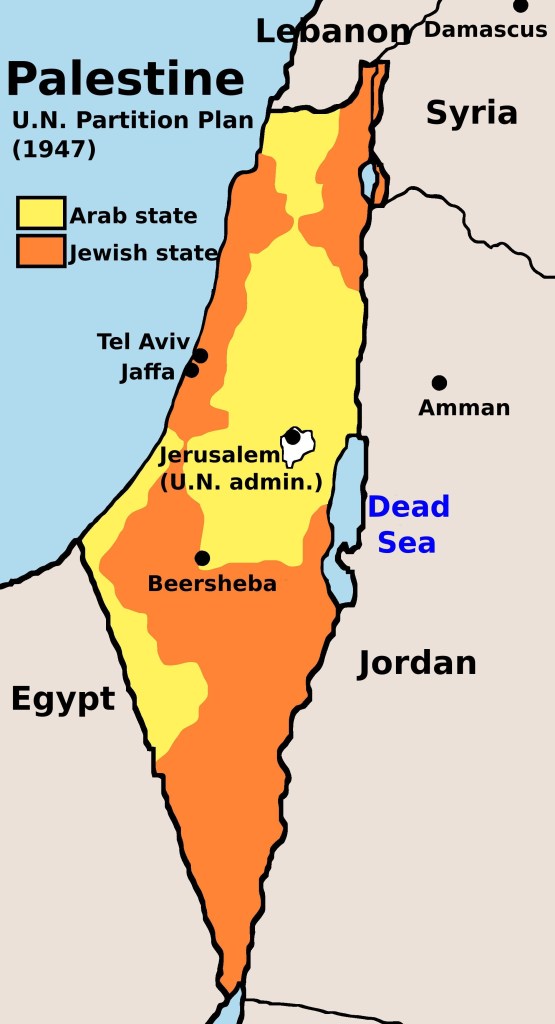
By raising the term Nakba, the Palestinians are countering the efforts of the Israeli government to whitewash and cover up its historic crimes in 1948. The expulsion of the Palestinian population was not just an accident, but the deliberate result of a purposeful plan by the Zionist leadership to seize Palestinian towns and land. The UN had decided to partition Palestine in 1947, by passing the resolution 181, which entrenched the creeping colonisation of Palestine during the British mandate period.

However, the Zionist forces went beyond even this partition, seizing lands and towns originally allocated to the proposed Arab state.

The UN partition plan for Palestine – map courtesy of Wikipedia

By May 1948, not only had Zionist forces seized more territory than they were originally allocated, but 750 000 Palestinians had been expelled from their towns and villages. Plan Dalet was the military operation, devised by the Haganah in British Mandate Palestine, to expel the Palestinians and seize their lands. Thousands of Palestinians were massacred, brutalised and dispossessed. More Jewish immigrants could be settled in the newly occupied territories.

Map courtesy of Al Jazeera

The West Bank and Gaza Strip were the only territories left remaining to the Palestinians. Thousands of refugees were crammed into refugee camps. It is no exaggeration to say that the Nakba involved the ethnic cleansing of Palestine. As for the false claim that the Palestinians were ordered to evacuate their homes, historian Walid Khalidi puts that lie to rest. The Arab and Muslim authorities instructed their officials to remain at their posts, continue supervising the mosques, lands and institutions of the nation.

One of the oft-repeated phrases deployed by Zionism’s supporters is that the Israelis, in contrast to the pre-1948 Palestinian population, made the desert bloom. The direct consequence of that claim is to legitimise the Zionist settlement of Palestine, which began under the British Mandate. The late Shimon Peres, former Israeli general and prime minister, made the claim that the Palestinians lived in isolated villages amidst large swathes of desert. It was the Israelis who cultivated the land and made the desert bloom.

This dismissal of the pre-1948 Palestinian population as just a bunch of peasants living in an empty desert serves to downplay the demand of the Palestinians for an independent state. The Zionist claim of having made the desert bloom has parallels with the white Australian notion of terra nullius. Even if the existence of an indigenous population is admitted, the notion that the colonial settlers developed the land is used to explain away the violent dispossession and cultural dispersal of the indigenous inhabitants.

The mythology of Zionists making the desert bloom may be comforting to Tel Aviv, but is demolished by the historical evidence. As Whitney Webb writes in Mintpress News magazine:

Indeed, prior to 1948, the historical record demonstrates that Palestinian farms were very productive and that both Palestinian Arabs and Jewish settlers were successful farmers. For example, a UN report on agriculture in Palestine between 1945 and 1946 recorded that Palestinian-grown crops accounted for nearly 80 percent of Palestine’s total agricultural yield that season, with Palestinian farms producing over 244,000 tons of vegetables, 73,000 tons of fruit, 78,000 tons of olives, and 5 million liters of wine.

This picture hardly matches that of a barren, fallow land left unused and uncultivated. In fact, Ottoman controlled Palestine was a centre of agricultural productivity and a growing, bustling urban sector. By depicting the Palestinians as ‘primitives’ or incompetent malingerers, colonial settler projects, such as Zionism in Israel (and similarly in Canada, Australia, the United States), the violence of the original settler occupation is minimised.

It is high time that the violence and dispossession of the Palestinians in the Nakba was more widely known and discussed.

Wartime fascist accomplices are transformed into noble martyrs courtesy of the United States

The old adage ‘you are known by the friends you keep’ has never been more relevant, especially with regard to the American-adopted cause célèbre of former Archbishop Stepinac of Croatia. Aloysius Stepinac, chief of the Catholic Church in Zagreb, Croatia, welcomed the establishment of the nazi puppet state by the Ustasha, in 1941. Misleadingly named the Independent State of Croatia (NDH is the acronym in Croatian), that regime went on to massacre Jews, Serbs, antifascist Croats and Bosnian Muslims throughout its brief existence.

Defeated by the communist Yugoslav Partisans, the political and military functionaries of the nazi-collaborating fanatical Ustasha regime fled into exile. Stepinac, who spent his tenure advocating for the NDH, remained in Yugoslavia. Put on trial for treason and collaboration with the enemy, he was sentenced to 16 years in prison.

His case became a cause célèbre for the US Congress, with senior American politicians depicting Stepinac as a martyr of Communist oppression. His crimes as an accomplice of a murderously fascist and racist regime was covered up.

There is no disputing that the role of the Catholic Church in wartime Croatia was one of deep involvement with the NDH government. No, Stepinac did not kill anyone himself, but his preaching and official endorsement of the nazi-collaborating NDH regime qualified him as a hate preacher. The Arab and Islamic worlds do not have a monopoly on hate preaching. Stepinac endorsed the violent racism of the Ustasha, and their vicious crimes – particularly the mass killings of the NDH- operated concentration camp at Jasenovac, appalled even the Nazis.

If Stepanic expressed any criticisms or reservations of the NDH regime’s mass atrocities, it was not out of concern for the lives of the racist Croat government’s many victims; it was because such conduct would drive Croats into the arms of the Yugoslav partisans. The new Yugoslav communist authorities agreed to release Stepinac – on condition that he leave the country forever. He refused, with the encouragement of the Vatican.

Meanwhile, senior figures in the Ustasha NDH wartime regime, including its leader Ante Pavelic, were escaping Europe to find sanctuary in Latin American nations via the now infamous ‘ratlines’. Essentially an underground network organised with the collusion of the Vatican, Pavelic and his nazi-collaborator friends escaped the danger of facing any war crimes trials. Stepinac however, imprisoned by the Yugoslav authorities, was the object of a campaign of lionisation, scrubbing his record as an accomplice of genocidal violence.

Numerous Congressional politicians took up the cause of Stepinac as a religious martyr suffering under the totalitarian Communist yoke. However, there was a problem. In 1948, Moscow expelled Belgrade from the Communist movement. The brewing conflict between Stalin and Marshall Tito erupted into the open. Washington sensed an opportunity to secure Yugoslavia’s orientation to the West.

Pushing for the release of Stepinac had to be balanced against the larger geopolitical objective of securing Yugoslav cooperation. Tito did indeed orient to the West, accepting American financial aid and establishing diplomatic relations with West European nations. The Yugoslav version of socialism morphed into a kind of state-managed capitalism, a marketisation of key areas of the economy. From the late 1940s, the Truman administration provided Yugoslavia with loans, military assistance and access to much needed supplies.

Washington continued to quietly urge Belgrade to release Stepinac, which they did in 1951. He died in 1960. In 2016, the Croatian government officially annulled the 1946 Yugoslav verdict of the Stepinac trial, a decision heavily condemned by Jewish organisations.

The Croat Ustasha and its followers enjoyed a new lease of life after the Second World War. Numerous wartime collaborators found sanctuary in Australia, among other Western nations. Organising clubs, sporting groups, founding churches and distributing publications, Ustasha cells popped up in the expatriate Croat community. A version of history sympathetic to the NDH made the rounds among the Croat migrant community.

Numerous Ustasha followers, tolerated by the Australian authorities as good anti communists, plotted and carried out terrorist acts against the wider Yugoslav migrant community, and targeted Whitlam-era Labour politicians for officially recognising the Yugoslav government. Until today, there are Croat expatriates who still admire the activities of the wartime NDH.

The Stepinac case is worth remembering – with thanks to Harry Blain in Jacobin magazine – for a number of reasons. The public campaign to endorse Stepinac was not an isolated example of aberrant behaviour by the US Congress. After the conclusion of World War 2, numerous ultranationalist Eastern European Nazi collaborators were surreptitiously spirited out of Europe and recruited by American intelligence agencies. Their horrifying crimes as servants of Nazi imperialism were overlooked, as they were regarded as reliable anticommunist militants in the Cold War.

There is another reason why we should remember the Stepinac case – because it demonstrates whom the US (and Britain) regard as worthy of friendship and support. It was not too long ago that both Washington and London listed the late Nelson Mandela and the African National Congress (ANC) as terrorist entities. Throughout the 1970s and 80s, Mandela was routinely dismissed as a Communist dupe and terrorist by the American and British governments.

As African Americans embraced the anti-apartheid struggle, the ruling circles in Washington and London continued to marginalise the ANC. The ostensible reason for this rejection was the ANC’s adoption of armed struggle. However, the violent racist crimes of former Nazi collaborators was swept under the carpet as they gained sanctuary in the United States. You certainly are known by the friends you keep.

Marine world fossils, Ordovician biodiversification, and the cultural hostility to evolution

Along comes an article, which evokes two responses; a) it’s what I have been trying to convey for a long time, and b) I am glad someone finally said it. For a few years now, I have written about the pseudoscientific and ultranationalist ideology of Hindutva, the ideology underpinning the rule of the Bharatiya Janata Party (BJP) in India. It is a curious amalgam of Hindu fanaticism and hostility to scientific inquiry.

Binoy Kampmark, in an article published in Dissident Voice, highlights an acidic implication of Hindutva ideology – the scrapping of evolutionary biology from high schools. The anti-science undercurrents of the BJP are nothing new; for a few years, BJP government representatives have attacked the work and findings of Einstein, substituting in their place Hindu supremacist religious beliefs.

Hindutva ideologues have claimed that Lord Vishnu and Hindu gods had aircraft, guided missiles, and that the Vedas render Einstein’s theories of relativity incorrect and irrelevant. Now, Darwin’s elaboration of evolutionary biology is about to be cancelled. The body that governs the Indian school curriculum decided, in pursuit of a Hindu supremacist agenda, that Darwin’s body of work would be removed from high schools.

The BJP has long regarded the non-Hindu population, such as Muslims, as foreign interlopers (cue outrage over the Mughals). However, the anti-scientific vitriol has never been far from the surface. Ancient holy texts supersede scientific inquiry and evidentiary findings. We should point out that India is not the only place where faith-based holy books are attempting to encroach upon areas of science.

In Kentucky, USA, the Creation Museum, owned and operated by Australian expatriate Ken Ham and his Answers in Genesis organisation, promotes the pseudoscience of creationism. Preferring models of Noah’s Ark, along with humans coexisting with dinosaurs, the putative museum promotes a view of natural history based on a literal interpretation of the Book of Genesis. Ham’s museum is only one example of a widespread creationism/Intelligent Design cultural movement in the United States.

The US, and to a lesser extent the other Anglophone nations, have witnessed their fair share of the the evolution culture wars. Since the publication of Darwin’s On the Origin of Species – and especially his later book The Descent of Man – religious authorities have waged a relentless culture war against the removal of supernatural forces from natural history. A materialist approach to questions of the origin and changeability of species was perceived, especially by Protestant fundamentalism in the US, as an attack on divine authority.

Once Biblical inerrancy is dethroned, and a scientific understanding of human-natural origins is adopted, religious institutions lose their sanctity as repositories of eternal wisdom and societal guidance. Ken Ham and his museum are having their own problems.

The Indian government’s announcement regarding the intended abolition of Darwin from school curricula stands in stark contrast to a significant science story covered by Scientific American magazine, among other outlets. In Wales, a team of palaeontologists and researchers have uncovered the well-preserved fossils – mostly soft-tissued organisms – of a marine ecosystem. It is rare to find such exquisitely preserved nonbiomineralising fossil organisms. On miniature scales, ranging from 1mm to 5 mm, these organisms are the fossilised remains of a Middle Ordovician ‘marine dwarf’ ecosystem.

Located in Central Bank Quarry, central Wales, this trove of 462 million year old marine life is a window into the world of the Great Ordovician biodiversification event. This fossil discovery represents marine life during the Ordovician, a geologic period spanning about 42 million years; from the end of the Cambrian period (485 million years ago) to the beginning of the Silurian (443 million years ago). Biota in the Ordovician was characterised by marine genera, including new species of sponges, arthropods, trilobites, and the first jawless, prehistoric fish.

The Great Ordovician Biodiversification Event (GOBE) is less well known than the misleadingly named Cambrian ‘explosion’, but nevertheless crucial in understanding the evolution of life. The GOBE was an evolutionary radiation of life forms, rapid on the geological time scale, but occurring over millions of years. It involved a spectacular increase in marine biodiversity, largely filling in the prominent phyla established during the Cambrian period.

What has all this got to do with the culture wars? For every advance in the philosophically materialist approach, based on scientific evidence, we can expect a culturally motivated attack on the philosophical foundations of science. The Intelligent Design movement, having witnessed the ascendancy of the natural sciences, portray themselves as purely scientific advocates, denying or downplaying the theological bases of their teleological world view.

Should the entirety of the geological and biological sciences be thrown out because it contradicts the literal interpretation of holy texts? Scriptural inerrancy is antithetical to a scientific and evidentiary approach. In India, the BJP authorities have openly denounced relativity, quantum mechanics, and now evolutionary biology and geology. As Kampmark states with regard to the Hindutva ideology, ignorance is being garlanded with claims of scientific expertise.

Those geology classes which I took in high school – decades ago – have certainly come in handy until today.

The notion of a good guy with a gun is complete fiction

After every mass shooting in the United States – and sadly, they occur with horrifying frequency – there are calls by the conservative pro-gun lobby to provide teachers, or religious worshippers, or shopping centre customers, or office staff, with guns. If only the regular, everyday citizens had guns, the bad guys would be stopped and lives saved, right? This myth of the good guy with a gun is not only completely inaccurate, but is solidly entrenched in the American individualistic, frontier-capitalist culture.

One of the most surprising findings in the aftermath of mass shootings – such as after the Uvalde killings – is that the armed good guys fail to stop the bad guys. Indeed, arming persons only increases the likelihood of further homicides. In fact, the Uvalde incident was quite shocking. Not only did heavily armed police fail to enter the school grounds, thus avoiding confronting the active shooter; those police officers who actually did enter the school grounds did nothing to stop the shooter.

Branko Marcetic, from Jacobin magazine, elaborated the real scandal of the Uvalde police failure. Going into details about the police conduct of that particular shooting, he wrote:

The police weren’t twiddling their thumbs outside the school. They were twiddling their thumbs inside of it, standing around, running away, and cowering for a full seventy-seven minutes while the shooter fired round after round into packed classrooms just feet away, the screams of children echoing through the school hallway.

There is no hesitation in demanding ever greater levels of police militarisation; one of the rationales for this increasing flow of arms to the police is the myth of the good guy with a gun. As an aside, I always make an observation; did any of the Americans who subscribe to the ‘good guy with a gun’ notion demand the arming of Palestinian people in the occupied territories after the 1994 mass shooting by Zionist extremist and Israeli-American mass murderer Baruch Goldstein?

Israel receives an uninterrupted supply of guns and armaments from the United States; surely, in the eyes of gun advocates, the equation can be balanced by providing the Palestinians with masses of guns? Be that as it may, the mythical good guy with a gun is a product of a particular melding of American sociopolitical and economic circumstances. The Dirty Harry type detective, blasting the bad guys away with pinpoint accuracy (no civilians or bystanders are ever killed or injured) originates from the frontier-justice capitalism implemented in the US.

Binoy Kampmark, writing about the Uvalde shootings, stated that the belief in the individual rights to bear arms has become something of an article of faith. He wrote: “Faith in the sanctity of guns permits a form of tolerable urban warfare, a type of assimilated frontier violence characterised by high death tolls.”

The key phrase here, I think, is the assimilated frontier violence equated with urban warfare. The colonial settler of the 19th century, committing violence against the indigenous nations as capitalist settlement expanded, is now adapted to an urban environment, where the majority of the population live. The hard-boiled, taciturn and self-reliant gun-packing individual, once typified by the rural cowboy, is now transferred to an urbanised setting.

The impact of Prohibition, the rise of the FBI, the rise of populism in the 1920s and 30s made the heroic, lone detective – aided by the popularity of crime fiction such as the Philip Marlowe character created by Raymond Chandler – solidified the notion of a virtuous, law-abiding gunman reserving his most violent behaviour in dealing with the criminal underworld. When he shoots, he never misses.

Hollywood took up the cudgels in promoting the good guy with a gun – innumerable John Wayne movies, Dirty Harry, and today the superhero protagonist – each in their own way apply the street justice of gun violence by blasting the criminals away, with absolute accuracy; and always with justice on their side.

The debate about gun control in the United States – which erupts with ferocity after every mass casualty shooting – has taken on predictably partisan lines in recent decades. Conservatives are usually pro-gun, framing their advocacy as a defence of the Second Amendment. Liberals are normally promoting gun control, highlighting the terrible loss of life caused by shooters with automatic and semiautomatic weapons. However, the debate was not always so partisan. There was a time when the NRA, and dyed-in-the-wool conservatives like Ronald Reagan, supported gun control measures.

In the 1960s, when the civil rights movement was at its height, and black nationalist groups such as the Black Panthers, began to assert their constitutional right to bear arms, the conservative side of politics advocated strict gun control legislation. No less a figure than California governor Ronald Reagan, in 1967, advocated for the implementation of gun control. The NRA supported such legislation. When guns were upheld in the pursuit of racial and economic justice, the Republicans had no qualms about pursuing gun control.

As the gunmen perpetrating homicidal violence were increasingly white and from the political far right, the gun control debate changed. Ultrarightist violence became, if not acceptable, then at least tolerable. Gun rights, and the notion of a good guy with a gun, was cynically exploited to divert attention from the ultranationalist ideology which drove lethal gun violence.

Building and nurturing schools – and a wider society – where physical and mental well-being are prioritised, and guns no longer needed, is a more effective solution than simply increasing the number of armaments among the civilian population. And please, stop using Switzerland as an argument for greater gun distribution; the Swiss have gun control legislation, in line with the European Union.