Columbus Day is steadily being replaced by Indigenous Peoples Day – and it is about time

The second Monday of the month of October has been a federal holiday in the United States since 1937. The reason? Columbus Day. The landing of Christopher Columbus on the shores of Hispaniola in 1492, and the subsequent European incursion into the native American territories, has been the subject of official commemorations and celebrations. Columbus Day is the time when American audiences are exhorted to celebrate the ostensibly heroic adventure of the great explorer, and subsequent economic and political success of the European project to colonise the indigenous civilisations of the American continents. This laid the groundwork for the emergence of the American nation-state as a capitalist entity. The story of great explorers from Europe, discovering hitherto ‘untouched’ lands, and forging the path to a new settled and urbanised white-settler nation-state has particular resonance in Australia.

The story of the intrepid and entrepreneurial Columbus, actively seeking out an imperial patron in his determined quest to discover new lands for adventure, excitement and the expansion of scientific understanding, is taught in American schools and universities. A native of Genoa, an Italian trading city-state, he courted the European monarchs of his time, finally finding acceptance at the Spanish court. The Spanish monarchs, King Ferdinand and Queen Isabella, had done their bit of ethnic cleansing in the Iberian peninsula, expelling the Spanish Jewish community in 1492, and conquering the largely Moorish territory of Granada, thus forcibly converting the entirety of the Iberian territories to their brand of Christianity. The Spanish Inquisition was given free reign to extend its fanatic savagery. Classical books, libraries, manuscripts that had been preserved by the educated Moorish Islamic emirate were systematically destroyed. The civilisation that had flourished in Granada, its cultural and educational contributions, had to be wiped out.

What has that got to do with Columbus? In the same year, the Spanish royals gave their consent to Columbus’ proposed journey of conquest – a fact not lost on Columbus himself, who recorded as much in his diaries. The Spanish royalty had enforced its religious and political conformity on their Iberian territory, defeating and expelling the Jewish and Muslim communities. Now, the stage was set for the barbarity of European expansion to begin.

Columbus did not actually discover the Americas – he was lost and thought he had reached India. However, with that out of the way, Columbus set about making a tremendous impact both demographically and economically on the native civilisations that initially welcomed his presence. The late Howard Zinn, the socialist American historian, wrote of how the Bahama Indians, the Arawaks, were quite hospitable towards the new arrivals – the boat people – but Columbus had other plans. He immediately began to take slaves, subjugating whole tribes and nations to his project of exploiting the natural and mineral resources of Hispaniola. Setting up gold mines, he forced thousands to work to death, taking hostages, killing any recalcitrant persons, and using brute force to implant his economic system on the population.

Howard Zinn wrote that:

In the year 1495, they went on a great slave raid, rounded up 1,500 Arawak men, women, and children, put them in pens guarded by Spaniards and dogs, then picked the 500 best specimens to load onto ships. Of those 500, 200 died en route.

Too many of the slaves died in captivity. And so Columbus, desperate to pay back dividends to those who had invested, had to make good his promise to fill the ships with gold. In the province of Cicao on Haiti, where he and his men imagined huge gold fields to exist, they ordered all persons fourteen years or older to collect a certain quantity of gold every three months. When they brought it, they were given copper tokens to hang around their necks. Indians found without a copper token had their hands cut off and bled to death.

Apart from the lucrative gold mines, Columbus found another use for the indigenous people – as slave labour on enormous landed estates, the encomiendas. The indigenous population was not only physically subjugated, but its culture, languages, and education had to be eliminated. He also engaged in another form of entrepreneurial activity – sexual slavery. Columbus himself wrote that:

A hundred castellanoes (a Spanish coin) are as easily obtained for a woman as for a farm, and it is very general and there are plenty of dealers who go about looking for girls; those from nine to ten (years old) are now in demand.

Back in 2004, in an article called ‘Rethinking Columbus Day’, published in Counterpunch magazine, Patrick W. Gavin quotes the words of Bartolome de las Casas, a Spanish priest who wrote of what he saw while accompanying Columbus on his exploits. De Las Casas recorded what he had witnessed:

“What we have committed in the Indies stands out among the most unpardonable offenses ever committed against God and mankind and this trade [Indian slavery] as one of the most unjust, evil and cruel among them.” Natives who did not deliver enough gold had their hands cut off. Those who ran away were hunted down by dogs. Prisoners were burned to death. Las Casas wrote that his countrymen “thought nothing of knifing Indians by tens and twenties and of cutting slices off them to test the sharpness of their blades.” To avoid such treatment, many natives committed suicide, and mothers killed their children to spare them from such an abject life.

The European enslavement of the Americas is no cause for celebration. As James Nevius wrote in an article published in Common Dreams online magazine, Columbus was a lost sadist, and does not deserve a holiday in his honour. The Columbus Day narrative feeds into a false history of the Americas as untamed, wild nature, which was subdued and flourished due to the economic and cultural enhancements brought by European settlement. The purpose of removing this holiday and replacing it with Indigenous Peoples Day is not just to regurgitate a painful history, necessary as that is. It is also to celebrate a series of cultures and nations that have been struggling to find acceptance and understanding.

Movement to abolish Columbus Day based in indigenous people’s resistance

A number of American cities have moved to officially replace Columbus Day with Indigenous Peoples Day, and this is a welcome achievement. Seattle city authorities abolished Columbus Day last year, 9 other cities have followed suit this year, and Alaska has become the first state to rename Columbus Day the Indigenous Peoples Day. We must stop celebrating an enemy, and recognise the reality of the Indigenous nations, and their suffering at the hands of European conquest. The push to abolish Columbus Day has broader political, social and cultural implications.

It compels all of those nations that have their origins in colonial-settler projects – like Australia – to face up to uncomfortable truths about history and identity. Columbus represents the European conquistador, much like Captain James Cook is the archetypal British pirate………sorry, explorer. Columbus, in a similar way to Cook, was the first boat person, to establish his presence on lands that had complex and cultured civilisations. The resistance of the indigenous nations forms the basis for the abolition of Columbus Day, and also sets a necessary precedent for those of us in Australia who originate from the non-Indigenous nations to re-examine our own history of pushing the indigenous people to the margins. We can start by heeding the words of socialist councillor in Seattle, Kshama Sawant, who stated that abolishing Columbus Day is part of a wider struggle against racism and discrimination:

The 15th-century explorer “played such a pivotal role in the worst genocide humankind has ever known,” Sawant said, referring to the decimation of the Native American population in the decades after Columbus.

She continued:

“Learning about the history of Columbus and transforming this day into a celebration of indigenous people and a celebration of social justice … allows us to make a connection between this painful history and the ongoing marginalization, discrimination and poverty that indigenous communities face to this day.”


Standing up against hatred: a group of UK Jews who confronted post-war fascism

The Independent newspaper carried an inspirational story on October 2 2015; the 43 Group, a band of British Jews who fought against the resurgence of British neo-fascism after the end of the world war, is to be the subject of a new TV series. While half a million Jews served in the Soviet Army during the years of World War Two, about 30 000 fought in the British army. After witnessing the horrors of that war, with its concentration camps, systematic extermination of subject peoples and maltreatment of Jews and other ethnic groups as ‘sub-human’, the Jewish veterans of that conflict returned to their homes in Britain, only to find that British neo-fascism was marching in the streets, stirring up hatred against alien peoples, namely Jewish communities.

Oswald Mosley, the main British exponent of fascism in the UK, had reorganised his group, and the Blackshirts were on the rampage in London. Interred during the war, Mosley had led the British Union of Fascists, (BUF) the largest ultra-rightists and white supremacist political organisation in Britain. During the 1930s and 1940s, their shrill rhetoric against Jews, socialists and anyone who opposed fascism brought terror directly to the streets of Britain. The defeat of Nazi Germany had removed the immediate appeal of fascism to the British public, and after the war, newsreels about the genocide of the Jews brought home the full genocidal horror of the concentration camps.

Morris Beckman, a Jewish veteran of the British army, returned home after seeing the devastating consequences of that war; however, as the Guardian explained:

He, like thousands of British Jews, came home from the war thinking fascism was buried. Each week they saw fresh newsreel evidence of the Nazi genocide. But they were sickened to find Mosley released from internment and reviving the British Union of Fascists, which had flourished in Jewish areas such as the East End before the war. He says:

“The Talmud Torah (religious school) in Dalston had its windows smashed. Jewish shops were daubed ‘PJ’ (Perish Judah). You heard, ‘We have got to get rid of the Yids’ and ‘They didn’t burn enough of them in Belsen’.”

With the Labour home secretary James Chuter Ede refusing to take action and the Jewish establishment urging peaceful protest, the demobbed Jews had had enough.

The reformed Mosleyites – calling themselves the British League of Ex-Servicemen and Women, were railing against the foreign presence in England, smashing businesses owned by Jews, daubing racist graffiti across the streets, and terrorising the Jewish community.

Another group of British ex-servicemen and women decided that they had had enough. From April 1946, 43 Jewish war veterans met at the Maccabi Sports and established the 43 Group. Their purpose? To confront and disrupt the Mosleyite fascist organisation, sabotage its activities and shut it down. From then on, whenever and wherever the neo-fascist groups organised to intimidate and terrorise the Jewish community, they were confronted by Jewish ex-soldiers and paratroopers equipped with the necessary skills to fight back.

Let The Independent correspondent, Cahal Milmo, elaborate the consequences:

The result was a succession of pitched battles during fascist gatherings where the 43 Group and their opponents gave no quarter. Knuckledusters, knives, steel-toed boots and sharpened belt buckles were wielded on both sides with devastating effect. One former veteran said he was told: “We’re not here to kill. We’re here to maim.”

It is easy to dismiss post-war fascism of the Mosleyite variety as a lunatic fringe movement, unworthy of so much attention and publicity. Let us not forget that Mosley’s reinvention of British fascism as a nationalistic defender of British values and empire against the swarthy tide of foreignness was not an uncommon view in Britain in the years after the war. Mainstream British political parties have found electoral success with campaigns designed to stir up xenophobic sentiment among the voting public. While the Mosleyites transcended social class, incorporating the thuggish hooligan in the street into their ranks, it is the quiet support of the genteel entrepreneurial class that has provided expression for the anti-immigrant political stream in Britain, minus the low-level shouting and thumping hooligan aspect. Anti-semitism and racism of the street has always found a similar yet refined expression in the socially acceptable middle and upper classes in Britain.

The 43 Group spent five years breaking up fascist meetings, confronting white supremacist violence on the streets, and infiltrating fascist groups for the purpose of smashing them. Jewish cemeteries were guarded to protect them from desecration by racist vandals. Aided by sympathetic black taxi drivers, who provided crucial intelligence updates and transport, the Mosleyites were successfully repulsed. The British variant of neo-fascism was broken. The Mosleyites disbanded in 1950.

Their story, to be told in a new television series, is an interesting, inspirational and encouraging episode amidst the decline and greyness of post-war Britain. When ordinary people stand up against hatred, they can achieve extraordinary accomplishments.

Go read the article in The Independent here.

Adam Goodes threw an imaginary spear – Eric Cantona took a stand against racism by throwing a kung-fu kick

Eric Cantona, the long-term French footballer (now retired), was in the news again only a few days ago. He used to be in the news quite frequently, having played for a number of French football clubs before moving to England and making his mark for Manchester United. Cantona’s arrival at Manchester, his strong, tenacious and skillful footballing and his determination despite the odds revived the fortunes of the Manchester United club. His career was closely followed by the mainstream media, and his football prowess, along with his fiery temperamental nature, were never in doubt. However, earlier in September 2015, he was quoted in the news for an issue unrelated to football (okay, soccer for our Australian readers).

He made a strong, assertive statement about the current refugee crisis now confronting the European Union. The former Manchester United legend stated that he was quite happy to open his home to accommodate refugees, and blamed the Western governments for the refugee crisis through their devastating wars in the Middle East. Appalled by the rising ultra-right and anti-immigrant xenophobia in Europe, Cantona stated that “We create wars for economic reasons and then people flee countries because we’ve created chaos and we’re not even able to receive them.”

Cantona reasoned that his French compatriots had swung to the right on a national level, and while he voted for the nominally socialist French President Hollande, he expressed his disappointment in the rightward trajectory of the governing party in France. Cantona’s remarks were widely reported in the British media, and were made in response to the current influx of refugees seeking entry in European Union countries – the most serious refugee crisis in Europe since the end of World War Two. As Molly Scott Cato stated in her article for the New Statesman magazine, the response of European governments to the refugee influx today has ominous parallels with the treatment of Jewish refugees fleeing persecution in Germany in the 1930s. Today we know what happened to those Jewish people who were denied sanctuary. Scott Cato notes the overwhelming cacophony of xenophobic outpouring, and the expression of semi-fascistic viciousness exemplified by the cowardly sneering of Murdoch columnist Katie Hopkins, in greeting those who are escaping the horrors in their own countries – nations that have been driven into chaos by the wars of the imperialist states.

Je Suis Cantona – twenty years on

This is not the first time that Cantona has confronted racism – indeed, this years marks twenty years since the most seminal moment in English football history. This moment has significance not so much because of its association with football – okay, soccer – but because it forms the equivalent JFK moment for those who follow football in the United Kingdom.

In an excellent article published in Counterfire magazine, Philosophy Football’s Mark Perryman described the immediate impact and ongoing repercussions of Cantona’s actions in ‘Je Suis Cantona’. January 1995, in an ordinary match between Manchester United and Crystal Palace, Cantona, after being targeted by the opposition Crystal Palace players, is red-carded. Nothing unusual there – Cantona, being a Frenchman playing in the English premier league was the frequent recipient of foul play by other players and jeering abuse by opposing football fans.

The game was proceeding as normal – the fans were shouting, cheering their respective teams, booing the opponents. Cantona was walking off the field when a particular fan, who happened to be a member of the anti-immigrant and racist British National Party (BNP), made his way down eleven rows to the fence on the field and expressed his opinion of Cantona. What did he say? According to court transcripts, our racist friend offered the following intelligent commentary about Cantona’s presence in the sceptered isle: “You dirty French bastard. Fuck off back to France”. Some versions of the event have the foul-mouthed, racist assailant, expressing the following variation on the theme: “Fuck off back to France you French motherfucker.”

We can see here the common theme expressed by the racist abuser; a profound cultural aversion to anything of foreign importation, in this case, French. Not exactly a criticism one would find in the arts and cultural review pages of The Guardian or The Independent newspapers, but nevertheless we can discern an emergent theme: foreigners are not welcome. Cantona, already seething, did the unthinkable – he ran up to the fence, and launched himself feet-first at the racist footballer fan – something that sent shock waves not just through Britain, but through the rest of Europe as well. The Guardian newspaper covered the event here. The BBC offered a retrospective on the incident in an article largely hostile to Cantona here.

Counterfire’s Mark Perryman summarised the issues in his article in the following way:

Je Suis Cantona? To identify with Eric then rather than his National Front and BNP supporting foul-mouthed verbal assailant was about taking sides. Football, from the authorities and players to the media and the fans, then and now, would excuse almost anything said at a game as ‘banter’. A collective refusal to bother with making any kind of distinction between a wind up, anti-social behaviour causing offence and criminal acts of racist abuse. Eric knew the difference.

Adam Goodes and Nicky Winmar know the difference between banter and racist abuse

Cantona proved his worth on the field – in 1996, he scored the winning goal for Manchester United in the FA cup final of that year, defeating the renowned and intimidating Liverpool side. Not his most brilliant goal, but one that lifted Manchester United out of the doldrums, bringing redemption to a team that had been underestimated and written off. In that year, Cantona hoisted the FA Cup trophy for Man-United – the first non-English captain to lift the hallowed trophy in victory. While the 1996 victory has not been forgotten, it has been overshadowed by the kung-fu kick that Cantona administered to a racist, shrieking football fan that is still the subject of discussion. He took his stand against racism – albeit in the language that someone like a BNP violent offender can understand. Yes, Matthew Simmons, the cultural-critique antagonist of Cantona’s, has a history of violent offences.

In 2013, Indigenous footballer and two-time Brownlow medalist Adam Goodes was the subject of racial abuse by a 13-year old fan. How did he react? He called the security guards, and the offending person was escorted off the field. When he was booed again in May 2015, how did Goodes respond? By performing a war dance and throwing an imaginary spear.

In 1993, at St Kilda, Indigenous footballer Nicky Winmar was subjected to a torrent of racial abuse. How did he respond? He lifted his jersey, and pointed to his chest, affirming his pride in his Indigenous heritage and culture. As Keith Parry, lecturer in Sports Management at the University of Western Sydney explained in his article “Booing Adam Goodes – racism is in the stitching of the AFL”:

Although the AFL became the first major Australian sporting code to outlaw on-field racial sledging in 1995, there continues to be too many shameful incidents of racial vilification by fans towards Indigenous AFL players. That Goodes has now been consistently booed by a variety of opposition fans for a sustained period of time suggests racial abuse may be an endemic problem.

We all have our personal preferences when it comes to sport. Some players we like, others we do not like. Some teams we support, others we do not. Granted that not every single person who booed Adam Goodes over the course of his matches is a vicious, small-minded racist. There has been an interminable debate in the pages of the Australian corporate media about whether or not the booing of Goodes is motivated by racism. This can be examined from here until the end of time, so for the purpose of clarity, let’s make a judgement call – as elaborated by Chris Graham of New Matilda magazine:

We can debate the booing of Adam Goodes till the cows come home, but it doesn’t really get us anywhere. So in the interests of moving forward, how about we negotiate a deal.

Racists, you can boo Adam Goodes all you want, and pretend it’s not racist.

The rest of the nation: We’ll continue to call it what it is. Racist.

And in the meantime, maybe the AFL can pull its finger out and actually do something practical to address the problem.

Robbie Blowers, legal practitioner and American expatriate who has adopted Australia as his home, wrote a insightful essay for Business Insider Australia. He notes that Goodes was not booed (well, no more than normal) prior to his speaking out against racism. Blowers elaborates that in many ways, Australia’s problem with racism has parallels to America’s problem with guns: they are both so deeply culturally ingrained that its practitioners and purveyors can hardly see that they are problems for the wider society. As Blowers explains:

It is a fact that Adam Goodes gets booed horrendously at football games because of his race. It is also a fact that many people out there who boo Adam Goodes are not doing it with the intention of racially vilifying him. While these two facts seem diametrically opposed, they can and do coexist. However, the people booing at these football games need to understand that, irrespective of their intentions, they are contributing to racial vilification nonetheless.

Goodes has attracted this level of hostility, precisely because he has emerged as an advocate for his people. As Nisha Thapliyal elaborates in her article for Green Left Weekly, Adam Goodes is not just an exceptional player, but stands apart because he has gone beyond philanthropic work and spoken out about the endemic racism against the First Nations of Australia that is found at all levels and sectors of Australian society. He has used his position as a sporting star not just to enrich himself, but to be an advocate for his people. Confronting racism against the Indigenous people by speaking out in the public domain will elicit a hostile reaction from those who wish to shut down any such discussion, because it confronts basic notions of ‘Australianness’, and the historical amnesia that surrounds the frontier wars waged by colonial Australia against the First Nations.

There should be no excuses for racism in sport. As Celeste Liddle elaborates in her informative article regarding the Adam Goodes issue:

If there is one lesson I’ve learnt from AFL recently, it’s that in the world of competitive contact sport, nothing is more terrifying than an Aboriginal player lobbing an invisible spear in the general direction of the crowd. What’s more, despite this imaginary projectile being, well, imaginary, it is clear that it is far more offensive to commentators than any of the racist jeers from the crowd that preceded it.

Adam Goodes threw an imaginary spear; lucky for the fans that booed him, he did not react like Eric Cantona.

Let us leave the last word to the Indigenous Australian journalist and writer, Stan Grant. He wrote a thought-provoking, poignant commentary called “I can tell you how Adam Goodes feels. Every Indigenous person has felt it“. The First Nations are estranged and marginalised, pushed to the outskirts of an otherwise wealthy society. Grant explains that his nation is marooned on the tides of history, excluded from the ‘boundless plains to share’ celebrated in Australia’s national anthem. Grant found a path to success through education and journalism; Goodes found his path through exceptional sporting prowess. But the weight of history, and the ongoing systemic exclusion of the Indigenous from the wider society, cannot be overcome so easily. It is heartening to see the groundswell of support for Goodes, indicating that there are Australians who realise that racism is not a historical artifact, but a living part of the Australian political and economic society. However, it is also high time to recognise that the political athlete, the sportsperson who stands up for their community, is a welcome and necessary component of an equitable society.

For once, the New York Times is correct – the threat of ultra-right terrorism is real and growing

In the spirit of giving credit where it is due, even to ideological opponents, it is with considerable respect that we must state that the New York Slimes, the loyal lapdog of the US imperial empire, finally got something right. In June 2015, the august newspaper of American ruling class expansionism published an article called ‘The Growing Right-Wing Terror Threat”, which elaborated upon the threat posed by the politically active ultra-right. Written by Charles Kurzman and David Schanzer, the opinion piece elaborates on the numerous studies and data sets aggregated by academic institutions and think tanks across the country that highlight the mortal danger of far-right terroristic violence. While the headlines of major newspapers and media channels are dominated by hyperbole regarding terrorism from Islamist-inspired individuals, the writers go on to state that:

But headlines can mislead. The main terrorist threat in the United States is not from violent Muslim extremists, but from right-wing extremists. Just ask the police.

It is easy to find stories that regale the public with the threats (real or imagined) from groups that proclaim themselves Islamist-oriented. Since the ‘war on terror’ and the September 11 attacks, public anxiety about such movements has reached incredible levels, and almost every discussion in the corporate media about terrorism immediately focuses on the issue of Islam, the Islamic ideology, and the presence of the Muslim community as an allegedly stealthy reservoir of support for terrorist activities. Blame for attacks by Islamist individuals warrant apportioning onto the entire Islamic community.

However, the New York Times writers, summarising the findings of numerous studies into the subject of terrorism, state otherwise:

Despite public anxiety about extremists inspired by Al Qaeda and the Islamic State, the number of violent plots by such individuals has remained very low. Since 9/11, an average of nine American Muslims per year have been involved in an average of six terrorism-related plots against targets in the United States. Most were disrupted, but the 20 plots that were carried out accounted for 50 fatalities over the past 13 and a half years.

In contrast, right-wing extremists averaged 337 attacks per year in the decade after 9/11, causing a total of 254 fatalities, according to a study by Arie Perliger, a professor at the United States Military Academy’s Combating Terrorism Center. The toll has increased since the study was released in 2012.

Collective responsibility, applied far and wide to the Muslim community when a terrorist perpetrator is ostensibly motivated by his/her religion, evaporates into thin air when the perpetrators of violence are white. When Jerad and Amanda Miller, in Las Vegas in 2014, killed two police officers stating that the citizen revolution had begun, were they speaking for white America when they placed the Gadsden flag, and a swastika, on the bodies of the slain police officers?

The rightist killers had, six days prior to the killing, posted a rambling manifesto on their Facebook page, explaining that they were joining the militia movement to fight the government oppression of their kinfolk. Patriot and far-right groups cloak their actions in the mantle of liberty and fighting tyrannical government, citing the doctrines of America’s Founding Fathers (the founders of white America that is). After all, are they not just remaining faithful to the literal interpretation of the foundational documents of the American constitutional system?

Rightist and white supremacist violence are routinely interpreted as isolated incidents, blown out of proportion by the allegedly liberal bias in the American media. The Department of Homeland Security would disagree with that interpretation, issuing a report detailing the rising and constant menace of ultra-rightist terrorist groups. The shootings at Charleston, South Carolina, back in June 2015, by white supremacist Dylann Roof, refocused some attention back on the terror threat presented by the ultra-right. Al Jazeera (American edition) carried a story in July 2015 analysing the understated yet intimidating menace of white supremacist terrorism. At a White House Summit on Countering Violent Extremism, hosted by President Obama in February 2015, there was extensive discussion about Islamic-inspired movements, such as Islamic State, and their propensity for violence. However, ultra right extremism did not rate a mention.

Since September 11, numerous legislative measures have been taken to combat the ostensible threat of Islamic extremism, legislative measures clamping down on civil liberties have been approved by political bodies on the basis of combating this terrorism, and the character of Western political society has changed, perhaps irrevocably. The purported rationale for launching the ‘war on terror’ was precisely the combating of Islamist groups that resort to violent methods. Domestic and foreign policies have been influenced by this paradigm, even though the scale of this eruption of American militarism is poorly understood by the public. It is interesting to note that the multiple interventions carried out by the United States has not actually reduced the threat of terrorism. The rationalisation of US invasions overseas as part of a war on terror only serves to disguise the violent methods and predatory aims of American imperial conquest.

It is necessary for the New York Times writers to ask the next question – what steps are being taken to combat the rise of ultra-right terrorism, directed against federal authorities and minority groups? Surely white supremacist shooters are not as likely to use the same methods as Islamic fanatics, like flying airplanes into buildings on a suicide mission? Well, actually, ask that question to the residents of Austin, Texas.

It is not just a question of greater numbers, or more violent methods, of ultra-rightist violence. White supremacist and sovereign citizen militia groups are allowed to flourish and recruit because of deep-level sympathies their ideologies draw from Republican and associated right-wing parties. The disparity in media scrutiny between white ultra-right terrorism, and Islamist-based attacks, serves to shift public attitudes away from examining the racism and discrimination that pervades American capitalist society itself. Right-wing violence results in greater casualties, higher fatalities, but is met with lower rates of prosecution of the perpetrators by the federal authorities.

Make no mistake – white supremacist groups have been waging an ongoing war on the African American community for decades, something that is under-reported but deeply entrenched in the capitalist system. Dylann Roof was caught, but the threat has not subsided. The ultra right threat is not only physical, but political as well. If the ideologies motivating its practitioners find a level of community support, then extremism becomes the new normal. Social and economic policies can be changed to influence the character of the society in which we live to be more intolerant, xenophobic, and based on ultra-competitive individualism. The ultra right can commit its atrocities because the ideologies that underpin it are ubiquitous, aided and abetted by a culture of complicity that refuses to recognise the magnitude and extent of racism in capitalist society.

The Irish Times states it plainly – Hiroshima was a crime against humanity

This month marks the 70th anniversary of the atomic bombings of Hiroshima and Nagasaki by the United States in August 1945. Hiroshima city remembered the attack with solemn ceremonies, commemorative and educational activities, and the city fell silent on the day of August 6 to respect all those who were killed and maimed by the bombing. During the official ceremonies to mark the event, doves were released into the sky, and a Buddhist temple bell tolled at 8.15 am. That was the exact time the atom bomb, dropped by the pilots and crew of the American B29 bomber Enola Gay, detonated over the city of Hiroshima in the first nuclear attack in human history on August 6, 1945, 70 years ago.

The blast from the bomb, the latter codenamed with the euphemistic ‘Little Boy‘, vaporised 80 000 people in the city, with thousands more dying over the following days and weeks. Much of the city was flattened, with every building, excepting a few earthquake-resistant buildings, within a 1.6 kilometre radius of the explosion destroyed.

The effects of the radiation took their toll over the subsequent years, leaving a poisonous legacy. In the months and years that followed, thousands more succumbed to leukemia and other cancerous diseases, the consequence of prolonged exposure to severe radiation.  This attack, followed by the bombing of Nagasaki three days later, involved atomic weapons. The United States had already subjected Japanese cities to firebombing by conventional means, such as that of Tokyo, in March 1945. That firestorm was so intense and unrelenting, it remains the subject of intensely emotional debate, much like that surrounding the atomic bombings.

Within the period March to August 1945, the United States Army Air Force systematically attacked and firebombed 66 Japanese cities, with any town with a population greater than 30 000 considered a legitimate target. As Associate Professor Tilman Ruff from the University of Melbourne notes, the US Army Air Force deployed on average 500 bombers with a payload of 4000-5000 tons of conventional bombs per city. These bombings took their toll, with the Japanese war effort shattered, and the economy grinding to a halt in 1945. The Toyko firebombing remains the single most destructive and overwhelming attack on any city in a time of war.

Hiroshima – an act of terror masked as a mercy killing

The atomic bombings of Hiroshima and Nagasaki are portrayed, mainly in the English-speaking world, as actions motivated by a strong desire to end the war as quickly as possible in order to save lives (American). The Hiroshima bombing, and the similar atomic attack on Nagasaki, are given a humanitarian cover, disguised as mercy killings by an American political and economic leadership intent on reducing the death and destruction resultant from a ground invasion of the Japanese mainland.

This narrative of ‘saving lives’, portraying the incineration of two cities and their inhabitants as life-saving measures to avoid a prolonged and bitter war, has become deeply ingrained in the English-speaking countries. Hiroshima has come to symbolise the beginning of a new atomic age of warfare. Remembering Hiroshima as a world-changing event, serves to disguise the destructive impact of the atomic bombings. The New York Slimes, the faithful lapdog of the imperial American ruling class, described the attacks on Hiroshima and Nagasaki as ‘awesome brutality’. While the article’s author, Serge Schmemann, does admit that the atomic age escalated the danger of geopolitical disputes to human survival, he casts doubt on ever resolving the ethical question of whether these attacks are justifiable.

This official portrayal, underlying the motivation for the pursuit of nuclear weapons by the United States and associated imperialist powers, is undermined by a number of stubborn facts. By 1945, the Japanese war machine had been largely defeated, the Imperial Japanese navy sunk to the bottom of the ocean, and the economy laying in ruins. The Japanese air force had an achilles heel – fuel supplies, which were in short supply. The Japanese army was retreating, and fighting only rearguard defensive actions to maintain its losing grip. In July 1945, the Allied powers – the USSR, the United States and Britain – issued the Potsdam declaration, insisting on a complete surrender of the Imperial Japanese forces.

As Professor Gar Alperovitz, the principal expert on the Hiroshima and Nagasaki attacks and author of the definitive works on the decision to use the bomb, notes that:

Long before the bombings occurred in August 1945—indeed, as early as late April 1945, more than three months before Hiroshima—U.S. intelligence advised that the Japanese were likely to surrender when the Soviet Union entered the war if they were assured that it did not imply national annihilation. An April 29 Joint Intelligence Staff document put it this way: “If at any time the U.S.S.R. should enter the war, all Japanese will realize that absolute defeat is inevitable.”

The Japanese government was already suing for peace, sending out overtures to the United States and the Soviet Union. The Japanese leadership was worried, not so much by the destruction of cities, but by the removal of the emperor-system should a surrender be negotiated. As early as April 1945, the Japanese government was approaching its main antagonists with proposals for terms of surrender. The United States, under then President Harry S Truman, knew full-well of these tentative proposals, and were aware of the sensitivity with which the Japanese regarded the preservation of the emperor.

Henry Stimson, then US Secretary of War, wrote that:

the true question was not whether surrender could have been achieved without the use of the bomb but whether a different diplomatic and military course would have led to an earlier surrender. A large segment of the Japanese cabinet was ready in the spring of 1945 to accept substantially the same terms as those finally agreed on.

Atomic bombings were militarily unnecessary but politically expedient

In an article for The Nation magazine, Professor Alperovitz stated that; “The War Was Won Before Hiroshima—And the Generals Who Dropped the Bomb Knew It”. That is the title of an informative article in which Alperovitz elaborates that the top American military leadership, fanatical conservatives in their political beliefs, were quite clear in their opinion about the atomic bombings – they were unnecessary and militarily futile. Alperovitz quotes the writings of Admiral William Leahy, President Truman’s Chief of Staff and the most senior American naval military officer on active service during World War Two. Leahy wrote in his memoirs that:

the use of this barbarous weapon at Hiroshima and Nagasaki was of no material assistance in our war against Japan. The Japanese were already defeated and ready to surrender.… in being the first to use it, we…adopted an ethical standard common to the barbarians of the Dark Ages. I was not taught to make war in that fashion, and wars cannot be won by destroying women and children.

It is interesting to note that Leahy, writing these words back in 1950, clearly resolved the ethical question surrounding the atomic bombings, an issue that Schmemann, writing for the New York Slimes in 2015, cannot.

Fleet Admiral Chester Nimitz, the Commander in Chief of the Pacific Fleet, stated in a speech two months after the atomic attacks that “the atomic bomb played no decisive part, from a purely military standpoint, in the defeat of Japan…” General Henry Arnold, commander of the US Army air forces, stated in an interview that the Japanese military position was hopeless even before Hiroshima, and that the Japanese air force had lost control over its own skies. This was General Arnold’s statement only eleven days after the destruction of Hiroshima. General Dwight Eisenhower, later to become president, regretted the use of the atomic bomb, and expressed his misgivings when its use was being debated to then Secretary of War, Stimson. After the war was over, Eisenhower expressed the opinion that “it wasn’t necessary to hit them with that awful thing.”

The bombing of Hiroshima, and Japanese cities in general, was very expedient politically. The United States had a long history of not only racism towards its indigenous nations, but also against any non-white nations generally. Anti-Japanese, and wider anti-Asian racism, was a deeply embedded features of American media and popular culture. Japan had emerged as an imperialist competitor at the turn of the nineteenth and twentieth centuries, directly challenging the United States. The ‘yellow peril’ became a fixture in American cultural output. As Christian Appy, author of an article in The Nation magazine explains it:

American wartime culture had for years drawn on a long history of “yellow peril” racism to paint the Japanese not just as inhuman, but as subhuman. As Truman put it in his diary, it was a country full of “savages” — “ruthless, merciless, and fanatic” people so loyal to the emperor that every man, woman, and child would fight to the bitter end. In these years, magazines routinely depicted the Japanese as monkeys, apes, insects, and vermin. Given such a foe, so went the prevailing view, there were no true “civilians” and nothing short of near extermination, or at least a powerful demonstration of America’s willingness to proceed down that path, could ever force their surrender. As Admiral William “Bull” Halsey said in a 1944 press conference, “The only good Jap is a Jap who’s been dead six months.”

As Appy elaborates, while the most virulent expressions of anti-Asian racism have diminished in the post-World War Two years, the idea that the atomic bombings saved lives, has not.

The entry of the Soviet Union into the Pacific war

The USSR had agreed, at two international conferences with the western Allies, to enter the war against Japan in the event of the defeat of Germany in Europe. In May 1945, Germany surrendered, and three months later, the Soviet Union entered the war against Imperial Japan by invading the Japanese-occupied area of north-eastern China, Manchuria. Though this military invasion occurred in between the atomic bombings of Hiroshima and Nagasaki, it had been planned well in advance, and the Soviets were also making preparations to invade the Japanese mainland.

Japan was facing a war on two fronts, its military forces already overstretched. The USSR brought with them not just military prowess and strength, but an ideological commitment to destroy the emperor system, overturn capitalistic relations in the areas they occupied, and implement a socialist system in tune with their political calculations, as the Soviet Army had done in Eastern Europe. Even the most hardline elements in the Japanese leadership knew that the war was all but lost with the entry of the USSR. Now it was a question of not whether it was feasible to continue the war, but what the best possible terms might be in any imminent surrender. In the meetings of the Japanese War Cabinet in 1945, it was recognised that if the USSR brought its full might to bear in the Asia-Pacific, the ability of the Imperial Japanese military to fight would be extinguished.

Japanese historian Yuri Tanaka, interviewed by ABC Radio’s North Asia correspondent Mark Carney, explained that the Soviets would have had no hesitation in overturning the emperor-system, changing the economic structures, and even killing members of the royal family. By August 1945, the Japanese ruling class had no choice but to surrender.

The Soviet Army smashed through the remaining Japanese formations in Manchuria in August 1945. But this was not the first time that the USSR and Japan had faced off – back in 1939, Japan, using Manchuria as a launching pad, began an annexationist war against the Soviet Union. In what was the largest tank battle in history up till that time, the Soviets decisively defeated the Imperial Japanese troops at the Battle of Khalkhin Gol. From May until September 1939 the two antagonists fought it out in this this important, decisive, yet largely-forgotten theatre of war. Japan sued for peace with the USSR, and a peace treaty was signed in September 1939.

Japan’s leaders were aware that the Soviet contribution to the war effort would be strategically decisive. However, the political leaders in Tokyo were not the only ones aware of the Soviet Union’s aspirations and capabilities to realise them – the ruling class of the United States was also worried by the rise of an economic and military superpower. The bombing of Hiroshima, while less important that the participation of the Soviet Union in convincing Japan to surrender, was also an opening salvo of a long Cold war against a new ideological and economic enemy. Jeffrey Kingston, director of Asian Studies at Tokyo’s Temple University, stated that the atomic attacks were opening shots in the subsequent cold war, a demonstration of which power has the most destructive weapon in order to intimidate and coerce a post-World War Two political settlement favourable to their interests.

Emperor Hirohito remained in place after the surrender, and the American occupation of Japan resulted in the gradual rehabilitation of that country as a largely pro-western capitalist power in the Pacific, always under the watchful eye of the United States. Atomic diplomacy became a new reality, as the United States used its near-monopoly of nuclear weapons to threaten, coerce and cajole its rivals in its bid to become a supreme international power after the end of World War Two. Hiroshima was the start of atomic intimidation, directed not just at the Japanese ruling class, but also at the emergent Soviet Union. Greater numbers of historians, such as Peter Kuznick, director of the Nuclear Studies Institute at the American University in Washington, and Mark Selden, Senior Research Associate in the East Asia Program at Cornell University, are recognising that the atomic bombings were not purely defensive and humanitarian gestures, but rather belligerent actions by an aggressor power intent on demonstrating its capacity for destruction.

A crime against humanity

The atomic bombings by the United States were part of its ruthless drive to extend its economic and military domination in the Pacific, demonstrating the same economic motivations, and contempt for human life, as their Japanese counterparts in Tokyo. The war planners in Japan have blood on their hands – the mass killings of Chinese in Shanghai, the mass murder and rape of civilians in Nanking, the coercion of women prisoners into sexual slavery, the death marches of malnourished and diseased war prisoners as they toiled in hard labour – these are not in dispute, nor are they being whitewashed. Japanese Prime Minister, Shinzo Abe, must apologise for the crimes of the Japanese military and political command, and cease his efforts to sanitise these aspects of Japan’s war-time history. Abe’s push to revise Japan’s pacifist constitution so as to allow the deployment of Japanese troops overseas must be resisted.

The nuclear age, the age of atomic weaponry, has been constructed on an edifice of lies – that the atomic bombing of Hiroshima ushered in an era of peace. The Hiroshima bombing, and its counterpart in Nagasaki, underlie the mythological absurdity that atomic weapons bring peace and stability. The scramble by the imperialist states to build and stockpile nuclear weapons has only resulted in escalating tensions, and brought the risk of total annihilation of human (and planetary) life ever closer. Each geopolitical dispute can spiral into a cascade of out-of-control events, and the use of nuclear weapons becomes a realistic possibility. The Cold War, far from being a period of peace, was one of an armed truce. While the major imperialist states were largely unaffected by war, the non-white world of Asia, Africa and Latin America bore the brunt of inter-imperialist competition, suffering heavy loss of life in proxy wars of geopolitical rivalry.

The title of the current article comes from an article by Irish journalist Eamonn McCann – Hiroshima was a crime against humanity. McCann writes that the full horror of the Hiroshima bombing was first brought home to the English-speaking world by an Australian journalist, Wilfred Burchett:

It wasn’t until the Australian Wilfred Burchett arrived as the first journalist to make it to Hiroshima that the aftermath of the explosion was described to a western audience: “I write this as warning to the world,” was his intro on page one of the Daily Express. He described in detail how he had walked through a hospital ward packed with people with their skin hanging in flaps from their bodies, eyes opaque, dying, but with no visible marks. There being no word for it yet, he wrote of “an atomic plague.”

The voice of the Irish Times is a welcome break from the usual Hiroshima apologia that is recycled on the anniversary of that event. More voices are being raised, asking the difficult questions about this attack. The numbers of the hibakusha – the survivors of the Hiroshima and Nagasaki atomic bombings – are dwindling, and their experiences and testimonies need to be circulated around the world to warn of the danger of nuclear weapons. Not only should the United States apologise for the gratuitous acts of mass murder committed at Hiroshima and Nagasaki, but they should listen (as we all should) to the words of the mayor of Hiroshima, Kazumi Matsui. In his remarks on the seventieth anniversary of the Hiroshima bombing, he said:

Meanwhile, our world still bristles with more than 15,000 nuclear weapons, and policymakers in the nuclear-armed states remain trapped in provincial thinking, repeating by word and deed their nuclear intimidation. We now know about the many incidents and accidents that have taken us to the brink of nuclear war or nuclear explosions. Today, we worry as well about nuclear terrorism.

As long as nuclear weapons exist, anyone could become a hibakusha at any time. If that happens, the damage will reach indiscriminately beyond national borders. People of the world, please listen carefully to the words of the hibakusha and, profoundly accepting the spirit of Hiroshima, contemplate the nuclear problem as your own.
The Confederacy lost the civil war, but found acceptance in fighting America’s imperialist wars of conquest

April 2015 marked the 150th anniversary of the end of the US civil war. The sesquicentennial was celebrated with many commemorative activities, historical reenactments, seminars, documentaries and presentations by academic associations. General Robert E. Lee, the overall commander of Confederate forces whose Army of Northern Virginia had twice tried to invade the North and failed, finally surrendered on April 9 1865 at Appomattox Court House, Virginia to the commander of Union troops, General Ulysses S Grant. Lee’s forces had abandoned the Confederate capital, Richmond, in the face of advancing Union soldiers, and had no option but to surrender.

The year of 1864 was actually the decisive year of the American civil war, when the fate of the United States hung in the balance. Either side was still capable of winning, and the slave-owning secessionist war showed no signs of slowing down. In July 1863, General Lee’s second foray to carry the war into the North failed, with his defeat at the Battle of Gettysburg. Grant was appointed commander of all Union military forces in March 1864, and began a series of heavy, bloody battles with the Confederacy. The Emancipation proclamation, freeing around four million African American slaves, had been in effect for just over a year. Millions of former slaves flocked to the Union armies, depriving the Confederacy of essential labour power.

The Gettysburg Address by President Lincoln, along with the Emancipation Proclamation, transformed the Union’s attempts to defeat a secessionist rebellion into a revolutionary war. The economic and social underpinnings of the Southern slave-owning economy were being attacked. After all, the Emancipation Proclamation can rightly be considered the largest, government-sanctioned expropriation of private property in world history until the Russian Bolshevik Revolution of 1917.

Add to that the following: in November 1864, Union General William T. Sherman launched his March to the Sea, (otherwise known as the Savannah Campaign) a military attack designed to cut the Confederacy into pieces, and destroy its economic base. Sherman’s Army of the Tennessee left their supply lines behind, lived off the land, attacked the economic infrastructure of slavery and liberating thousands of slaves. Having captured Atlanta, Georgia in September 1864, Sherman’s army was well placed to launch a serious offensive aimed at destroying the Confederacy’s transport networks, industrial base, as well as military targets.

Sherman captured Savannah Georgia at the end of 1864, the Confederacy’s economy destroyed and the slaves liberated. By the end of the year, the slave-owners rebellion was in retreat. By April 1865, the civil war was over. The slave-owning Confederacy was defeated, but white racial supremacy as a political ideology was not long in recovering, and reasserting itself in a different way.

150 years later, the struggle against racism continues

Abayomi Azikiwe, writer and activist for the Workers World Party in the United States and the editor of Pan-African News Wire, wrote an article about the end of the civil war and the efforts at Reconstruction. He wrote that while formal emancipation and the defeat of the Confederacy were historic steps forward, the effort to construct a nation without racial oppression is still unrealised. The former Confederate states, having lost the military campaign, now resorted to underground and rearguard actions to preserve racial segregation. Under the Federal government’s programme of Reconstruction, former slaves acquired land, competed for jobs, sought out education, and raised money to improve their economic position. The hungry and unemployed mass of African American labourers were now looking for work and economic security. All this was done in the shadow of millions of US troops stationed at strategic points in the South.

The Southern power structures resorted to dual tactics to resist the desegregation of public life. The former Confederate general and slave trader Nathan Bedford Forrest founded the Ku Klux Klan to advance the cause of white racial supremacy and waged a racist terrorist war against the black communities of the South. This terror campaign targeted the Reconstruction process, and attempted to sabotage efforts at racial integration.

Democrat politicians in the South whipped up a campaign of white racial hatred against the African American community, helping to pass a series of laws that racially segregated public and economic life in the South. These laws became the basis of Jim Crow legislation, a system of racial caste laws that enforced racial segregation in the economy, education, infrastructure and in public interactions between blacks and whites.

These were the laws overturned by the Civil Rights movement decades later in the 1950s and 1960s. Lynchings and racist terror against the African American community undergirded the systematic exclusion of the later, and their enclosure into impoverished ghetto-communities. The Reconstruction process ended in 1877, and while it is not the purpose of this article go into a rigorous examination of its successes and failures here, it is important to note that American capitalism, while demolishing the secessionist basis of slavery, still needed racism in its drive for economic conquest. The American civil war – the Emancipation Proclamation and the liberation of slaves – encapsulated revolutionary ideas about equality in the social and economic spheres. These ideas are at direct odds with the underlying basis of the capitalist system as an exploitative, class-based social structures. This contradiction came to the fore in years of Reconstruction.

While the Confederacy was defeated, its cause found re-acceptance into the American family – firstly through the waging of wars against the indigenous nations of the United States, and secondly through the launch of imperialist conquests overseas.

Endless wars need and reinforce domestic racism

The sub-heading above comes from an informative article by Greg Grandin, history teacher at New York University and author of the essay “The Confederate Flag at War (But Not the Civil War)”. The Stars and Bars, the Confederate flag, was lowered after the surrender at Appomattox Court House. But it found readmission into the American family with the wars against the first nations of the Americas. In the era of westward expansion, as white settlers interacted with the native American nations, conquest and annexation were the order of the day. The ‘Lost Cause’ of the Confederacy found renewed expression in the racist wars to subjugate the indigenous populations. As Grandin states in his article:

But Confederate veterans and their sons used the pacification of the West as a readmission program into the U.S. Army. The career of Luther Hare, a Texas son of a Confederate captain, is illustrative. He barely survived Custer’s campaign against the Sioux. Cornered in a skirmish that preceded Little Big Horn, Hare “opened fire and let out a rebel yell” before escaping. He then went on to fight Native Americans in Montana, Texas, the Pacific Northwest, and Arizona, where he put down the “last of the renegade Apaches,” before being sent to the Philippines as a colonel.  There, he led a detachment of Texans against the Spanish.

The crucial moment for the full rehabilitation of the ‘Lost Cause’ arrived at the end of nineteenth century, when the United States ruling class embarked upon its own programme of imperialist conquest. Cuba, Puerto Rico, the Philippines and Guam – these were the first countries to be fully subjugated by the projection of American military power overseas, and were wrested from the control of the Spanish empire. The Spanish-American war of 1898 marked the rise of the United States as an imperialist power in its own right, and the seamless integration of the Confederate-brand of racism into the imperial project. Since the days of slavery, Cuba was viewed as a potential slave state. Now, the American army left the shores of the United States waving the Confederate flag, joined by Confederate veterans and their descendants.

In June 1898, as the United States conquered Cuba, veterans of the Confederacy were gathering for a reunion in Atlanta Georgia. The city was festooned with Confederate flags. The event was marked by speeches appreciative of the historic conquest of Cuba, valorising the heroism of the soldiers that gone to subjugate the island. Long gone were any references to equality, emancipation and liberation, ideals that permeated former President Lincoln’s Emancipation Proclamation and Gettysburg Address. Here was the language of class rule and conquest. President McKinley, on a victory tour of the South, praised the invincible fighting spirit of the American military, united as one, to vanquish foreign enemy. To quote from Grandin’s article again:

War with Spain allowed “our boys” to once more be “wrapped in the folds of the American flag,” said General John Gordon, commander of the United Confederate Veterans, in remarks opening the proceedings. Their heroism, he added, has led “to the complete and permanent obliteration of all sectional distrusts and to the establishment of the too long delayed brotherhood and unity of the American people.” In this sense, the War of 1898 was alchemic, transforming the “lost cause” of the Confederacy (that is, the preservation of slavery) into a crusade for world freedom. The South, Gordon said, was helping to bring “the light of American civilization and the boon of Republican liberty to the oppressed islands of both oceans.”

During World War One, then-President Woodrow Wilson, a Southerner, re-segregated Washington, pushing out African Americans from federal jobs, and began the annual tradition of laying a wreath at the Arlington Cemetery’s Confederate war memorial. He screened the racist film, Birth of a Nation, in the grounds of the White House with major political figures and officials in attendance. This film depicted the ‘Lost Cause’ of the South as a noble, unflagging venture against the unscrupulous racially-integrative project of the capitalistic North.

But more than that, Wilson willingly appropriated the Confederate cause into his own advocacy of militant, messianic imperialism. World War One was not just about justice, but about America going out to conquer. Confederate veterans and their descendants rallied in Washington in June 1916 to demonstrate their support for Wilson and empire-building. The conquered banner was no longer relegated to the past, but was rehabilitated as an active participant in American wars overseas. The Confederate flag was hoisted by American troops in battle fields around the world – Okinawa, northern Europe, and later in Vietnam. It was also hoisted by serving American soldiers in Baghdad in 2007. Grandin quotes African American soldiers serving in Vietnam, who witnessed the proliferation of Confederate flags among the white troops in that conflict. One African American trooper wrote home’ “and we still have some people who are still fighting the Civil War.” Two weeks after he wrote these words, he was dead – officially killed in action.

As American militarism engages in mass violence and wars overseas, whether through drone strikes, outright invasions, and the use of greater domestic repression at home, racism is not confined to one particular geographic region or economic system. It is a necessary pollutant that sustains an unjust, inequitable, and exploitative system. Imperialist wars not only eat away at the fabric of the republic, they toxify the cultural and political environment. Democratic ideals, enshrined in documents such as the Emancipation Proclamation, are shunted aside as more repressive tactics are adopted by the ruling class, and suggestions by top-level political figures for further suppression of ethnic and minority groups are considered to be quite normal.

As the capitalist system remains mired in terminal crisis, greater levels of police violence are directed against the African American community, and indeed against minority communities across the United States. We in Australia need to re-examine our political and economic directions, as we are tobogganing head-first into the American scenario. If the United States is characterised by social decay, racist violence and economic growth that benefits only the ultra-wealthy, why is this example being held up as worthy of emulation?

Charleston, the Confederate flag and racism – the political intersection of ultra-right terrorism

In June 2015, a young gunman Dylann Roof, shot dead nine people of African American descent in the Emanuel African Methodist Church in Charleston, South Carolina. He was attending a bible study group and prayer service, when he took out an automatic weapon, opening fire, and killing nine persons including the senior pastor and state senator the late Clementa C Pinckney. Roof, the shooter shouted racial slogans, declaring that African Americans were destroying his white kinfolk.

He deliberately spared the life of one person so that she could bear witness to the attack. Roof hoped that the living witness would explain to the wider world his motivations for the shooting. His decision to kill was motivated by his desire to stop black people taking over the country, as he saw it. After his arrest, he stated to police that his intention was to ignite a racial war. The facts of the mass murder are well established.

In the immediate aftermath of the killing, there was an intense debate among politicians, media commentators and the corporate media about whether the mass murder at Charleston constituted an act of domestic terrorism, a hate crime, or both. The governor of South Carolina, Nikki Haley, in speaking about the atrocity, stated that she cannot and never will understand what motivates someone to enter a holy place of worship and kill.

Well, it is true that the motivations driving the perpetrator in each and every case of murder are complex and multifarious. In the more recent case of the Chattanooga shooting, involving the death of four US marines, there was never any doubt that this act constitutes a case of terrorism, especially given the fact that the shooter’s name is something like Mohammed Yousuf Abdulazeez. In this case, the shooting is immediately categorised and understood as terrorism. However, when a white mass murderer is arrested by police, he is provided with a hamburger meal, and a bullet-proof vest for his protection should he be the target of vigilante violence.

Let us help Governor Haley understand the motivations of Dylann Roof by having a closer look at his picture – on his jacket, he is wearing two flags, one of the previous apartheid South African regime, the other the flag of the white supremacist state of Rhodesia, as Zimbabwe was previously known. Indeed, Roof’s own web page, in which he elaborated his melange of white racist and sovereign-citizen-militia ideas as a manifesto, described himself as the ‘last Rhodesian’. Roof never made any secret of his ultra-rightist political motivations.

As Eugene Puryear, author of the article “Charleston Massacre: Yet another terrorist act against Blacks in America” explains it, the reason for the obfuscation of this issue as an expression of ultra-rightist terrorism is clear:

The establishment in capitalist America is fearful of revealing the depth of racist oppression that continues to exist. Particularly in South Carolina, a state run by hard-core Tea Party types with a deep strain of racism that involves quite a bit of Confederate boosterism.

The leaders of South Carolina, then, will be loathe to admit their own complicity in not only the terrorism of the past but its glorification in the here and now.

The Confederate flag – the long reach of the US civil war

South Carolina, one of the states involved in the Confederacy’s secessionist war of the 1860s, has a long history of deep-seated racism. South Carolina’s government, in 1961, raised the Confederate flag atop the state government headquarters as a direct response to the rise of the black American civil rights movement and racial desegregation. South Carolina state authorities resisted desegregation for as long as they could, and the ubiquity of the Confederate, slave-owners flag throughout the southern states is astounding: it can be seen on licence plates, coffee mugs, articles of clothing, and body tattoos. Roof was not unaware of this cultural and historical context.

Indeed, April this year marks the 150th anniversary of the end of the US civil war. In the wake of the Charleston shooting, there is renewed interest in the legacy of that war, and the question of racism in American society has taken on political urgency. Roof chose the target that he did, not out of sheer coincidence, but for specific political reasons. Barry Sheppard, long-time socialist and anti-racist activist in the United States penned a thoughtful article called “Racist Charleston massacre has clear political roots”. In it, Sheppard states that:

Roof’s choice of the Emanuel African Methodist Church as the scene of his terrorist attack was also political. It is one of the oldest Black churches in the South, having been established as a refuge for slaves in the early 1800s. Ever since, it has played an important role in the fight for Black rights, including up to the present.

One of the founders of the church was a former slave, Denmark Vesey, who had been able to buy his freedom from his owner. Vesey was the main leader of a planned armed slave revolt in 1822.

South Carolina, being one of the defeated states after the civil war, has a long history of terrorist violence against black Americans. In the immediate aftermath of the US civil war, when the slave-owning class and its economic base were smashed, South Carolina witnessed a white supremacist backlash against Reconstruction, with newly-formed racist groups such as the Ku Klux Klan launching an underground war of terror to sabotage any attempts at racially integrating the political and economic structures of the state.

Eric Foner, professor of history at Columbia University and an expert on race relations in the US, wrote that South Carolina authorities resisted the federal government’s Reconstruction programme tooth and nail, and appealed to white resentment against black ‘encroachments’. This generated an interpretation of US civil war and reconstruction history where whites were the aggrieved party, facing a hostile takeover by the formerly subservient African Americans. Roof’s exclamation that ‘you are taking over the country’ has historical resonances that derive from this interpretation of white ‘victimhood’. Southern ‘victimhood’ provides an outlet for the Dylann Roofs of the world to vent their racial hatred wrapped in the mantle of purported injustice.

When elaborating his reasons for committing the crime, Roof provided his own perverse fascination with a mythologised history of the Confederate white-supremacist political platform, drawing from the reservoir of the ‘lost cause of the South’. The slave-owning Confederacy is not just a long-defeated historical artifact, but lives and breathes through its lineage with racist terrorism aimed at the African American community.

The Confederate flag was finally lowered from South Carolina’s state house in July 2015, after a concerted campaign by political and community figures across a wide spectrum of American society. As Monica Moorehead, activist and writer for the Workers World party stated in her article “Who gets credit for removing Confederate flag?”:

Finally. The profoundly offensive, pro-slavery Confederate flag no longer flies high in front of the State House grounds in Columbia, the capitol of South Carolina. It was taken down on July 10, 43 years after it was first hoisted in a ceremony “officially” marking the centennial of the start of the U.S. Civil War.

It is unfortunate that is took the Charleston shooting, a terrorist tragedy, to finally achieve even this limited step, but a forward step it is for race relations in the United States. It required a mass outpouring of public justifiable outrage after the Charleston mass murders for the political establishment to remove this symbol of slavery and racism.

However, consider the following: the US military still has major bases named after Confederate slave-owning military figures. In the Workers World online magazine, Sara Flounders lists the following symbols of US military domination honouring the slave-owning officers:

Fort Hood, Texas, is the largest military base in the U.S., named after a Confederate general, John Bell Hood.

Fort Rucker, Ala., named for Confederate Col. Edmund W. Rucker, is where all of the Army’s aviation training has taken place since 1973.

Fort Bragg, N.C., named to honor Confederate Gen. Braxton Bragg, is home to the 82nd Airborne Division and Special Operations Command Center.

Fort Benning, Ga., named for Confederate Brig. Gen. Henry L. Benning, is home to the formerly named School of the Americas, which provides military training tactics of torture, assassination and subversion for Latin American military officers.

Fort Gordon, Ga., is home to the U.S. Army Signal Corp and the former base of a military police school. The base is named after Confederate Lt. Gen. John Brown Gordon, head of the Ku Klux Klan in Georgia. Gordon was a vicious segregationist who fought Black Reconstruction following the U.S. Civil War with racist terror.

This issue goes deeper than just names and symbols. The Confederate influence in the US military goes beyond symbolic honours. While after the US civil war, little united North and South, and the Confederate cause was defeated, there was one area where the white separatist cause could find reconciliation and acceptance; the pacification of the indigenous American nations and the emergence of American imperialism.

How and why that happened will be the subject of the next article – part two.

Summing up Part One

The Charleston shooting was a wake-up call not just about the issue of racism in the United States, but also about an equally important trend – the resurgence of ultra-right terrorism. Dylann Roof’s political motivations were the product of a very fertile soil – the continuing presence of not only a white supremacist political platform in American society, but the growth of the ultra-right and its propensity for violence against minority groups. As Brendan McQuade, a visiting assistant professor in international studies at DePaul University states in his essay for Counterpunch online magazine, the reanimation of the Ku Klux Klan, the Sovereign Citizens and patriot militia groups, the John Birch Society and its influence in the ultra-right libertarian Tea Party, point to the need for a serious examination of the visceral racism and white supremacy that is built into the social and economic roots of the capitalist system. If an anti-racist alternative is too limited or weakened, there will be a steady stream of willing recruits, the Dylann Roofs of future generations.


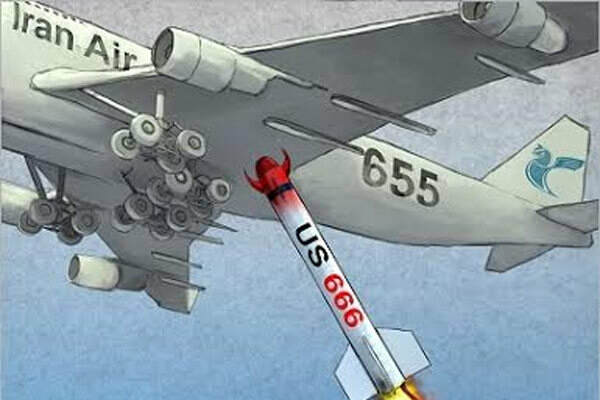
Iran Air Flight 655 – Lest We Forget

The title above comes from an article in the Washington Post published in 2013, referring to the shooting down of civilian Iranian Air Flight 655 back in 1988. The Iranian airliner was on a routine flight from Tehran to Dubai, when it was shot down by two surface-to-air missiles launched from the US warship USS Vincennes. The aircraft was in Iranian airspace, flying over Iranian waters in the Persian Gulf, and was flying away from US warships in the area. All 290 passengers and crew were killed. There were no survivors.

Why is this important to remember?

In the context of the tragic downing of Malaysian airliner M17, where official outrage in the United States and Australia were squarely directed at the Russian President Vladimir Putin and the Russian-backed rebels in eastern Ukraine, it is appropriate to explore the conduct of the US with regard to the comparable crime of shooting down a civilian airliner.

There was near unanimity in the corporate-controlled media about the culpability of Putin, and the blame was placed on the shoulders of the Ukrainian rebels opposed to the US-backed, ultra-rightists and racist regime in Kiev. The possibility that one of many neo-fascistic, thuggish militias operating under the guidance of the Kiev regime was never seriously considered or investigated. Australian Prime Minister Tony Abbott threatened to ‘shirtfront’ Russian President Putin at the G20 Leaders Meeting in Brisbane. The Russian government laughed off the remarks, but it does indicate that the Australian ruling class is willing to play the role of attack-dog for the American imperialist power. The steady and unrelenting barrage of accusations of the Russian side’s culpability has never been seriously questioned.

Be that as it may, the perpetrators of a such a horrific crime should be brought to account.

July 3 1988

Throughout the Iran-Iraq war, which lasted most of the 1980s, the United States actively encouraged the Iraqi regime of former President Saddam Hussein with military assistance, intelligence-sharing and loans. The US stationed naval warships in the Persian Gulf, supposedly to protect maritime commercial traffic in that region. The US Navy was monitoring naval and air traffic out of the Persian Gulf, and had engaged in attacks with Iranian warships. The USS Vincennes commander, Captain William C. Rogers III, ordered the shooting down of the Iran Air 655 and two missiles were launched. The aircraft was destroyed and all on board were killed. They included 66 children.

In the subsequent investigation into the attack, the US authorities blamed human error, describing the airliner’s downing as a regrettable tragedy. Then US President Ronald Reagan, basing himself on the reports submitted by US naval officials, stated that the commanding crew of the USS Vincennes believed they were under threat and took appropriate defensive action given the circumstances. Admiral William Crowe, then the chair of the Joint Chiefs of Staff, also defended the actions of Captain Rogers, remarking that the USS Vincennes had sufficient reasons to believe they were in danger and took the necessary defensive measures.

All of the assertions of the US government in relation to the shooting down of Iran Air 655 have been shown to be false. The Iranian airliner was transmitting signals indicating its civilian status, something that the US Navy with all of its sophisticated technology could hardly have mistaken. Flight 655 was ascending, flying away from the military carrier rather than descending towards the ship.

The cover-up of the criminal action of bringing down a civilian airliner is just as inexcusable as the crime itself. In 1990, the captain of the USS Vincennes, William Rogers III, was awarded the Legion of Merit for meritorious conduct for his performance as a commanding officer.

The writers and editors of Veterans Today magazine, a journal that deals with the concerns of returned service personnel, had a different assessment of Captain Rogers and his crew. In an article entitled ‘Murder in the Air’, they wrote that:

The officers and sailors of the USS Vincennes may have the honor of being among the absolutely worst and most shameful of any who have ever served in uniform. 

In 1991, Admiral William Crowe grudgingly admitted that the USS Vincennes was inside Iranian waters when the shooting down took place, not in international waters as the US Navy had first claimed.

In 1996, the Iranian and US governments reached an arrangement organised at the International Court of Justice. A compensation payout of 61.8 million dollars was agreed to be provided to the families of the Iran Air 655 victims, and the United States expressed deep regret over the incident. The US government has never actually admitted responsibility for the attack, or ever apologised for it. Indeed, in August 1988, in the immediate aftermath of the airliner’s downing, former US Vice President George Bush (senior) stated that:

I will never apologize for the United States — I don’t care what the facts are… I’m not an apologize-for-America kind of guy.

The enormous fury and frustration that accompanies the drumbeat of denunciations regarding the downing of Malaysian Airliner 17 reeks of hypocrisy. The deceptions of the United States ruling class are astounding, given that they have flouted the international laws that they now claim to uphold. The outrage over the demise of MH17 (whether real or manufactured) serves a useful tribal function – to unite us in an aura of  hyperbolic self-affirmative superiority over an enemy that stoops to new barbaric lows – surely we are not as savage as them?

Iranians honour those who perished in the attack

The Iran-Iraq war ended in August 1988. The shoot-down of Iran Air 655 constitutes an unhealed wound for the Iranian side, evidence of the perfidy and cunning deceptions of the power to the West. The Iranians mark July 3 with commemorative events and sombre ceremonies to uphold the event lest we forget:

Courtesy of Mehr News Agency

In 2014, the Harvard Political Review published an article entitled ‘Sorry, but Iran Air 655 is not equivalent to Malaysia Flight 17’, a prolonged obsequious apologia for the shooting down of the Iranian aircraft. The author does make an interesting point – the United States, during the Iran-Iraq war, positioned its naval warships in the Persian Gulf to protect trade routes and uphold free navigation of the seas. This is actually a legitimate difference between MH17 and Iran Air 655. Perhaps that is the only valid point in the entire article.

The US imperialist power regards the Persian Gulf, and indeed the oil resources of the Middle East and Central Asia, as necessary to its own strategic and military interests. It will brook no opposition to its economic expansion, at the expense of the people in that region, the true owners of those natural resources. The attack on Iran Air 655 did constitute a strong signal delivered by the trigger-happy rulers of the American war machine – this region belongs to us, defy us, and we will take steps to blast you into oblivion. Malaysia has no economic or material interests in the Ukraine, or Eastern Europe. It has never attacked any European country, nor placed its soldiers on foreign soil, or constructed military bases in foreign countries.

Perhaps it is time to examine the deceptions, hypocrisies and evil committed by our own political and economic leaders. Successive Australian governments, both Labour and Liberal, have made it a virtue (if it can be called that) of riding on the coattails of US foreign policy objectives. An axis of evil can only exist when a criminal power has willing underlings that comply with its predatory actions.

Why are so many winners of the Nobel Prize of Jewish background?

This question is one of those dinner party, or coffee shop, conversations that rises periodically in the course of a social outing with friends. In a similar fashion to a brain-dead zombie, this question put to rest numerous times, only to rise out of its coffin to startling the unsuspecting. This topic arises because it speaks to our deepest anxieties – the seeming connection between race, intelligence and genes. Now the latter topic is too broad and wide-ranging to go into detail here, so let us confine ourselves to the immediate question, posed by the title above. However, it is a matter of record that numerous scientists that have won the Nobel Prize come from a Jewish background.

The conversation usually rears its head as the end point of a series of off-the-cuff observations – Einstein, he was Jewish, right? And Richard Feynman, co-winner of the Nobel Prize in 1965 and author of numerous popular science books – he was Jewish, right? Even scientists that are popularly known but not necessarily winners of the Nobel Prize get lumped into this topic – Sigmund Freud, the psychoanalyst, he was Jewish, right? And numerous psychologists that have followed in his footsteps, or based themselves partly on his theories – Erich Fromm, Erik Erikson – they were Jews, weren’t they?

The first observation to make in this regard is a statement by Einstein himself, commenting on the status of his theories of special and general relativity. Presenting his theories at the Sorbonne University in 1921, he stated, “If I am proved correct, the Germans will call me a German, the Swiss will call me a Swiss citizen, and the French will call me a great scientist. If relativity is proved wrong, the French will call me a Swiss, the Swiss will call me a German and the Germans will call me a Jew.” Being of Jewish origin in the scientific community was hardly a distinct advantage, given the strong anti-Semitism rampant in Europe in the early part of the 20th century.

Israeli writers have engaged in their own fist-pumping, high-five-boasting, chest-thumping commentary themselves whenever examining this question. This is understandable, given that they are trying to construct an image of the Jewish people being sturdily resilient in the face of numerous obstacles. Having been subjected to anti-Semitic pogroms, outcasts from mainstream society, educational achievement is one way to overcome the impediments of anti-Semitic prejudice.

Numerous theories are proposed to explain this apparent explosion of Jewish domination in the sciences. While there are various nuances and permutations of all those purported explanations, they fall into two broad categories. One is that Jews are possessed of super-DNA genetic material, elevating them into hereditary over-achievers. After all, DNA is the metaphor for our age, particularly since the latter half of the twentieth century is characterised by the monumental growth of genomic research, biotechnology and the human genome project? Did not former Australian Prime Minister, and leader of the Australian Labour Party, state that Australia’s support for Israel was ‘in my DNA?’

Let us dispense with simplistic and utterly ridiculous psycho-gene-babble nonsense about superior and inferior quality genes. The achievement of Jews in the sciences in a completely 20th century phenomenon. Jews were confined to ghettos, driven out of society for centuries in Europe. American psychologists, lawmakers and scientists, confronted by Jewish immigrants from Eastern Europe and the former Imperial Russian empire, regarded the Jews, Mediterraneans, Slavs, and basically anyone who was non-Nordic as intellectual inferior. American policy-makers and educators, steeped in the newly ascendant doctrines of genetic determinism and racial eugenics, were deeply worried that this new stock from Europe would cause a precipitous decline in the American intellectual achievement if they were allowed to settle in the United States. If the Jewish people had super-genes, surely they would have been enthusiastically welcomed into the country obsessed with improving the genetic quality of its human stock.

The second broad category of theories relates to Jewish culture, more specifically to the bookish traditions of the Jewish people. Basically they like hitting the books, driving themselves to excel in education. This sounds nice, partly true by appealing to longstanding cultural traditions, but falls short of explaining why Jewish intellectuals have flowered in the sciences. Back in the ghettos where they floundered for decades, religious education was the main order of the day; studying in the Yeshiva, absorbing ancient texts and the Talmud were all well and good, but that was hardly preparation for tackling the difficult – and at the time burgeoning – scientific fields of biology, geology, and physics. As Jonathan Valk explained in his article for Haaretz magazine, Einstein did not undertake his groundbreaking scientific work on the photoelectric effect (for which he won the Nobel Prize) in the Yeshiva, nor did Sigmund Freud elaborate the basic foundations of what became psychoanalysis by studying religious texts. As Valk goes on to explain:

But we aren’t dealing with something uniquely Jewish as such. Other than a common identity, what is it that unites all of these Jewish thinkers, innovators, and doers? With only the odd and arguable exception, every Jewish Nobel Prize winner has been steeped in the intellectual traditions, mores and values of secular, non-Jewish culture, in addition to whatever attachment they may have had to their Jewish origin.

It is precisely when Jews turn away from the narrow, sclerotic world of sectarian particularism and embrace the humanitarian and educational culture of their host society that enables them to achieve in the sciences. The sciences are based – at least theoretically – on a meritocratic basis, where commitment to investigation, empirical fact-finding and rigorous impartiality allowed minority groups to escape the confines of discrimination and where intellect can grow and develop. Achieving excellence in education, while being its own reward, was also the best way to integrate into the new society of the United States, and achieve acceptance as equal citizens. As Noah Ephron, lecturer in at Bar-Ilan University wrote in his article in Haaretz magazine, education and scientific achievement was the way to achieve what they wanted to become, productive and respected members of the wider community, breaking out of the anti-Semitic confines in which they had been imprisoned in Europe for so long.

This is not to suggest that anti-Semitism and racism evaporated overnight in American universities – far from it. But is was the first place that a minority group could transcend the barriers that had held them down. The mid-twentieth century in the United States provided the first fertile ground where Jews could achieve without the traditional hostility and encumbrances of European anti-Semitism.

The United States had always had a strong scientific sector, but it was the twentieth century combination of circumstances – the wars in Europe and the resultant disruptions they caused, and the newly emerging Cold War – that spurred the US ruling class into action, pushing scientific research as a top priority. Numerous European scientists – Leo Szilard, Enrico Fermi – emigrated to the United States, elevating the scientific melting pot occurring in that country. Across the European continent, the USSR loomed large, with its remarkable scientific establishment rising into international prominence, rivaling the traditional centres of scientific research and development in Britain, France, and western Europe. Though devastated by the German invasion, Soviet science and education made significant strides in the mid-twentieth century, frightening the American ruling class with the spectre of a rival, and scientifically advanced, power bloc.

As Canadian blogger and intellectual Stephen Gowans explains:

Soviet accomplishments in space, considered in light of the mistaken view that the USSR was always a poor second-best to the supposedly more dynamic United States, is truly startling. Soviet achievements include the first satellite, first animal in orbit, first human in orbit, first woman in orbit, first spacewalk, first moon impact, first image of the far side of the moon, first unmanned lunar soft landing, first space rover, first space station and first interplanetary probe. The panic created in Washington after the allegedly innovation-stifling Soviet economy allowed the USSR to beat its much richer ideological rival into space galvanized the United States to take a leaf from the Soviet book. Just as the Soviets were doing, Washington would use public funds to power research into innovations. This would be done through the Defense Advanced Research Projects Agency.

Science research and development became a multicultural agency in the United States in the wake of the Second World War.

There is one other point worth making here, one that Noah Ephron makes in his article – winning the Nobel Prize is a sensational achievement, there is no doubt. However, if a scientist does not win one, it is not worth losing any sleep over it. Nobel Prizes are given to scientists who have done remarkable work, achieved incredible discoveries or formulated revolutionary innovations. Notice that this is in the past tense – they did great work, but their best is behind them. As Ephron states, while not detracting from the importance of winning the Nobel Prize, they are a fading snapshot of bygone days for a scientist.

The current US Defence Secretary, Ashton Carter, is a physicist. A graduate of Oxford, his specialty is the field of quantum chromodynamics, a theory regarding the strong interactions between quarks and gluons that compose the hadron family of particles. He is also a representative of the military-industrial complex, pushing for a more aggressive US foreign policy, promoting the privatisation of scientific enterprises for further military research, and typifies the fusion of corporate and military power to further the agenda of the US ruling class. While working in the private sector, he held important posts in the government advisory boards promoting greater collaboration between the scientific community, the military and private companies. He speaks and works for the enrichment of defence contractors.

Murray Gell-Mann, a Nobel Prize winning physicist of Jewish origin, worked on the development of military technology in the 1960s. He has since become committed to disarmament and dialogue between nations. Gell-Mann is a pioneer in the field of quantum chromodynamics, the subject in which Ashton Carter took his PhD. It is not so important to note whether a scientist is of Jewish or non-Jewish background, but to note the role that they play in the wider community – as a spokesperson for peace, or a technocrat for war and profit. Rather than look back in dismay or jealous rage about the numbers of particular ethnic groups in the sciences, perhaps we should be devoting our collective energies to providing solutions for the economic and ecological problems that confront humanity today. Scientific enquiry and achievement cannot be sustained within the diseased political and economic order of capitalism that condemns larger numbers of people to a pauperised existence.

The US criminal justice system gives ultra-right terrorism a free pass

In Australia, there is ongoing and extensive commentary about the actions and motivations of Man Haron Monis, the Iranian-born self-styled Islamic sheikh who took hostages in the Lindt chocolate cafe located at Martin Place, Sydney, in December 2014. This attack was immediately elevated to a national terrorist threat by the Australian federal authorities, and media coverage of the siege itself and subsequent tragic shootout was at saturation level. Monis and two hostages were killed in the police raid that ended the cafe siege.

This hostage-taking has become part of the Australian national conversation about terrorism and its origins – Monis is the subject of regular articles, labeled a monster by some journalists, and every aspect of his individual psyche and religious affiliations is examined in careful detail. Monis was known to Australian police and intelligence agencies, and he did not actually have any connections with Al Qaeda, ISIS, or any other Islamist fundamentalist group.

A federal inquest was held into the Lindt cafe siege, although it does not appear to have answered many questions. However, one thing is certain, Monis has become the archetype for jihadist terrorism in Australia. His actions are portrayed as part of an international terrorism threat originating from the Islamic communities and religion, even though his motivations have been assessed as a mix of mental health problems, criminality and narcissistic attention-seeking, as well as extremism. The notoriety surrounding the name of Man Haron Monis should find comparable expression with that of the American Robert Doggart.

Who?

Christian terrorist

Meet 63-year old Robert Doggart, an ordained minister in the Christian National Church, former US Naval Sea Cadet Corps serviceman, electrical engineer, and businessman resident of Tennessee. He was arrested for plotting, along with nine other men, to massacre the entire Islamic community of Islamberg, a rural hamlet in Delaware County, New York. Stopped by the FBI before he and his co-conspirators could carry out their intended attacks, Doggart made no secret of his intentions. The residents of Islamberg, mostly African-American people of the Muslim faith who left New York to escape its endemic poverty, corruption, racism and lack of opportunities, have been living the quiet life in their city – much like the Amish and other religious minorities in the United States.

Doggart was chillingly clear in his social media posts, articles and statements about how and why he wanted to eradicate Islamberg and its residents from the map. He planned to start a military-style assault on the town, armed with automatic weapons, burn down the mosque and schools, and kill all the people in the town. In an article for The Daily Beast called “America snores when Christian terrorist threatens to massacre Muslims“, writer Dean Obeidallah quoted Doggart’s words that, backed up by members of an ultra-right terrorist militia from Texas and South Carolina, the people of Islamberg would face extermination by his self-styled holy Christian warriors:

“We will be cruel to them. And we will burn down their buildings [Referring to their mosque and school.] …and if anybody attempts to harm us in any way… we will take them down.”

He also detailed the weapons he would use in the attack, including an M-4 military assault rifle, armor-piercing ammunition, explosives, pistols, and a machete, because  “If it gets down to the machete, we will cut them to shreds.”

Doggart expressed a hope that he would survive the terror attack, but explained, “I understand that if it’s necessary to die [in this attack] then that’s a good way to die.”

Doggart explicitly based the rationale for his actions in his religion:

Doggart’s own words highlight his motive being grounded in at least partially in his view of Christianity:“Our small group will soon be faced with the fight of our lives. We will offer those lives as collateral to prove our commitment to our God.” Doggart continued, “We shall be Warriors who inflict horrible numbers of casualties upon the enemies of our Nation and World Peace.”

What is noteworthy about this case?

Doggart and his associates were never charged with any terrorism-related offences. While admitting that he spent months collecting weapons, plotting his attack, bringing weapons and far-right militia members together for the purpose of burning Islamberg to the ground and killing all its people, he was charged with interstate communication of threats, soliciting others to violate civil rights, and attempting to damage religious property. He was released on bail.

Islamberg residents responded, through their legal and collective representatives, that Doggart and his accomplices should have been charged with terrorism, as every Muslim American suspect has been similarly arraigned, regardless of how tenuous or fragile the case against them may be. A spokesperson for the Islamberg community stated the following:

Our community consists of veterans, doctors, lawyers, teachers, etc. We are true American patriots, unlike Doggart, who is not representative of Christianity, but more like the American Taliban.

The community has cooperated with federal and local law enforcement authorities, and no links have ever been found between the residents of Islamberg and any fundamentalist or extremist Islamist groups. However, that has not stopped the constant rumours of “jihadist training camps” circulating about the town, spread by always-credible news outlets like Fox News.

Looking clearly at ultra-right terrorism

The obsessive preoccupation with the threat of jihadist fundamentalism, and the subsequent smearing of the entire Islamic community, blinds us to the very real and greater danger that lurks within our society, the terrorism of the ultra-right. The increased surveillance of Muslim American communities, FBI-manufactured plots clearly based on entrapment, and the misguided belief that mass surveillance of the Islamic communities is necessary but unfortunate, are based on an enormous and erroneous assumption – that the Muslim faith encourages violent solutions to societal problems, and that Muslim communities are more conducive to take up violent actions in response to their challenges. Nothing could be further from the truth.

The sub-heading above is derived from an article by the Bulletin of the Atomic Scientists called “Looking clearly at right-wing terrorism.”  That article’s author states quite clearly that ultra-rightist groups have a long, and more violent, track record than any Al Qaeda or Islamist fundamentalist organisations:

Far-right terrorism in the US is more common than other types of violent radicalism. A recent study by the New America Foundation found that since 9/11, far-right extremists “have killed more people in the United States than have extremists motivated by al Qaeda’s ideology.” And perhaps most important, far-right terrorists are more prone to seek unconventional weapons—that is, weapons that might generate mass casualties or mass disruption. The study found that while no “jihadists indicted or convicted in the United States” had obtained or employed chemical or biological warfare agents, 13 individuals motivated by far-right extremist ideology, “acquired or used chemical or biological weapons or their precursor materials.” In the recent past, far-right extremists have also plotted the use of radiological weapons.

Since September 11 2001, the ‘war on terror’ has influenced the public perception and media conversation about terrorism as a purely foreign, mostly Islamic, importation. The focus of law enforcement authorities on the Islamic communities is underscored by an obsessive prejudice against anyone perceived to be Middle Eastern. The domestic ‘jihadist’ menace, if there is one, was superseded long ago by the violent activities of the white supremacist, and Christian Identity, ultra-rightist movements. The United States does have a serious terrorism problem, but simply refuses to tackle it.

Back in 2012, the Combatting Terrorism Centre at West Point issued an extensive report called “Challengers from the Sidelines – Understanding America’s Violent Far-Right (pdf).” It details the extensive political landscape of the ultra-right, its activities, growth, motivations and trends. Does the US criminal justice system regard the main targets of ultra-right terrorism, ethnic and minority groups, expendable and less worthy of attention than victims of white Anglo-American extraction?