New Zealand – the small nation that is mightily important

Australia – it is high time to stop treating New Zealand as a second-rate cousin.

New Zealand is a beautiful, picturesque country. I had the wonderful privilege of traveling through both the North and South Islands of New Zealand, immediately prior to the terrible earthquake that devastated the east coast of the southern island. We will get to the earthquake in a later article, not the current one – stay tuned. However, firstly, it is necessary to dispense with some Australian-manufactured stereotypes and myths about the ostensibly poorer cousins across the Tasman Sea.

Australians have a long history of ridiculing our compatriots across the sea – jokes about the Kiwis abound in Australia. The sporting rivalry is fierce – whether it is the long-standing competition in the cricket, or the clashes between the Wallabies and the All Blacks in the rugby union; there is no shortage of ferocious opposition. The BuzzFeed news service carried an article entitled “32 Reasons Why Australia And New Zealand Share The World’s Fiercest Rivalry”, in which the author explains that while Australia may feel overconfident with regards to the size of the country, New Zealand wins hands-down when it comes to breathtaking landscape.

Australians built attractions, such as the Sydney Opera House and Sydney Tower, to rival the natural wonders of New Zealand. The latter responded by building the SkyTower in Auckland, which is taller than any building in Australia…….and on and on the rivalry goes.
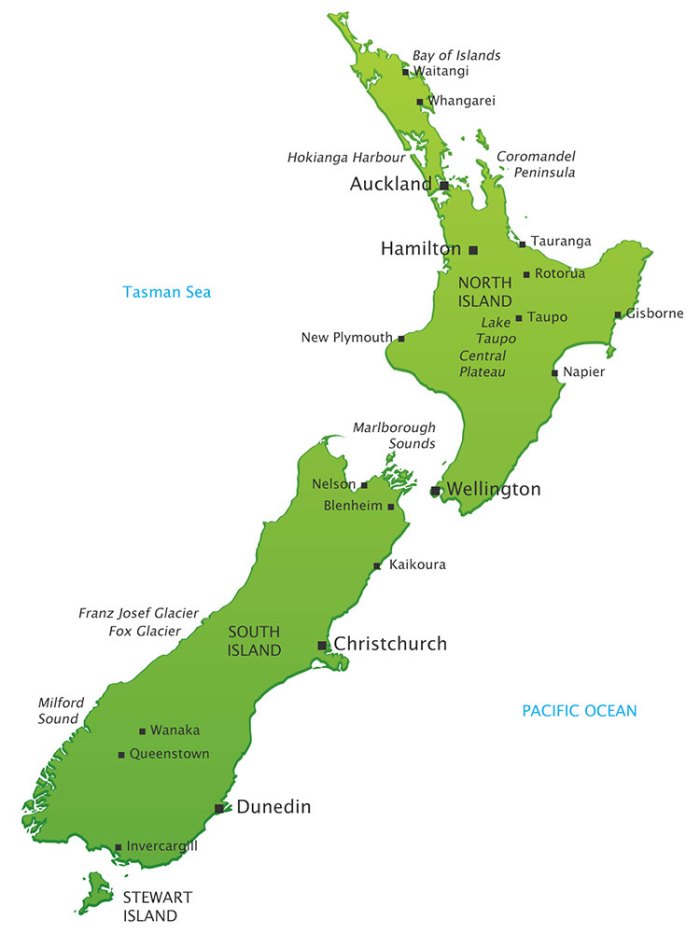
Aotearoa
Aotearoa – courtesy of Maori.com

However, setting aside the stereotypes that frequently infect any discussion between Australians and New Zealanders, let us take a closer look at Aotearoa – the land of the long white cloud. The similarities between the two British-sponsored settler-colonial states on either side of the Tasman far outweigh any purported differences. The origins of both colonies as outposts of British capitalism, and their historical characteristics as New Britannia settlements, weigh heavily on the current features of the two nations.

Let us not forget, that without the participation of New Zealand, there would be no Anzacs. Last year was the centenary of the Anzac landings, and New Zealand hosted its share of commemorative activities to remember those New Zealanders who served, and never returned. This year, Anzac exhibits were given prominence (as they are usually are) in celebrations about the role of New Zealand troops in British wars overseas.  In Wellington Museum, there were long queues to view the Great War exhibition, which detailed the history of New Zealand’s contribution to the British empire’s military campaigns in World War One.

New Zealand, like Australia, has a long history of serving as a mercenary force, firstly for the British empire, and currently aligning itself with the goals of the United States. The United Kingdom was the industrial juggernaut that stood at the apex of the British empire, it was the dominions, like New Zealand, which became more British than Britain and loyally participated in British expeditionary forces wherever the Empire deemed necessary. Chris Trotter, political and social commentator for the New Zealand media outlet Stuff, wrote an article placing the current participation of New Zealand troops in the Middle East within a historical context. Trotter remarked that:

Since the late-19th century, this country has happily marched in the great expeditionary columns that have trudged their way across the dry and dusty regions of the world. From the South African veldt to the Sinai desert, the Kiwis’ broad-brimmed hats have dutifully bobbed along behind the pith helmets of their Imperial British mentors.

That sounds familiar to Australian readers.

Chris Trotter’s article “New Zealand’s only Middle Eastern exit strategy – leave now” elaborates that troops from New Zealand participated in the mad scramble for colonial possessions in the wake of the Ottoman Turkish empire’s defeat in World War One. Britain wanted to acquire the land of Palestine, and throughout 1917-1918, took steps to forcibly take the country, with the willing participation of soldiers from New Zealand:

All New Zealanders know about their country’s role in the invasion of the Gallipoli Peninsula in 1915. Less well known is the role that Kiwis and Aussies played in driving the British Lion’s blood-stained claws into the carcass of the Ottoman Empire’s Middle Eastern provinces – especially Palestine – between 1916 and 1918.

The New Zealand Government’s reticence about drawing Arab attention to the role this country played in the emergence of the State of Israel is entirely understandable. What purpose would be served by reminding Arab historians about the Kiwi and Aussie troops responsible for the deaths of more than 200 Palestinian men and boys in the tiny village of Surafend in 1918? Or about the fulsome vote of thanks delivered to the Antipodeans by residents of the nearby Jewish settlement of Richon Le Zion?

Dredging up these historical incidents might prompt Egyptian historians to investigate the role played by the New Zealand and Australian mounted infantry in suppressing the Egyptian nationalist revolt against British domination which exploded in the final months of 1918 – a task made much easier by the Antipodeans’ already fearsome reputation for brutality against Arab civilians.

Questions might be asked about whether or not New Zealand’s behaviour towards the Islamic world has changed all that much over the course of the past 100 years. True, the British Empire is no longer the dominant global superpower, but its American successor would appear to be no less persuasive when it comes to drawing the Antipodeans back into the marching columns of imperial adventures.

Once again, Australian readers would recognise the eerie similarities between themselves and their compatriots across the Tasman Sea.
Generated by IJG JPEG Library
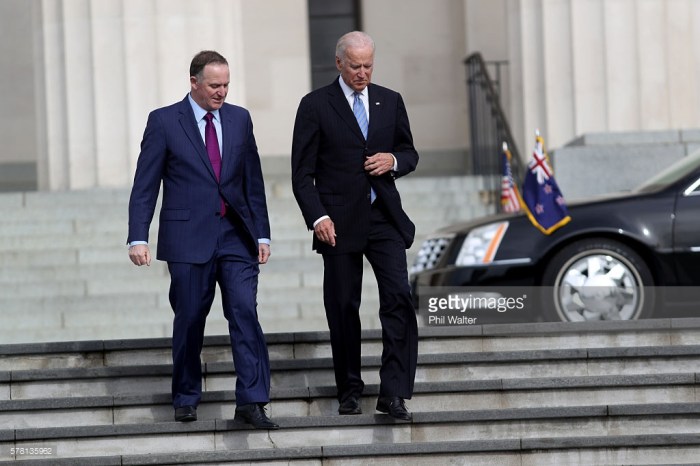
US Vice President Joe Biden and New Zealand Prime Minister John Key – courtesy of Getty images

In July 2016, US Vice President Joe Biden turned up in New Zealand for a series of wide-ranging meetings with the political leaders in Aotearoa. Biden’s stopover was aimed at ensuring that New Zealand aligns itself unequivocally with the ambitions of the United States in the Asia-Pacific region. Biden, who had visited Sydney Australia prior to his arrival in New Zealand, made menacing speeches about the power of the United States, and in particular its naval forces with respect to China. Bellicose and belligerent, Biden was in full form as he elaborated that the US was intent on achieving the status of the dominant power in Asia, and was not going to budge an inch.

However, the cowardly bully is never confident without satraps behind him. Biden wanted to ensure that New Zealand remained fully committed to the United States. Wellington has lined up with the Americans, but has also pursued its own economic interests by maintained friendly and burgeoning relations with Beijing. New Zealand’s minister of defence, Gerry Brownlee, maintained that while his government cooperates with the United States, it was not going to give up its lucrative connections with China. He stated that New Zealand’s defence relationships with the United States and China were not mutually exclusive.

In a further strengthening of American-New Zealand military ties, Biden confirmed that a US warship would be visiting the latter country as part of the New Zealand Navy’s 75th anniversary celebrations. The US military will neither confirm nor deny if the warship contains nuclear warheads – and the New Zealand government stated that it will not ask. That marks a reversal of the long-term commitment of New Zealand to keep the country nuclear-weapons free, since the decision by the Lange government in the 1980s to ban nuclear weapons from the country’s territory.

We are approaching the word-limit of this article, so let’s make some last observations. We briefly alluded earlier on to the earthquake that hit New Zealand’s south island in November 2016 – we will get to that subject in the next article. That earthquake had complex causes, but relates to the fact that the south island straddles the boundary between two continental plates – the Australian and the Pacific. The constant pushing and shoving between these plates pushes up rock strata to create mountain ranges, such as the Southern Alps. The tectonic dragon – as the New Yorker explains – is alive and well in New Zealand. Forty miles off the coast of Wellington is the Hikurangi Trench, where the Pacific plate moves westward underneath the Australian plate. However, on the South Island, the Australian plate is moving eastward and submerging beneath the Pacific plate.

Southern Alps - image courtesy of Wikipedia
Southern Alps – image courtesy of Wikipedia

We will get to all of that in the next article – stay tuned.

However, there are other human-induced earthquakes that have rocked New Zealand, and their effects are just as devastating. The political earthquake that is neoliberal capitalism has left its imprint on the people of New Zealand, destroying lives and leaving behind shattered wreckage in its wake. Cutbacks to employment, reducing social security, pushing people off welfare in a punitive drive to allegedly balance the budget books, has resulted in social dislocation and increasing poverty in the country. While focusing on forcing increasing numbers of people off welfare may make the books look like they are balanced, it fails to take into account the full social and economic costs of doing so.

Most of the corporate media have been in hysterics about the political earthquakes of Trump and Brexit – these have implications for New Zealand as well. However, we will leave that for the next installment. While everyone is screaming shrieks of desperation at the emergence of Trumpism in America (and Tory Brexit populism in the UK), let us all relax, have a drink, and maintain cool heads. No need for frenzied delirium at developments in Britain and the United States.

For now, let us emphasise that what a nation chooses to remember and forget from its history helps to shape its identity. Vincent O’Malley, historian and writer from New Zealand, referred to this proclivity when writing about the British-Maori wars. The Anzac episode is heavily promoted and commemorated – the Maori are left forgotten, homeless on the streets of Auckland, detritus left behind by the neoliberal project and ignored by us Australian tourists as we enjoy the glitzy shops of Queen Street. The Polynesian Maori nations fought tremendous wars in order to be recognised as sovereign people in their country. Walking down the streets of Auckland, as we gave our last New Zealand dollars to the homeless, we came to realise that the Maori deserve better than trite homilies about ‘not living in the past’ and ‘just get over it’.

This is not to suggest that there has been no progress at all in the fight for Maori self-determination and cultural identity – by no means. But when an earthquake hits, it wreaks destruction – and it takes concerted effort to rebuild from the wreckage. In a twist of irony, it is us Australians that like to complain about the mythical ‘Kiwi layabout’, that breed of white New Zealander that comes to our shores purely to live off our supposedly highly generous social security system. If only the first boat person to arrive in Australia, Captain Cook, had been told to turn around and go back to where he came from, the history of Australia (and New Zealand) would be remarkably different.

There is a social and political earthquake shaking New Zealand – the trading of our ethics and social values for money in a neoliberal society. As the authors of Socialist Voice Aotearoa put it – we are witnessing the demise of compassionate New Zealand for money, and we must halt its decline.  When social values and cross-cultural community solidarity decline, we see the rise of homelessness, social disruption and human misery. New Zealand may be far away from Europe, the United States and Britain, but its fate is inextricably bound up with the processes of neoliberal globalisation that has been carried across the world. New Zealand may be geographically small, but its characteristics and destiny are mightily important for all of us.
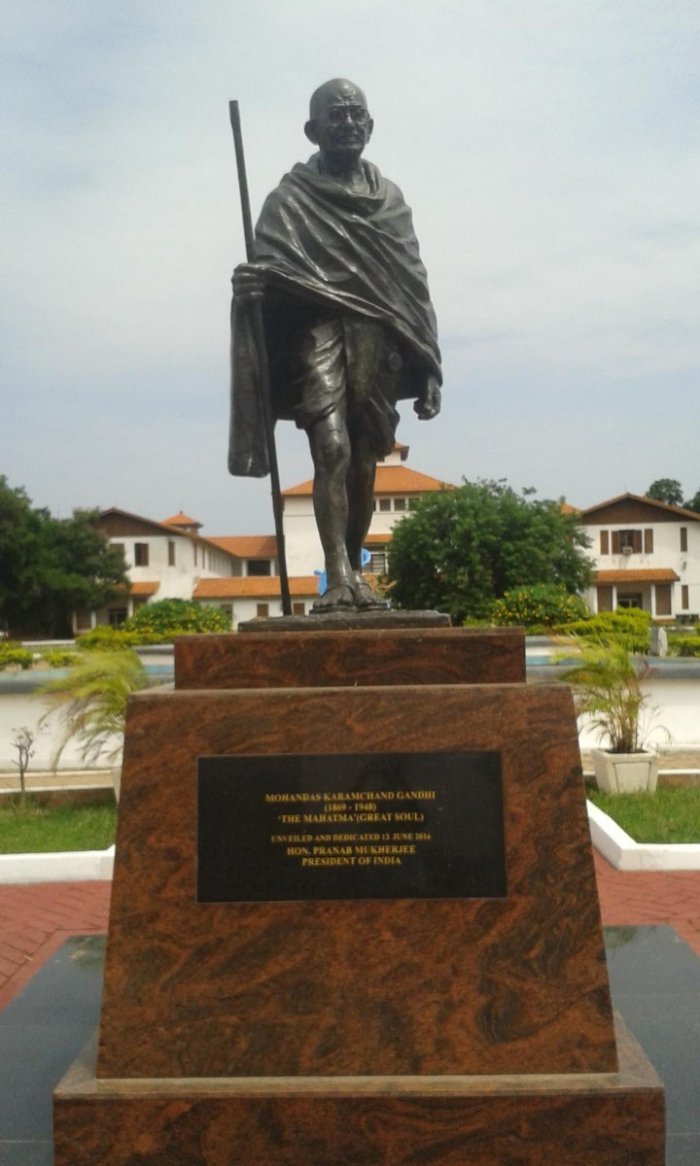
Cecil Rhodes must fall, but Mahatma Gandhi must stand – two statues and two controversies

In October of this year, a statue of Mahatma Gandhi was removed from the grounds of the University of Ghana, only a few months after it had been erected there as a presentation from the visiting Indian President, Pranab Mukherjee. This statue was removed after a petition by Ghanaian scholars and academics, who pointed out that Gandhi, during is stay in South Africa, made racist statement towards black Africans, and that his example was inappropriate for modern-day Ghanaians. In an article for The Guardian newspaper, Jason Burke elaborates on the reasons why the petitioners were outraged by the prominence of the Gandhi statue:

The petition states “it is better to stand up for our dignity than to kowtow to the wishes of a burgeoning Eurasian super power”, and quotes passages written by Gandhi which say Indians are “infinitely superior” to black Africans.

More than 1,000 people signed the petition, which claimed that not only was Gandhi racist towards black South Africans when he lived in South Africa as a young man, but that he campaigned for the maintenance of India’s caste system, an ancient social hierarchy that still defines the status in that country of hundreds of millions of people.

The Gandhi statue - the target for removal amid claims Gandhi was racist towards black Africans
The Gandhi statue – the target for removal amid claims Gandhi was racist towards black Africans

Gandhi’s life in South Africa, where he worked as a barrister defending the rights of the Indian community, is the subject of numerous scholarly works and articles. He spent twenty-one years of his life there, confronting an apartheid regime of strict racial discrimination, long before the authorities in Pretoria used the word ‘apartheid’ to describe their racially stratified society. His South African period is of especially relevance – why? This controversy around the Gandhi statue in Ghana arrives hot on the heels of a similar dispute that erupted back in March 2015 – Rhodes Must Fall.

Students and lecturers from the University of Cape Town, South Africa, began a campaign to remove the statue of Cecil Rhodes, British empire-builder and racist entrepreneur-coloniser, from their campus. The campaign to remove the statue began a series of thoughtful and serious questions about the decolonisation of education, the progress (or lack thereof) of racial and economic equality in the post-apartheid South Africa, and the nature and role of the former British empire. A vociferous campaigner for British imperial rule, Rhodes founded the British South Africa Mining Company for the purpose of exploiting the rich mineral wealth of southern Africa.

Rhodes, whose name was given to the country of Rhodesia (now Zimbabwe) openly expressed his motivations for empire-building – the superiority of the English people, as he saw it. He loudly and repeatedly expressed the view that British settler-colonialism was the highest priority for the British people, because the British were the ‘first race’ in the world. He made plain his disdain for whom he viewed as lesser races, namely, the black African people.

Cecil Rhodes statue at the University of Cape Town
Cecil Rhodes statue at the University of Cape Town – removed in April 2015 after student protests

Dying in 1902, Rhodes was unrepentant to the end, never wavering in his view that blacks must be ruled over by a class of wealthy whites. His history is one of racial hatred, treachery and deception in amassing enormous reserves of wealth and waging vicious wars against millions of black Africans. Rhodes is remembered today, if at all, for funding the scholarship that bears his name. Such a programme was intended to fund the brightest and best students from all of Britain’s colonial possessions, for the purpose of studying at elite British educational institutions. Australians can appreciate the academic calibre of Rhodes scholars until today, having made a lasting impact on Australian society with their superior intellectual skills.

Be that as it may, the Rhodes Must Fall campaign highlighted the importance of addressing racial and economic iniquities, not for the purpose of self-flagellation, but for the purpose of redressing historical grievances. Rhodes and his role in creating the regional dominance of the British empire should never be erased from the historical memory – Rhodes Must Fall wants the world to know his crimes for the purpose of re-evaluating the legend that has surrounded Rhodes and his impact since his death. Every historical figure, including Rhodes and Gandhi, accumulate a vast body of myths and half-truths after they pass on – whether deliberate hagiography or the product of rose-tinted views of their work. Each person must be evaluated, if only to fully appreciate their achievements and weaknesses. Rhodes was a racist land-hungry imperialist, and for that reason, his statue must fall.

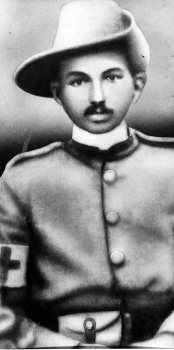
If that is case, should not Gandhi’s statue also fall? Did he not make racist comments and statement about black Africans during his time in South Africa? Did he not support the British empire, going so far as to work as a stretcher-bearer for British forces in their war against the Boers in the early part of the twentieth century? Gandhi himself created and joined the Indian Ambulance Corps for the express purpose of providing service to the British military forces during the Boer War.

Mahatma Gandhi in the uniform of a sergeant as the leader of Indian Ambulance Corps. During the Boer War of 1899 and the Zulu Rebellion of 1906. He donned the Khaki uniform and set his mission of mercy and brought help and succour to many a wounded soldier.
Mahatma Gandhi in the uniform of a sergeant as the leader of Indian Ambulance Corps.

Gandhi, during his South African stay, made numerous statements that can only be interpreted as racist comments against black Africans. He was only concerned with the status of the Indian community in that country, and sought to improve their standing by cooperating with the British authorities. He intended to prove to his white counterparts that the Indian was unjustly dismissed as a ‘savage’ and ‘brute’, no better than a kaffir – the latter a derogatory term referring to black Africans. For instance, in his voluminous writings, you may find statements such as this:

A general belief seems to prevail in the Colony that the Indians are little better, if at all, than savages or the Natives of Africa. Even the children are taught to believe in that manner, with the result that the Indian is being dragged down to the position of a raw Kaffir.

In 1904, he wrote to the authorities in Johannesburg to complain about the mixing of Indians and Kaffirs in an unhealthy slum section denoted ‘Coolie location’, and he claimed that disease and epidemics would surely persist if this unsanitary mixing continue. Gandhi made various statements denouncing the heathen-beliefs of the black Africans, and strenuously sought to distinguish the Indian as an educated and civilised contributor to the British empire, unlike the ostensibly primitive black African. In 1893, soon after arriving in Natal, Gandhi wrote that:

“I venture to point out that both the English and the Indians spring from a common stock, called the Indo-Aryan. … A general belief seems to prevail in the Colony that the Indians are little better, if at all, than savages or the Natives of Africa. Even the children are taught to believe in that manner, with the result that the Indian is being dragged down to the position of a raw Kaffir.

He arrived in what was then Natal colony, South Africa, in May 1893 an inexperienced and politically immature lawyer. He persistently couched his appeals to British authority in terms of the superior values of the Indian – in contrast to the black African. There is no question that Gandhi absorbed and reflected the prejudiced attitudes and values of his day and community. Gandhi’s grandson and biographer, Rajmohan Gandhi, admitted that his famous grandfather was at times ignorant and prejudiced about black Africans. As the author E S Reddy stated in an article for The Wire magazine:

The class and colour prejudices Gandhi carried from India were reinforced by those of the merchants and the white officers he dealt with. In countering the arguments of the white racists, he tried to show that Indians, unlike the Africans, had an ancient civilisation. He used the language of the whites, which was offensive to Africans, and referred to them as ‘kaffirs.’

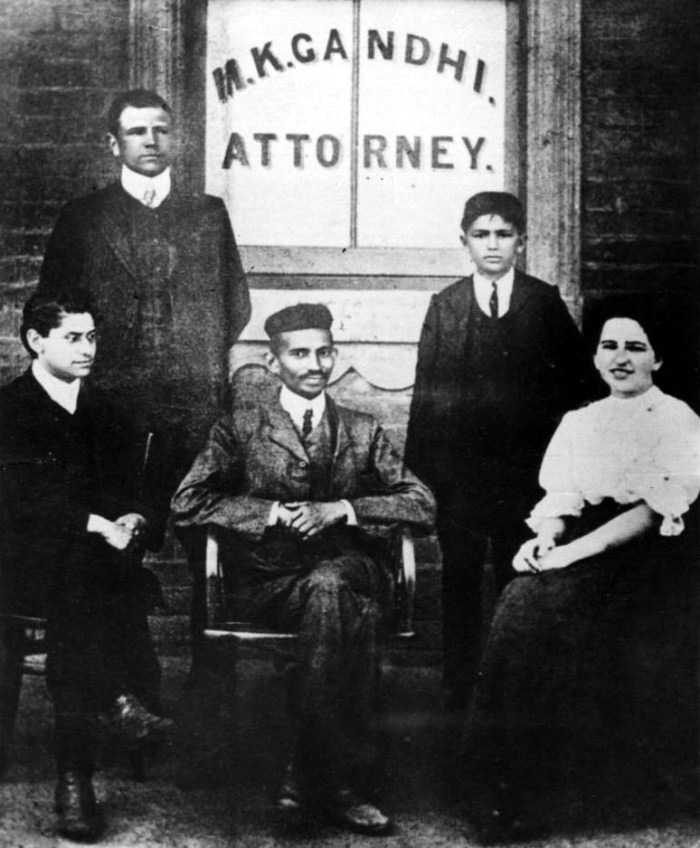
Gandhi in Johannesburg 1905
Gandhi in Johannesburg seated in front of his law practice – 1905

Throughout his stay, he witnessed the many injustices done to the black African community, and the exploitative nature of the British empire. As he matured in years and political outlook, he began to take steps on the path that made him an agent of social and political change. Gandhi developed and refined the doctrines and practices of non-violent civil resistance which are today an inspiration for political leaders and people world-wide. Indeed, it is worth recalling the words of Nelson Mandela, and his analysis of Gandhi. For instance, in 1995, after his release from prison, Mandela wrote the following:

Gandhi must be forgiven those prejudices and judged in the context of the time and circumstances. We are looking here at the young Gandhi, still to become Mahatma, when he was without any human prejudice save that in favour of truth and justice.”

He also stated in 2003 that:

Gandhi’s political technique and elements of the nonviolent philosophy developed during his stay in Johannesburg became the enduring legacy for the continuing struggle against racial discrimination in South Africa. (Speech made during the unveiling of the statue of Gandhi in Johannesburg in October 2003)

As Gandhi took up the cause of his community in South Africa, he began to recognise the injustices of the racially and economically stratified society against which he and his supporters were fighting. The Boer war (1899-1902), during which the British armed forces committed numerous atrocities on the white South African minority, was a politically awakening experience for those who emerged from this trauma – Gandhi included. Non-white political organisations, paradoxically, were given a boost by the bitter experiences of this war. As the South African statelets – Natal, Transvaal and so on – moved towards establishing a national entity in the early years of the 1900s, the non-white communities found themselves collectively marginalised. In this context, witnessing the brutality of white-only rule against the indigenous and non-white populations served as a political awakening for the young Gandhi.

As the Indian community mobilised for their rights in the new South Africa, Gandhi started to widen his political horizons, declaring in a speech that:

South Africa would probably be a howling wilderness without the Africans…”

“If we look into the future, is it not a heritage we have to leave to posterity that all the different races commingle and produce a civilisation that perhaps the world has not yet seen.

In 1912, the South African Native National Congress was formed – the predecessor of the African National Congress. Gandhi welcomed this development, and never sought to impose his example or leadership upon it. He only offered his philosophy of satyagraha – insistence on truth – as a method to combat racial oppression.

Years later, after Gandhi had returned to India to struggle against the British rule over his native country, he made statements to demonstrate that his interest in and support for South Africa never wavered. In a speech to Oxford university in 1931, he declared:

As there has been an awakening in India, even so there will be an awakening in South Africa with its vastly richer resources – natural, mineral and human. The mighty English look quite pygmies before the mighty races of Africa. They are noble savages after all, you will say. They are certainly noble, but no savages and in the course of a few years the Western nations may cease to find in Africa a dumping ground for their wares.

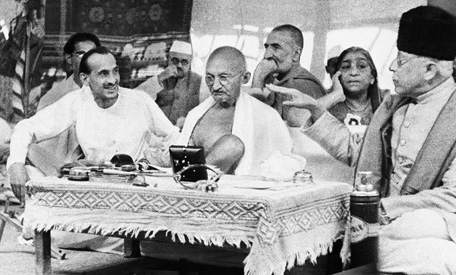
Gandhi surrounded by his supporters - August 1942
Gandhi surrounded by his supporters – August 1942

Having learnt from the experience of anti-colonial nationalism, Gandhi applied himself to the struggle in India for home rule. One of his lifelong comrades and staunchest supporters, Jawaharlal Nehru, not only learned from Gandhi’s example, but applied it to all oppressed groups. From the 1920s onwards, Nehru advocated the necessity of uniting on a multi-ethnic and pluralist basis, including oppressed people of all colours in the struggle against colonialism. He went on to become the first post-independence Indian prime minister, as well as the architect and leader of the Non-Aligned Movement.

The non- aligned anti-colonial movements encompassed all races and ethnic groups for the common purpose of self-determination. One of the main exponents and practitioners of anti-colonial liberation was a black African political leader, Kwame Nkrumah – who lead his country, today known as Ghana, to independence. Nkrumah was a socialist and pan-Africanist, who derived inspiration from numerous sources. One of the sources from which he learned and drew inspiration was Mahatma Gandhi, whose doctrines of non-violence and non-cooperation profoundly influenced the Ghanaian anti-colonial campaign. It is obviously up to the authorities at the University of Ghana to decide whether or not to keep the statue of Gandhi on their campus. No-one can dispute that. However, rejecting Gandhi’s example would be a huge disservice to all those – from all races – who drew inspiration from the Gandhian model in their own anti-colonial struggles for self-determination.

The United States and Britain enable the catastrophe that has engulfed Yemen today

Since March 2015, Saudi Arabia, along with its Gulf State allies, has pursued a relentless bombing campaign and siege of the nation of Yemen, in order to influence the political order in that country. This Saudi war, which has targeted hospitals, schools, the electricity grid and civilian infrastructure in Yemen, has been prosecuted because of the fulsome military and political support provided to Riyadh by Britain and the United States. This forgotten war has been largely eclipsed by all the media attention on Syria. While American officials loudly and emphatically condemn the war crimes of Russian military forces in Aleppo, they have enabled their Saudi allies to commit atrocities on a national scale in Yemen with impunity.

As the Common Dreams magazine reported, the Saudi-led air forces – whose warplanes are refueled by the United States – carried out an air-strike on a funeral hall in Yemen’s capital, Sanaa. At least 140 civilians were killed, and 500 were wounded. The Saudi aircraft struck that particular funeral hall because the attendees included high-level officials from the Houthi-led insurgent movement, the latter waging a long-term political and military struggle to achieve self-determination for Yemen. The air strike on the funeral hall procession represents a major escalation of the Saudi offensive against Yemen. In the Yemeni capital Sanaa, thousands took to the streets to protest this latest Saudi outrage. The leader of the rebel Houthi movement, Abdul-Malek Houthi, angrily denounced the attack, and stated that these kinds of airstrikes are being done with the weapons and permission of the United States.

The United Nations humanitarian coordinator for Yemen, Jamie McGoldrick (center, in light blue shirt) inspects a funeral hall on Monday, two days after it was destroyed in Sanaa, Yemen, in an airstrike by a Saudi-led coalition. At least 140 people were killed.


Such an attack constitutes a war crime, and questions are being raised in the United States about American culpability for this crime. The Saudi authorities announced that they would investigate this bombing, and denied responsibility. However, it is clear that the funeral hall attack is only the latest in a long string of assaults on hospitals, markets and places where large groups of civilians congregate. National Public Radio elaborated upon how the United States has become an indispensable partner for the Saudi Arabian government in its offensive against the Yemeni Houthi movement. The war was intended to be a quick and decisive victory over the rebellious forces, with the Saudis installing their Yemeni proxy, current President Abed Mansour Hadi, in power. However, the war has ground on for much longer than anyone anticipated, and the Saudis – along with their American and British backers – find themselves stuck in a quagmire of their own making.


Yemenis shout slogans during a rally in Sana on Monday protesting Saudi-led airstrikes that hit a funeral hall. (Yahya Arhab / European Pressphoto Agency)


Abed Mansour Hadi, installed as President in 2012 as part of a Saudi and American sponsored agreement, is the preferred candidate of the outside powers. His installation was meant to reduce the political upheavals and revolutionary demands that led to the ousting of his predecessor, long-term Yemeni President Ali Abdullah Saleh. However, this peace process was artificial and superficial, with the Yemeni Houthis sweeping to power, taking over the capital and large portions of Yemen itself. Hadi was forced to flee to Saudi Arabia where he has remained ever since, despite an occasional and temporary foray by Hadi into the Yemeni city of Aden.

While the United States involvement in the specific funeral hall attack is criminal, it is only one part of the wider role the US (and Britain) have been playing in enabling the Saudi regime to devastate the country and population of Yemen. The Common Dreams magazine published an article by C J Werleman called ‘The American-Made Catastrophe in Yemen’. In this article, Werleman draws attention to the fact that the United States provides billions of dollars worth of military supplies to the Riyadh government.

US President Barack Obama has the dubious distinction of being the president that has shipped more weapons and munitions to Saudi Arabia than any of his predecessors – since 2009, Obama has provided 115 billion dollars worth of military equipment, training and supplies to the Saudi Arabian monarchy. The relationship between the Saudi and American governments has come under renewed scrutiny, not so much because of any qualms about the Saudi assault on Yemen, but because of American unease over the more egregious crimes of the Saudi war machine.

A Saudi military member stands next to a destroyed building in Aden, Yemen. (Photo: Ahmed Farwan/flickr/cc)

Not only has Saudi Arabia waged an aggressive aerial campaign, but has also implemented a naval blockade of Yemen since 2015. Saudi forces stop and search any maritime traffic heading towards the Yemeni ports, and turn back any shipping. The blocking of sea ports has added to the misery of ordinary Yemenis, with millions facing the prospect of starvation. Food scarcity has hit the children of Yemen particularly hard, and it is apparent that a humanitarian catastrophe of epic proportions is unfolding in the war-ravaged country. Unicef has reported on the dire situation on the ground, and it is the Yemeni children that are paying the heaviest price. In these terrible conditions, it is unsurprising that diseases such as cholera have broken out in Yemen.

It is noteworthy that American naval forces participate in this naval blockade of the country, and America has imposed financial sanctions of Yemen to interrupt the flow of goods and services to that nation. Britain and United States actively participate in intelligence gathering, provide targeting information and aerial refueling for the Saudi forces. American and British officers cooperate with their Saudi counterparts to coordinate attacks. The US Navy attacked and destroyed radar sites in Houthi-controlled areas of Yemen, after one of its warships was fired upon by missiles which the US claims originated from Houthi military forces. The Pentagon has signalled that it can directly intervene in Yemen, though that statement ignores the fact that the US has been heavily engaged in making the Saudi war on Yemen possible.

Despite all of these forces ranged against them, the Yemeni Houthis have remained defiant and resilient. The Hadi government, while officially recognised, has only a very thin base of domestic support. As the Saudis, and their imperialist enablers, haemorrhage money and credibility as they are bogged down in this tiny nation of Yemen, the outside world must speak out. As the United States and Britain stand behind their Saudi mercenary, we, the ninety-nine percent, must expose the system that rewards merchants of death. What kind of economic and political system enables profiteering from human misery and death? When arms sales and political alliances with fanatical warriors leads to a nightmarish scenario of destruction and heartbreak, it is surely time to hold those responsible for such criminal wars to account.

Colin Kaepernick sat down to make all of us consider what we stand for

The quarterback for the San Francisco 49ers, Colin Kaepernick, refused to stand for the American national anthem prior to the commencement of an NFL game. Why should this small act of defiance generate so much controversy and debate?

Firstly, the NFL is huge business in the United States. A multibillion dollar extravaganza, the NFL, along with baseball and other national sports, are fused with unbridled patriotism in American popular culture. The national anthem is played as a matter of routine. Chris Hedges, long-term commentator and political writer, wrote in an article back in 2014 that sporting events have largely become mass religious ceremonies tied to blessing American wars and militarism. The virtual religious reverie of the sporting arena – typified by NFL games – is used to normalise inflated war budgets, cultivate public support for the US military forces, and reinforce public opinion in favour of endless wars overseas. He wrote that:

The heroes of war and the heroes of sport are indistinguishable in militarized societies. War is sold to a gullible public as a noble game. Few have the athletic prowess to play professional sports, but almost any young man or woman can go to a recruiter and sign up to be a military hero. The fusion of the military with baseball, along with the recruitment ads that appeared intermittently Saturday on the television screens mounted on green iron pillars throughout Fenway Park, caters to this illusion: Sign up. You will be part of a professional team.

While traditional places of worship remain empty on Sundays, the sporting arena is where religious fervour is expressed. The uniforms, caps, and paraphernalia of football (and baseball as Hedges wrote) form modern-day holy relics, preserved in the museums and halls of sporting fame across the land. The collective outpouring of euphoria is accompanied by, among other things, the singing of the national anthem. It is not unusual for military aircraft to stage flyovers prior to NFL games. The beauty, power and precision of the airplanes – according to the NFL – demonstrate the close fusion of sporting prowess and military heroism in the public mind. However, there is no mention of the horrific toll that war takes on the population. As Hedges reminds us:

War is not a sport. It is about killing. It is dirty, messy and deeply demoralizing. It brings with it trauma, lifelong wounds, loss and feelings of shame and guilt. It leaves bleeding or dead bodies on its fields. The pay is lousy. The working conditions are horrific. And those who come back from war are usually discarded. The veterans who died waiting for medical care from Veterans Affairs hospitals could, if they were alive, explain the difference between being a multimillion-dollar-a-year baseball star and a lance corporal home from Iraq or Afghanistan. At best, you are trotted out for a public event, as long as you read from the script they give you, the one designed to entice the naive into the military. Otherwise, you are forgotten.

The NFL crowds roar their enthusiastic approval during the prematch flyovers – the military that produces crippled and traumatised veterans, while libraries and schools close, and billions are allocated to ever-expanding military budgets. Back in 1991, in the aftermath of the First Gulf War, when the United States pummeled Iraq – the latter a military pipsqueak compared to the US – patriotic fervour was at an all-time high. Prior to the commencement of the SuperBowl that year, in Tampa, Florida, Whitney Houston – a black woman – sang a rousing rendition of the Star-Spangled Banner. Her talent was incredible and indisputable. Here was an America that had vanquished the ‘Vietnam Syndrome’ – public opposition to overseas wars. America was patriotic and great again – what could be more emblematic than a black woman, surrounded by American flags, belting out the national anthem at the SuperBowl?

Decades later, America remains mired in the Iraqi quagmire struggling to turn defeat into something resembling a positive return on investment, the United States remains the starting point and epicentre of the terminal phase in the capitalist economic crisis, and a professional black American footballer refuses to stand for the national anthem. Kaepernick’s simple protest action has sent shock waves throughout American society, and his action has filtered through not only the sports world, but also into the political system. Kaepernick, and those who have stood by him throughout this controversy, are challenging the blind faith in patriotism, the latter that makes all of us ignore the ills plaguing the country. Police violence against African Americans is at epidemic proportions, and Kaepernick highlighted this issue as one of the reasons why he took the action he did.

Not only are police officers avoiding accountability for their murderous actions, the financial oligarchy that is responsible for the current economic downturn has also avoided facing the consequences of its culpability. Kaepernick’s action is gaining support not only from African Americans and supporters in the Black Lives Matter movement. American war veterans, white and black, are also organising support for the quarterback. They are refusing to join the violent right-wing backlash against Kaepernick, pointing out that military service does not blind them to the fact that African Americans are being assaulted and killed by brutal police forces across the country. Former US Army Ranger Rory Fanning expressed his support for Kaepernick, stating in an interview that:

Anyone who’s been to a sports event in this country, or seen one on television, knows full well the connection that is made between sports and military. From the national anthem to the jets flying overhead to the convenient trotting out soldiers to “thank them,” nationalism and “patriotism” is constantly forced down the throats of sports fans.

Many soldiers thought they were going overseas to sacrifice for freedom and democracy. But they are not seeing those ideals being practiced in this country.

Kaepernick’s protest is resonating with soldiers who feel like they’ve been lied to. One thing that has come across clearly from so many soldiers’ tweets and posts is that soldiers do not feel like they are risking their lives so the state can kill with impunity here in the United States.

Fanning added that while the United States kills people overseas with impunity, the same thing is happening inside the US itself. He explained that he had served in Afghanistan; however:

Then after returning from Afghanistan I saw how the security state had grown at home. I saw that the United States has the largest prison population in the history of the world, with African Americans (there are a lot of people of color in the military) being disproportionately incarcerated. Public schools are being gutted in every city. The media and politicians barely mention our endless trillion-dollar wars and drone operations.

Let us listen to what Kaepernick is trying to say about the condition of his own society, rather than wrap ourselves in the false mantle of wounded patriotism. He is using his status and fame as an NFL player to raise awareness about the legalised, systematic form of racist police violence and jarring economic inequalities. As Dave Zirin commented in his column about Kaepernick’s protest:

It is also pathetic that so many in the sports media, who a few months ago were praising the legacy of Muhammad Ali, are coming down so ferociously on Colin Kaepernick. As if sports and politics can mix only in the past tense, and racism is something that can only be discussed as a historical question. People can choose to agree or disagree with Kaepernick’s analysis or arguments, but they should deal with the reality of the facts he’s risking his career to bring into light.

Kaepernick’s true sin – if you can call it that – is to highlight the injustice of an economic and political system in which he has thrived. Make no mistake – Kaepernick acquired wealth and fame in the NFL structure, and is risking losing all of that in taking the stand that he did. He is willing to sacrifice millions in endorsements, corporate sponsorships and salary to raise awareness of, and take a stand against, the racist injustice of an unequal corporate state. Kaepernick has broken the silence around the bargain that successful athletes make with corporate America – remain silent about the racism in society, and enjoy your millions as you rise the sporting ladder.

The election of Barack Obama as President of the United States drew a false finish line beneath the question of racism. After all, has not racism ended with the rise of a black man (actually a biracial man) to the top political office in the land? Is not Kaepernick himself biracial and successful? What grounds for complaint does he have? It is interesting to point out that Kaepernick, being of biracial background, is not the first person with mixed ancestry to protest against racism. Malcolm X had white ancestors, those ancestors passing on their reddish hair and lighter skin to the main who rose up eloquently and bravely against racism. Frederick Douglass, the anti-slavery writer and activist;  W E B Du Bois, sociologist and the first African American to earn a PhD from Harvard University – both had white ancestors, and yet both became, each in their own generation, courageous and intelligent advocates for African Americans.

An elite composed of black faces is taken to indicate that America has resolved its racial divisions. Kaepernick reminds us that African Americans, regardless of whether or not individuals have ‘made it’, face a racist corporate state determined to defend its wealth and privileges at all costs. Kaepernick’s protest reminds us that human solidarity and empathy cannot be banished, while the fundamentalist doctrine of neoliberal austerity ravages the community. Individual success, while noteworthy, should not be acquired at the expense of societal resources. Kaepernick’s motivations are not unrealisable pipe-dreams; his colleagues in the NFL have taken their stand as well.

Laos and the long shadow of an American criminal war

US President Barack Obama visited the small nation of Laos in early September 2016. He is the first sitting American president to set food in that country. He did so after attending the G20 summit in China, a meeting of the largest economies and central bank officials, the purpose of which is to encourage economic and political cooperation to stabilise and strengthen the capitalist system. Laos was one of the invitees to the 2016 G20 summit. It is always encouraging when economically smaller nations, such as Laos, are recognised as growing in importance, and are invited to further their integration into the international community. Obama visited Laos specifically to welcome the Vientiane government, and boost bilateral ties between the two nations. This is all very well and good, but it does raise serious questions about the role of the United States in South Asia.

American investments and influence in Asia was acquired, not by peaceful means of trade and economic ties alone, but by waging criminal wars of aggression to carve out spheres of influence at the cost of millions of lives and casualties. This is illustrated no better than anywhere else than by the experience of Laos. In the context of the American war on Vietnam throughout the 1960s, Laos was also targeted by the US authorities. It is true that Laos, like Vietnam at the time, was experiencing a civil war between the Royal government, backed by the imperialist states, and the Pathet Lao, the nationalist and Communist political movement which was eventually supported by the former USSR and China. Laos became a battleground state, locked into the Cold War, in much the same way as Vietnam. Successive attempts to establish a Pathet Lao regime were undermined by the secretive political machinations of the West, cooperating with the Laotian Royalist forces. When these intrigues failed, the United States turned to a devastating, but no less secretive, type of warfare.

From 1964 to 1973, the United States air force dropped at least two millions tonnes of bombs on the nation of Laos, conducting 580 000 missions over the population of 6.8 million people. That effort means that a planeload of bombs was dropped on Laos every eight minutes, 24 hours a day, for nine years. Laos became the most heavily bombed country per capita in the world. This counterinsurgency effort was undertaken ostensibly to disrupt the supply lines of the North Vietnamese inside Laos, and bring further pressure on North Vietnamese forces. Actually, this aerial bombing campaign was part of the secret war, the CIA-sponsored programme of regime change, intended to establish a friendly pro-Western government in the country. The Americans had taken over from the French in trying to subdue the anti-colonial and nationalistic movements for independence, not only in Laos, but also throughout Indochina.  The bombings killed thousands, displaced many more – villages and towns were completely destroyed, the landscape left a cratered desolate wasteland. Areas of farmland were rendered useless and uninhabitable – more tonnage was dropped on Laos than on Germany by the Americans during World War Two.

The CIA and American authorities were heavily involved in all aspects of the Laotian fighting – the Royal Laotian army was trained by US personnel, CIA operatives armed and trained anti-Communist guerrillas from among the Hmong tribespeople, supplementing them with mercenaries from Thailand, Taiwan, South Korea and the Philippines. The Hmong guerrillas, assisted and abetted by the CIA, funded their activities with the production and sale of opium. Countless thousands were not only displaced by the aerial war, but had their lives ruined by the outflow of heroin as part of this secret war. It was a secret war for the American (and Australian) populations, but not for the Laotians who endured this suffering.

Laos is still coping with the trauma of that war, with unexploded ordnance (UXO) dotting the countryside. Close to half the country is contaminated by UXO, and thousands have been maimed and killed long after the war and foreign invasion ended in 1975. In June 2014, Democracy Now published the stories of those who are living with the deadly legacy of the American bombing. The Democracy Now team spoke with Thoummy Silamphan, a bomb accident survivor from Laos, who explained what happened on that fateful day when as an eight year old, he went out to collect bamboo shoots:

THOUMMY SILAMPHAN: One day, I needed to find some bamboo shoots for to feed my family, to make soup. So—and when I saw the bamboo shoots, and I tried to dig into bamboo shoots. After that, the bombie explode to me.

AMY GOODMAN: What you call a “bombie,” like a bomblet, exploded?

THOUMMY SILAMPHAN: Yes, because at that time in my village or in those areas, we have a lot of the bombing, and we don’t know the bomb under ground. And when we’re digging for bamboo shoots, and then the UXO explode to me, yeah. And it get—I lost my left hand. And that time, it’s very, very difficult for me to continue my life.

The Legacies of War web site summarises some of the startling realities that Laotians must contend with in their everyday lives, surviving in the dark shadow of this criminal American war on their country. For instance:

  • Between 1993 and 2016, the U.S. contributed on average $4.9M per year for UXO clearance in Laos; the U.S. spent $13.3M per day (in 2013 dollars) for nine years bombing Laos.
  • In just ten days of bombing Laos, the U.S. spent $130M (in 2013 dollars), or more than it has spent in clean up over the past 24 years ($118M).

In a way, the United States is still terrorizing Laos, by not providing sufficient funds and resources to adequately clean up the Laotian countryside and detoxify it in order to make it at least livable again. This malignant neglect has got to stop. This lack of funding reflects the grotesque priorities of a decaying social and economic system – boosting funding for large banking and financial institutions to stabilise the terminally ill system; neglecting the ecological and human costs of wars that are the products of that system.

President Obama, when speaking during his Laotian visit, expressed regrets about the consequences of the bombing campaign, and pledged 90 million dollars to help remove unexploded ordnance and cluster bombs from the country. That is all well and good, but it does leave us with two relevant observations to make; firstly, 90 million is still a pittance given the scale of the cleanup, and the horrific barbarism of the bombing visited upon the Laotian nation. Back in 2010, Brett Dakin, writing about this issue in The Guardian newspaper, stated that:

So far, the US has contributed an average of about $3m a year to bomb removal efforts in Laos. In contrast, the US spent more than $2m a day (about $17m in today’s dollars) for nine years dropping the bombs in the first place. The US can, and should, do more.

The state department must make a sustained commitment to solving this problem, starting with an allocation of at least $7m next year for the removal of unexploded ordnance in Laos. According to the department’s own weapons removal and abatement experts, this would dramatically reduce the impact of unexploded ordnance in Laos. A modest increase in funding would have an enormous impact for the people who live among the hidden remnants of the Vietnam war in Laos.

The horrific legacy of the US assault on Laos (and Vietnam) is still afflicting the people in that region until today. Millions lives in fear of their lives from the unexploded cluster bombs that litter the countryside. These cluster munitions are particularly lethal weapons because they contain multiple sub-munitions within one canister. The main ordnance disperses its payload over a wide area, causing casualties and injuries indiscriminately. Until today, the United States still uses, and trades in, cluster munitions.

The trade in cluster munitions brings us to the second relevant observation; while it is commendable that Obama has acknowledged the Lao victims of the US bombing, his administration is still creating more war victims. That is the point made by the writer and historian Jeremy Kuzmarov, in an article published in the Huffington Post. He wrote that the aerial and CIA-war on Laos provided a disturbing template for the current war on terror, a war that Obama has maintained and escalated throughout his years in office. As Kuzmarov observes:

The U.S. pioneered weapons systems in Laos such as drone surveillance and electronic ground censors connected to computerized bomb targeting centers that are a feature of the so-called revolution in military affairs guiding U.S. operations in the Middle East.

The U.S. government strategy in Laos was to subcontract counterinsurgency to proxy forces and rely heavily on Special Forces units and air power in the absence of regular ground troops while censoring media coverage. The manipulation of public opinion was epitomized by the fabrication of a story of a North Vietnamese invasion, during the monsoon season no less, when the roads were actually impassable.

Yes, the Obama administration changed the rhetoric surrounding the war on terror, referring to it as ‘overseas contingency operations’ (OCO). However, the content and substance has remained the same. Obama, throughout his two terms in office, has done nothing but escalate American military operations, deployment of US special forces, expand drone surveillance and warfare, and pivot increasingly to Asia, securing alliances with countries that can serve as allies in any potential conflict with China. Obama’s Laotian visit can be understood within the context of this pivot to Asia. Obama’s motivations to set foot in Vientiane is not just to spread a charm offensive, but also tactical – Laos is a potential gateway to Southeast and East Asia.

Laos has been getting on with rebuilding its country – after the end of the Laotian war in 1975, it was the former USSR that assisted in rebuilding the country from scratch, providing technical and financial assistance. Laos remains dependent on Chinese and Russian investment, though it has been steadily opening up to Western investment. The United States would like to claim a stake in the Laotian economy, and Obama’s historic visit is the first step in that endeavour. It is one thing to remember the Lao victims of the American bombing. However, Obama shows a perverse disregard for the Laotian casualties of that war and its lethal legacy by adopting the central doctrines of aerial bombardment and war by proxy – the very tactics developed by those responsible for bringing calamity on that country. It is time for the Obama administration to be held accountable for the war victims that it creates.

The Long Tan commemoration – a manufactured controversy

In August 2016, Australian government officials and the corporate media denounced a decision by the Vietnamese authorities to downgrade the scale of the fiftieth anniversary commemorations of the Battle of Long Tan. The Hanoi government, after much diplomatic wheeling-and-dealing, decided to reduce the scope and extent of the planned ceremony for the Long Tan battle. The event itself was intended to be on a much larger and more lavish scale than previous years, with a concert planned and that visiting Australian veterans were to wear their full uniforms and medals. The Vietnamese government decided to deny permission for such an event to proceed, and returned to their usual practice of allowing a low-key event.

The fact that a controversy erupted in the pages and web sites of the major Australian newspapers and media outlets is quite telling – it reflects on how Australians are manufacturing the memories of the Vietnam war. This particular battle is usually depicted as an unequal contest – a David-like Australian contingent, far outnumbered by the superior Goliath-like Vietnamese enemy, bravely holding out and winning against insuperable odds. This way of commemorating the battle, couched in terms of Australian courage in the face of overwhelming enemy advantage, plays an important role in disguising the true nature of the Vietnam war. The hypocrisies that surround this commemoration allow us in Australia to remember the Vietnam war, not as a savage assault by a militarily superior imperialist power against a rural people fighting for their independence, but as a study in platitudes.

Binoy Kampmark, writing in Counterpunch magazine, elaborates on the hypocrisies of this type of commemoration. The war of US imperialism against Vietnam, extending over decades, was a sustained assault on the majority of the population. The Vietnamese were firebombed, scorched, poisoned and tortured, and are still dealing with the calamitous consequences of that attack until today. While Australia’s role in that particular slaughter was only small, it was however complicit. The Australian government at the time, headed by then Prime Minister Robert Menzies, deliberately and aggressively pushed for a more active combat role in Vietnam.

While Canberra does play the role of subservient underling to the imperial power of the North, it never forgets its own calculated and cynical self-interest. Menzies and his cabinet colleagues aggressively lobbied the power-that-be in Washington for an Australian military mission in Vietnam; they did not wait to be asked. Participating in the assault on Vietnam was motivated partly by Menzies’ anti-Communist ideology, but also partly by self-interest. As the Canberra authorities saw it at the time, making a small investment now on the side of the Americans would pay large dividends in the long-term.

The Australian socialist writer and activist Tom O’Lincoln wrote about Australia’s contribution to the Vietnam war:

One way Australia’s peculiar boutique imperialism is presented as superior is to suggest our troops are free of war crimes. Is it true? The Australian troops in Vietnam committed no major massacres, but there’s much more to be said. The main culprits of atrocities are not the soldiers at the front line, but the leaders in Canberra and their mates who backed – even-egged on – the genocidal American war effort.

The commemoration of Long Tan attempts to wash away any guilt about or association with the crimes of US imperialism in that country. How can a heroic stand by a small and determined troop of Australian soldiers against a numerically superior enemy be considered part of a larger criminal enterprise?

The battle itself was the largest loss of Australian lives in a single battle – 18. Each one of these deaths is an individual tragedy, and the families of those killed live with the trauma and emotional scars of that time. We would do well to remember that the losses sustained by the Vietnamese in that battle were ten-fold the number of non-Vietnamese casualties. The Australian veterans of that conflict are fully entitled to commemorate their experiences as they see fit – in Australia. To travel to the country that was devastated by the conflict, a victim of a larger imperial assault, and expect their views to correspond to ours indicates either a willful conceit to expunge Vietnamese suffering from remembrances of the war, or a startling ignorance about the impact of that war on the domestic population of Vietnam.

Allen Myers, long-time socialist and activist, wrote in an article for the Red Flag newspaper ‘What’s behind the carry-on about Long Tan?’ that there are definitive political objectives behind the fuss about Long Tan;

The reason is that the veterans are being used by Australian governments and media, who want us all to believe that wars waged by Australian governments can be noble and just and worthy of our support. This propaganda strategy uses the bravery and sacrifice of the soldiers involved to conceal the vile purposes of the people who organise and benefit from war.

To do this, the propagandists seize on one or a few events and build a myth around them, attempting to make them emblematic of the whole war so that we will forget what it was really about.

It is interesting to note that at the official Long Tan commemorations in Canberra, there were a number of activities, including aircraft flyovers by two B-52 bombers from the United States air force. It was the US air force’s use of the long-range B-52 bombers, carrying out the indiscriminate bombing of densely-populated regions of Vietnam, Laos and Cambodia for years, that cost so many millions of lives. It was not just the carpet-bombing that devastated the region and resulted in millions of casualties, but also the constant use of chemical defoliants.

Rather than react with arrogant and condescending indignation regarding the decision of the Vietnamese authorities, there is another course of action open – disagree, but respect and accept their decisions about affairs in their own country. Let us remember the Vietnam war, address the trauma and suffering of that conflict, but avoid turning Long Tan into a shrine to aggressive militarism.

The Russian scientist, indigenous people and the Australian connection

Nicholas Miklouho-Maclay (1846-1888) was a Russian anthropologist, biologist and explorer who lived and worked in Sydney, NSW for a total of nine years, established himself as a respected member of the NSW scientific community. He created the first biological research station in the Southern Hemisphere, and made important contributions to the Linnean Society, the main scientific and natural history institute in the self-governing British colony of NSW at the time. He married the daughter of the five-times Premier of NSW, John Robertson. That should have solidified Miklouho-Maclay’s position in the Sydney scientific community and earned him a place in our history. However, he is largely forgotten, and his story has been revived through the efforts of researchers and historians, who compiled a fascinating documentary about him for the ABC in 2013 called ‘Remembering Nikolai’.

There is a large reason why he has been ignored – Miklouho-Maclay lived and worked among the indigenous peoples of Papua and New Guinea for three years, and championed the rights of the native nations to resist colonisation. Why is that important?

In the 1870s and 1880s, both the British colonies of Queensland and NSW were eyeing the natural resources of Papua and New Guinea for themselves. The Australian colonies, while not politically organised into a federation, were expanding on a capitalist basis. The Pacific islands, Polynesia and Melanesia were viewed as unexplored and untamed frontiers. NSW and Queensland lobbied the British government to colonise Papua and New Guinea. European colonisation of indigenous people and territory was in full swing in the late nineteenth century. The English, Germans, Dutch and French were already grabbing portions of the South Pacific and Asia – Melanesia was in their sights. Germany had set up a colony in the northern half of New Guinea, and the Queensland government strongly urged the British to get their foothold in the southern half of Papua.

Queensland’s ruling landed gentry, and to a certain extent, NSW – engaged in the practice of blackbirding. This involved the forcible recruitment, through kidnapping and trickery, of Melanesian workers into a scheme of indentured labour. Vanuatu, the Solomon Islands, Papua – the indigenous people of these nations were forced into a system of slavery, working in the sugar cane plantations and landed estates in Queensland and NSW. The full story of blackbirding is still being literally uncovered until today. As Jeff Sparrow explains in his article for The Guardian:

Between 1863 and 1904, 62,000 South Sea Islanders were brought to Australia, landing in Brisbane, Maryborough, Bundaberg, Rockhampton, Mackay, Bowen, Townsville, Innisfail and Cairns. The majority of the indentured labourers came from today’s Vanuatu, with a substantial proportion from the Solomons, as well as smaller islands. Some came voluntarily (even accepting multiple trips). Others did not – and varying degrees of deception and outright coercion were used by blackbirders to persuade them.

By the 1890s, the so-called “Kanakas” were providing 85% of the workforce for the sugar industry.

What has all this got to do with Miklouho-Maclay?

Nineteenth century European anthropology was the hey-day of pseudo-scientific racism; the belief that different human races represented different species, and could be organised hierarchically into an evolutionarily-upward structure, with the lower races – such as the indigenous peoples of Polynesia and Melanesia – at the lower end of the spectrum, and the white race, the colonisers at the top. Anthropology was used in the service of this colonising project, with pseudo-scientific devices such as phrenology and craniometry provided a veneer of respectability to a new imperial endeavour of systematic racism. Into this environment, Miklouho-Maclay worked tirelessly to refute this pseudo-scientific nonsense.

In a powerful article for Russia Beyond the Headlines, Miklouho-Maclay’s unending efforts in defending the colonised people are discussed at length. Early in his career, he travelled to the Canary Islands as an assistant to the great German biologist Ernst Haeckel. The latter espoused the pseudo-scientific racist views prevalent at the time, and Miklouho-Maclay was determined to disprove these supremacist theories. Europeans certainly did believe in liberty, equality and fraternity – as long as you were white.

Miklouho-Maclay was the first white man to settle and work among the indigenous Papuans – he moved there in 1871 and worked for three years among people deemed cannibals and flesh-eating savages. He formed close bonds with the people there, noting their complex societal structures and learned one of their many languages. He continued his ethnographic studies, and provided ample refutation of the predominant racism of his time. He wrote the following, quoted in the Russia Beyond the Headlines article above that:

“There is no ‘superior’ race,” Miklouho-Maclay wrote after finishing his research in Papua New Guinea. “All races are equal because all people on Earth are the same biologically. Nations merely stand upon different steps of historical development. And the duty of each civilized nation is to help the people of a weaker nation in their quest for freedom and self-determination.”

While making Sydney his second home, Miklouho-Maclay spoke out against the rising tide of colonisation, and criticised the push by his adoptive home to make Papua New Guinea an economic colony. Distrust of the newcomer turned into outright hostility, as he maintained his opposition to the new imperialism, driven by economic interests in the emergent colonies of NSW and Queensland. His campaign to defend the targets of creeping colonisation was examined in a biographical program on him for the Australian Broadcasting Corporation (ABC). That program quoted his words on the issue of Papuan annexation. Miklouho-Maclay spoke of his time living in Papua New Guinea:

During my stay among the natives… I had ample time to make acquaintance with their character, their customs, and institutions. Speaking their language sufficiently, I thought it my duty as their friend (and also as a friend of justice and humanity) to warn the natives… about the arrival, sooner or later, of the white men, who, very possibly, would not respect their rights to their soil, their homes, and their family bonds.’

He went on, ‘should annexation of the south-eastern half of New Guinea be decided by the British Government, I trust it will not mean taking wholesale possession of the land and its inhabitants without knowledge or wish of the natives, and utterly regardless of the fact that they are human beings and not a mob of cattle.’

‘I am perfectly convinced that acts of injustice from the white men, and disregard of their customs and family life, will lead to an irreconcilable hatred, and to an endless struggle for independence and justice.’

Sadly, the tide of colonisation was too strong, and the British did eventually carve out a portion of New Guinea, taking possession without the consent of the indigenous inhabitants. At the end of World War One, Papua New Guinea was handed over to Australia as a colonial possession. With the injustice of this act, the resultant implacable hatred that Miklouho-Maclay warned against was realised. That lead to a prolonged struggle for independence and self-determination in Papua New Guinea.

Ignored by the rising federative colonialism of Australia, Miklouho-Maclay was feted as a hero in his native Russia, and in the subsequent Soviet Union. His fight for racial equality was upheld by the Soviet authorities as a worthy example of a fighting intellectual-scientist. He was acclaimed by the Communist authorities as a man who saw beyond racial differences, and advocated the fundamental equality of human beings. Was this a case of the Soviet authorities exploiting his story for political purposes? In a way, yes. However, his life and work were celebrated during Tsarist Russian times, and his contemporaries, such as the great Russian novelist Leo Tolstoy, also sang his praises.

Tolstoy was moved to write about Miklouho-Maclay that, “You were the first to demonstrate beyond question by your experience that man is man everywhere, that is, a kind, sociable being with whom communication can and should be established through kindness and truth, not guns and spirits”. Given the serious nature of racism in Russia today, perhaps the current authorities would do well to remember that not so long ago, the Soviets did actually elevate anti-racist scientists such as Miklouho-Maclay into a cultural hero because of his humanist and anti-colonial stand. His life exemplified cross-cultural and multi-racial solidarity.

Miklouho-Maclay is largely forgotten in Australia, because his life and work reminds us of an ugly chapter in the foundational history of the Australian capitalist state. With the unfolding discoveries about our genetic makeup facilitated by the human genome project, science is providing irrefutable evidence that there is no scientific validity for racism. However, we must confront the racism that exists in our own society, a racism that is damaging and ruining people’s lives everyday.

Australians should be interested in Antarctica

The title above comes from an engaging article published in The Conversation online magazine earlier in July 2016. Entitled ‘Why Australians should care about the South Pole’, the essay is a summary of a book on that subject by Associate Professor Elizabeth Leane from the University of Tasmania. The article, written by Leane, provides a succinct overview of her findings in answering the question above. A number of countries make claims on Antarctic territory, each with its own history of scientific and exploratory involvement in that continent. The Arctic and the North Pole have long been the targets of interest and competition by the various imperialist states, until today. However, let us not dismiss the importance of Antarctica.

Let us not miscontrue anything here; Australians are already interested in Antarctica, with increasing and disturbing news of the adverse impact of global warming on the icy continent: the East Antarctic glaciers are melting rates more rapid than the initial expectations of scientists; the eastern Totten glacier being the main cause of concern. A team of scientists returned from an expedition to East Antarctica in 2015 and reported that warmer ocean waters were causing the Totten glacier to melt from below.

This news is on top of the already worrying trend that in West Antarctica, the ice sheet there is losing twice as much ice now as compared to the last survey, and its collapse is a critical possibility. The West Antarctic ice sheet is a sword of Damocles hanging over the head of humanity, and its melting has been observed and cataloged by climate scientists for half a century.

The specific, measured adverse consequences of global warming are one big reason to be interested in the icy continent. But these concerns are part of the wider campaign around human-induced global warming. There are many other reasons, specific to Antarctica, that make that continent an endlessly fascinating and rewarding experience in its own right. The scientific value of continued exploration and discovery in Antarctica make that icy region one of the most interesting places on Earth.

Whenever I raise the subject of Antarctica and the South Pole, my fellow Australians usually respond with a mixture of bewilderment and condescension borne out of a sense that interest in Antarctica is a general waste of time and energy. My first instinct is to respond with the enthusiastic contempt exemplified by Samuel L Jackson in Pulp Fiction, brandishing a weapon of some description, loudly daring my interlocutor to repeat their inane question of ‘why Antarctica?’ on pain of physical obliteration.

This method, while personally satisfying, is not the preferred technique of esteemed writers and creators of cultural capital. So, placing our initial response on the back-burner, it is with great pleasure that I can highly recommend The Conversation as a source of information regarding the scientific and political importance of the Antarctic.

Australia has had a long and deep involvement in the continent. While the popular image of the Antarctic is one of icy remoteness, isolation, ferocious weather and tragic exploration events, this is only one side of the story. As Professor Leane writes in her article:

The 1959 Antarctic Treaty, which declared the continent a place of peace and science and put national claims on hold, seemed to leave behind the imperial ambitions that produced the “race to the pole” in the early 20th century. And while Antarctica’s potential mineral resources are an ongoing source of concern, the South Pole, sitting atop almost 3km of ice, is not an obvious place to drill.

Now occupied by a large scientific research station, where (among other activities) astronomers use giant telescopes to study cosmological events, the South Pole is often assumed to be a politically neutral place, immune to the clamour going on in the north.

So it is not just the fact of ecological change that makes Antarctica important. The Antarctic Treaty was intended to place inter-imperial rivalry on hold, avoiding the unnecessary competitive outburst over that land in the late nineteenth and early twentieth centuries. It provided a framework for international scientific cooperation, and this has produced results: scientific and cultural ties between Australia and China have been evolving positively since 1984, the year the Chinese government began its first scientific expedition to Antarctica. China now has four Antarctic bases, and in 2014 Chinese President Xi Jinping visited Hobart and signed a memorandum of understanding with Australia for the purpose of expanding cooperation in the Antarctic region and Southern Ocean.

However, not all is smooth sailing – various countries, including Australia, have made territorial claims over portions of Antarctic territory. The competing wedge-shaped territorial assertions by the rival countries have resulted in making Antarctic territory resemble portions of a meringue pie, as Professor Leane stated. All of the claimants mapped out territory that all meet at the South Pole. The latter is not the geographic centre of the continent, however, it is the southernmost point of the Earth.

Interestingly, at latitude 90-degrees South, it is easier to travel to than the North Pole; the latter is in the middle of the Arctic Ocean, the South Pole sits on stable solid land. The United States established a scientific station, the Amundsen-Scott South Pole station. Sitting in the middle of the rival territorial claims, the US does not currently make any claims in Antarctica, but is positioned to do so in the future, should that decision arise.

There are only a few frontiers left on the Earth that can truly be said to remain unexplored. Vast sections of Antarctica fit this definition. However, it is not just the icy land mass of the continent that is open to exploration; the enormous land underneath the ice sheets is a large area of terra incognita. That is the description of the territory that lies underneath the Antarctic icy mass provided by an article published in The Conversation called ‘What lies beneath Antarctica’s ice? Lakes, life and the grandest of canyons.’

The authors go on to explain that deep beneath the solid ice-mass, lies a complex and as yet unmapped system of subglacial lakes, rivers and canyons. There are currently 400 known lakes in this subglacial environment, and more are being identified:

Under such a large volume of ice, how is it possible for water to exist at all without freezing? The answer is pressure: when a large weight of ice is pushed onto water, it can stay liquid at temperatures well below the normal freezing point. What’s more, the large body of ice actually insulates the bed and protects it from the very cold air temperatures above.

The liquid water is created by heat from the Earth’s interior and from the friction generated as ice flows over the bedrock, which can melt the underside of the ice sheet. It is this water that flows into the subglacial lake basins and eventually into the ocean.

The largest of these known subglacial lakes is Lake Vostok, covering an area of 12 500 square kilometres, located underneath Russia’s Vostok science station in the Southern Pole of Cold, part of the East Antarctic ice sheet. In these climatically harsh environments, microbial life has been found.

In Lake Whillans, located in West Antarctica, a diverse ecosystem of single-celled organisms was discovered in 2013 by an American research team drilling through the overlying glacier to extract water samples from the lake. These microbes have never before seen the sun. So how do they survive? The microbes rely on the minerals from the sediments and bedrock, with the constant pressure of the glacier above grinding the rock into powder, thus making minerals available for microorganisms without the need for photosynthesis. As the authors Dow, Graham and Cook explain in their article:

Such life thrives in this harsh environment without sunlight for photosynthesis. Instead, the microbes depend on the oxidation of methane and ammonia, derived from sediments that are hundreds of thousands of years old. This momentous discovery of life in such a harsh and unforgiving environment may provide scientists with critical information on the development of marine life cycles.

Antarctica is not the exclusive preserve of one country or international power. It is the common heritage of humanity. As such, international scientific and political cooperation is not only desirable but necessary to study that land, preserve its ecosystem, and avoid the climatic catastrophe that awaits us should Antarctica continue its current disastrous course towards sustained melting and collapse due to global warming. The future of Antarctica should be of top priority not just for all Australians, but for the international community.

Israel, Uganda, and Netanyahu’s Entebbe visit

In early July 2016, Israeli Prime Minister Benjamin Netanyahu began a multination tour of East African countries, starting with Uganda. He made a significant stopover in Entebbe, Uganda. Why? This was the 40th anniversary of the Israeli commando raid, a military action that  was aimed at rescuing Israeli hostages kidnapped by Palestinian militants. The latter found sanctuary at the time in Uganda, then under the rule of General Idi Amin. Israeli forces stormed the Entebbe airport, and during this action three hostages, all the hijackers, 45 Ugandan soldiers and one Israeli commando were killed.

The Entebbe raid, as that military operation has become known, was praised by PM Netanyahu as a significant action against terrorism. Visiting the site of Entebbe in July this year, Netanyahu gave an emotionally-charged speech – which is understandable, given that his brother was one of the commandos who died during the military operation. But he also recycled a number of propagandistic myths and distortions that are possible only by taking a pair of scissors and excising huge portions of recent history from the picture.

Tuck magazine published an article that covered Netanyahu’s visit, an article that sadly uncritically reproduces the Netanyahu version of history. Let us have a look at the claims made by Prime Minister Netanyahu, and how those claims do not stand up to scrutiny. He stated that this raid was a great victory against terrorism, and that the international community needs to cooperate to defeat this particular evil in the world. Netanyahu also stated that Israel intends to increase its economic, political and military relations with sub-Saharan and East African countries. He boasted that he was the first Israeli Prime Minister in over twenty years to make an official state visit to Africa. The purpose of this contribution is not to sound peevish or annoyed, or to make any personal attacks. The purpose is to examine those relevant portions of history that Netanyahu deliberately excluded from his speech in Uganda.

There is no doubt that General Idi Amin’s rule in Uganda was a military dictatorship, where opponents of the regime were tortured and eliminated. There is no question that Amin became, in his own erratic and schizophrenic way, a supporter of the Palestinian cause and made repugnant, repulsive anti-Semitic statements praising Hitler, revealing himself to be a very troubled, hateful person. He was most definitely the head of a monstrous regime. But what is missing from Netanyahu’s truncated picture is that during Idi Amin’s rise to power, he had two powerful patrons and supporters – Britain and Israel. He was a monster created, aided and abetted by influential backers – patrons that he eventually turned against.

In an article for The New Yorker magazine published in June 2016, author Helen Epstein relates that:

One issue that probably won’t be discussed during Netanyahu’s visit is why the hijackers chose Entebbe. The short answer is that Idi Amin, Uganda’s erratic dictator at the time, was a staunch supporter of the Palestinian cause and a professed enemy of Israel. But there is a longer answer: Israel itself helped install Amin in power, creating a monster who turned on his former patrons.

Israel had had a special relationship with Uganda since the latter’s independence from Great Britain, in 1962. Beginning in the nineteen-fifties, David Ben-Gurion, then Israel’s Prime Minister, sought strategic partnerships with states on the edge the Arab world, including Uganda, Kenya, Iran, and Turkey, to counter the hostile nations on Israel’s own borders. As part of what became known as the Peripheral Doctrine, Israel trained and equipped Uganda’s military and carried out construction, agriculture, and other development projects.

Israeli technicians were helping to construct, among other things, the Entebbe airport, so its blueprints and structure were well known to the relevant Israeli authorities.

Amin was a British-trained soldier, having risen through the ranks of the British-commanded King’s African Rifles, a multi-battalion unit raised from Britain’s East African colonies. This unit, loyal to British King and Country, was deployed in various actions in defence of the Empire, namely fighting the Kenyan Mau Mau insurgency in the 1950s. Amin saw action in that war, and proved himself a capable leader. The British were well aware of the type of man they were promoting, and in the early 1960s, when Uganda gained independence, it was Amin among other officers who were promoted to the very top of the fledgling Ugandan military hierarchy.

Israel was a keen supporter of Ugandan independence, and established a burgeoning relationship with the new country. Armaments and money flowed into Uganda, and Amin himself was fully supportive of this relationship. The civilian authorities in Uganda at the time, while professing Pan-Africanist sentiments, found themselves heavily dependent on the Ugandan army. Amin established close relations with Colonel Baruch Bar-Lev, Israel’s military attache in Uganda. While the civilian Presidents tried to maintain their autonomy from the military, Amin and other army officers were secretly plotting to seize power for themselves. Bar-Lev had advised Amin to form a particular unit, trained by Israel, to protect Amin himself. It was this unit that provided the backbone for the 1971 coup d’etat that brought Amin to power. It is no exaggeration to state that while Amin hungered for power himself, it was his Israeli enablers that made such a seizure of power a practical reality.

Amin, having become chief of staff of the Ugandan army in the 1960s, was viewed as a great asset by the British and Israeli authorities. Amin ran a sideline operation in his position; he supplied armaments and training for rebel groups operating in the South Sudan, a predominantly African region ruled by the Arabic-speaking regime in Khartoum. Israeli-made weapons found their way into the hands of South Sudanese rebel forces via Uganda, and the Arab-majority Sudanese army was bogged down in a grueling conflict with secessionist rebels. In fact, until today, with South Sudan an independent state, its main military and political supporter has been the state of Israel. The support for South Sudanese rebels fighting the dictatorial regime in Khartoum is motivated by Israeli strategic and economic interests, not any humanitarian concerns for subjugated peoples.

It is no longer a secret that Israel maintained a flourishing and profitable relationship with apartheid South Africa for many decades, while the rest of the international community was demanded an end to any links with that racist regime in Pretoria. That particular international cause for democracy and racial equality was ignored and sabotaged by the Israeli authorities – however, now, Netanyahu wishes to invoke the moral authority of the international community’s support for his alleged stance against terrorism. Israel’s outreach to African countries is based on cynical and ruthlessly calculated political interests. The Israeli authorities are looking for friends to outflank all the Arabic-speaking countries. That calculation is no secret – Israel was fully supportive of the newly-independent African states back in the 1960s; those relations have gone through various fluctuations and changes since then, but the underlying rationale has remained the same.

Thankfully, Amin’s regime has passed into the pages of history. After his overthrow in 1979, he was exiled and never saw his native Uganda again – he remained forgotten and irrelevant. He spoke out on various issues concerning his country, but now no-one was listening. Uganda itself has remained firmly in the orbit of the United States; current Ugandan President Yoweri Museveni has been in power since 1986. As Helen Epstein explains in her New Yorker article:

Early in Museveni’s tenure, Uganda once again became a pawn in the seemingly endless undeclared war between the Arab world and the West. In 1994, the Clinton Administration began funding Uganda and other countries to destabilize the government of Sudan’s Omar Hassan al-Bashir, whom it held partly responsible for the bombing of the World Trade Center, in 1993. Ugandan troops have also been deployed, at the West’s beckoning, in Somalia, Iraq, and Afghanistan. In return, the U.S. plows roughly seven hundred and fifty million dollars annually in developmental aid into Uganda, including a hundred and seventy million dollars in military aid. Meanwhile, the Ugandan leader has for years received a free pass when it comes to human-rights abuses. These include allegations of election rigging, torture, and the killing of opposition supporters.

Was the Entebbe raid a victory against terrorism, as Netanyahu boastfully claims? Yes and no. What does that mean?

Yes, it was a victory against terrorism – if by that, you mean the terrorism of the dispossessed, desperate and vulnerable. The Palestinians, stuck in squalid refugee camps, denied a basic existence, their future hopeless and abandoned by the international community, resorted to desperate tactics, lashing out at any target however soft its vulnerability. Back in the 1960s and 1970s, the very existence of the Palestinians as a nation was routinely denied by top-level Israeli politicians. Condemned to rot in refugee camps, with no education, prospects of hope of a bright future, the Palestinians struck out in dangerous, desperate and lawless ways, the only methods available to those that have been pushed out to the margins of existence.

Was it a victory against terrorism? No. The terrorism of the rich and powerful, those with the resources of a state at their disposal, goes unpunished and unaccountable. When refugee camps are bombed by warplanes, those who gave the orders for such actions remain at large, uninhibited by legal sanction. When an entire territory is blockaded and starved into submission, those who order and carry out such measures remain unpunished. When such punitive measures deny an entire population the basic necessities for survival, and undermine the ability of a society to sustain itself, the international community must do more than just watch. We would do well to remember the words of the late great humanist activist and author, Peter Ustinov, who stated that; “Terrorism is the war of the poor, and war is the terrorism of the rich.”

Obama in Vietnam – a view from Australia

US President Barack Obama made a well-publicised visit to two Asian countries in May 2016 – Japan and Vietnam. Specifically, he toured Hanoi, addressed the Vietnamese national congress and its ruling Communist Party, and then went on a historic tour of Japan. He became the first sitting American President to visit Hiroshima. His visit and speech at the atomic bombing site of Hiroshima garnered enormous media attention and debate. In particular, Obama’s refusal to issue an apology for the atomic attack on Hiroshima generated heated discussion and tensions both within the media, and within political and academic circles.

This issue has been extensively discussed; I have stated my position on that question in this article. While this is an important topic, it distracts from other, equally important issues that merit attention. It is to these unexplored issues to which we shall turn – namely, Obama’s visit to Vietnam. As President of the United States, Obama can visit any country that will take him, and that is fine. Given the long and tortured history of the relationship between Vietnam and the United States, Obama’s May 2016 trip will appear to be an exercise in mending fences. It is always commendable when two former adversaries resolve their differences and arrive at a form of reconciliation. Diplomatic relations between the two former enemies were restored in 1995. However, there are a number of points to note about his trip to Vietnam.

If we may use a sporting analogy – the contests between two adversarial boxers is normally a fight between evenly-matched fighters. Two heavyweight athletes, for instance, are pitted against each other, each with relatively corresponding strength and skills. The better boxer emerges victorious during the pugilistic context. The United States is a military heavyweight – and it deployed its enormous military forces against a military featherweight, Vietnam, throughout the 1960s and 1970s. From the mid-1960s until 1975, the United States ruling class unleashed its full military might – aerial firepower, ground troops, chemical weapons, CIA subversion programmes – against the people of Vietnam. Not only did three million Vietnamese lose their lives, neighbouring Laos and Cambodia were also targeted and ravaged by US aerial power. The environment of Vietnam was polluted by a combination of toxic chemicals, and their effects remain until this day.

As late as 2012, Obama, the anti-war candidate of 2008 and 2009 Nobel Peace Prize winner, was praising the American assault on Vietnam, helping to open a militarist ceremony to commemorate that particular attack. In his speech at the Vietnam Wall on Memorial Day back in 2012, Obama’s celebrated the warrior ethos of the American military, and hailed the attack on that country as a just cause. His purpose was two-fold; to censor the history of public opposition to that war, and to cultivate a militarist-patriotism in the US to justify America’s current imperialistic adventures in the Middle East. Rather than take stock of the impact of that war on Vietnam, Obama was purely concerned with the trauma and suffering that the Vietnam intervention caused on Americans, ignored the tremendous suffering inflicted on the Vietnamese people. It is worth quoting extensively from an article by Jack Smith, activist editor and former writer the US Guardian Weekly, detailing the impact of America’s war on Vietnam:

Vietnam, north and south, was pulverized by U.S. bombs and shells. The Pentagon detonated 15,500,000 tons of ground and air munitions on the three countries of Indochina, 12,000,000 tons on South Vietnam alone in a failed effort to smash the National Liberation Front backed by the North Vietnamese army. By comparison, the U.S. detonated only 6,000,000 tons of ground and air munitions throughout World War II in Europe and the Far East. All told, by the end of the war, 26,000,000 bomb craters pockmarked Indochina, overwhelmingly from U.S. weapons and bombers.

The Pentagon also dumped 18,000,000 gallons of herbicides to defoliate several million acres of farmland and forests. Millions of Vietnamese suffered illness, birth defects and deaths from these poisonous chemicals. The AP recently reported from Hanoi, Vietnam’s capital, that “More than 100,000 Vietnamese have been killed or injured by land mines or other abandoned explosives since the Vietnam War ended nearly 40 years ago, and clearing all of the country will take decades more.”

It should also be mentioned — since it will be suppressed during the commemoration — that U.S. forces, including the CIA and the Pentagon-controlled South Vietnamese military, tortured many thousands of “suspected” supporters of the liberation struggle, frequently with portable electrical current. An estimated 40,000 “Vietcong” (suspected members or supporters of the NLF) were murdered during the long-running “Operation Phoenix” assassination campaign conducted by the CIA, Special Forces and killer units of the Saigon forces.

The Vietnamese, through sheer determination, courage and willpower, not only resisted the American onslaught, but inflicted a humiliating defeat on the US armed forces. Since the war ended in 1975, Vietnam has concentrated on rebuilding its shattered society and economy. From the mid-1980s, the Vietnamese authorities have opened up Ho Chi Minh city to foreign capital, attracting foreign investment, allowing foreign multinationals to open factories and invest, and embarked upon its Doi Moi (renovation) policy, creating what Hanoi calls a ‘socialist market economy’. The merits and demerits of this policy, and the evolution of the Vietnamese Communist Party since the 1980s is beyond the scope of this article. However, Obama’s visit to the Vietnamese capital is not just a friendly visit, as stated by Professor TJ Pempel from the University of California, Berkeley. Obama was indicating his desire to upgrade US relations with Vietnam, refocus America’s strategic priorities to the Asia-Pacific region, and include Vietnam in the US pivot to China.

The four-decades old arms embargo of Vietnam by the United States was lifted by Obama – a symbolic gesture, but an important one. This gesture, along with Obama’s cynical pitch to achieve closer economic and military commitments from Hanoi, was designed to ingratiate American interests with Vietnam, as disputes with China continue to simmer. Hanoi has its own tensions with Beijing, extending back in the late 1970s, and these tensions have sporadically exploded. Rival contestants, not just Vietnam and China, but also Japan and the Philippines, have clashed over the South China sea, a dispute about sovereignty over commercially viable territories in that maritime region. As Tom Arms makes clear in his article for Tuck magazine:

The South China Sea is a clear case of classic geopolitics. It metaphorically sits alongside the Panama Canal, the Straits of Gibraltar, The English Channel, Suez and the Straits of Hormuz as one of the world’s maritime choke points. More than half the world’s merchant fleet traffic passes through the South China Sea. If China has total control then it can effectively cut off Japan and South Korea from Europe, Australia, India, the Middle East and Africa. It can also sever the link between India, Southeast Asia and the West Coast of America.

Then there is the oil and gas. There is as much oil in the South China Sea—seven billion barrels proven so far—as in all of Saudi Arabia. There is also 900 trillion cubic feet of natural gas.

While the South China Sea has its own history and dynamic, it can be resolved through the framework of the United Nations Convention on the Law of the Sea. Interestingly, the United States is not a signatory to that convention, but wishes to intervene aggressively in a maritime dispute over which it has no jurisdiction. However, Obama’s sales pitch to the Vietnamese authorities is not purely a defensive reaction with regard to a maritime conflict, but rather a calculated attempt to seek closer ties with a historic rival, and use Vietnam’s existing tensions to cobble together an anti-Chinese alliance. The Obama administration’s pivot to Asia is not just about winning new friends, but seeking out regional alliances in order to further strategic economic and political goals.

Why is all this relevant to Australia? Australia is not only an enthusiastic supporter of America’s wars overseas, but was an active participant in the Vietnam war. When the United States launched its first attacks on North Vietnam in the early 1960s, Australia eagerly sent a team of military advisors – the Australian Army Training Team (AATTV) in 1962. This team, along with American special forces, actively assisted and participated in, among other things, CIA initiatives, like the Phoenix Programme alluded to above, to disrupt the structure of the National Liberation Front of Vietnam – informally known as the Viet Cong – through torture, assassination, infiltration and terrorism.

In 1965, then Prime Minister Robert Menzies actively sought and acquired the approval of the Americans to increase Australia’s military commitment to support the United States in Vietnam. Menzies, through his ministers and officials, badgered and cajoled the relevant American and South Vietnamese authorities to push  for an escalation of Australia’s military involvement. While the government of the Saigon regime formally invited Australia to participate, this was done as a result of back-room machinations and arm-twisting of the Australian government, who eagerly pushed their way into being ‘invited’ as a military participant in the Vietnam war.

From the early 1970s, as the American assault on Vietnam was facing imminent defeat, refugees began fleeing from that country. Australia, one of the aggressors in that conflict, initially refused to take Vietnamese refugees, given Australia’s long-standing opposition to Asian immigration. The image of the ‘yellow peril’ was a long-standing staple of the xenophobic diet of white Australia. Australian Prime Minister Gough Whitlam urged his parliamentary colleagues to reject entry to the ‘f**king Vietnamese Balts’ – a reference to the earlier Baltic refugees of anti-socialist (and Nazi collaborator) persuasion.

In the mid-1970s, after the complete collapse of South Vietnam and the withdrawal of American military forces from Vietnam, Australian Prime Minister Malcolm Fraser did accept a small proportion of the thousands of Vietnamese refugees. Not that Fraser was motivated by humanitarian considerations, or that he was particularly generous or proactive – on the contrary. Fraser went out of his way to reassure his parliamentary colleagues and voter base that he was permitting only a minuscule portion of the Vietnamese refugees, and that they in no way represented any kind of threat to the ‘Australian way of life’. Senior Fraser government officials, including then immigration minister Ian Mcphee, stated that the Vietnamese refugees were not fleeing persecution, but actively seeking a better quality of life, implicitly accepting the premise that what motivated the Vietnamese asylum seekers was not an urge to survive, but greed for Australian prosperity.

Washington could renew the friendship with Hanoi by starting to provide compensation to the victims of the Vietnam war, the people who continue to suffer the ill-effects of the chemical warfare conducted by US forces over the course of that conflict. As Marjorie Cohn, law professor at the Thomas Jefferson School of Law, stated in an article about this issue:

Our government has a moral and legal obligation to compensate the people of Vietnam for the devastating impact of Agent Orange, and to assist in alleviating its effects. Indeed, the U.S. government recognized this responsibility in the Peace Accords signed in Paris in 1973, in which the Nixon administration promised to contribute $3 billion dollars toward healing the wounds of war, and to post-war reconstruction of Vietnam. But that promise remains unfulfilled.

After all, the American government has paid compensation to its own Vietnam veterans who continue to suffer the impact of Agent Orange and the toxic chemicals used by the US military forces in Vietnam. Let us end the distorting perspective of those who suggest that the United States ‘could have won in Vietnam’, that America ‘had one hand tied behind its back’ over there, that the politicians somehow ‘betrayed’ the front-line troops. Let us have an honest accounting of American savagery in that conflict, and seek out ways to prevent such wars in the future.