Responding to the Ebola crisis, Cuba shows the world how it is done

The head of the World Health Organisation (WHO), Dr Margaret Chan, was speaking about the terrible crisis afflicting the poor West African countries Liberia, Guinea and Sierra Leone, namely, the growing outbreak of the Ebola virus disease. This condition is a fatal disease, transmitted from undomesticated animals to people, and is transmitted by contact with the bodily fluids of an infected person.

The Ebola virus attacks the body’s immune system, undermining the latter and preventing the body from detecting the disease. Currently there is no vaccine, and treatments of infected people are basically supportive, that means helping the person’s immune system recover and fight the disease, but without actually attacking the original virus. This disease has been known since the early 1970s. The 2014 outbreak though, is the most complex epidemic since the discovery of the virus, and the challenges facing health care workers with the current outbreak are severe.

Dr Chan, in addressing this public health issue, made a sharp and observant comment about why the current Ebola outbreak is so severe:

Speaking to the WHO’s regional committee for Africa in Benin, she said: “Ebola emerged nearly four decades ago. Why are clinicians still empty-handed, with no vaccines and no cure?”

She continued: “Because Ebola has historically been confined to poor African nations. The R&D incentive is virtually non-existent. A profit-driven industry does not invest in products for markets that cannot pay.”

You can read her comments here in The Independent newspaper.  Dr Chan criticised the pharmaceutical industries lack of research and development into an Ebola vaccine, stating that with the lack of a profitable market, the drug companies were simply uninterested in investing money and resources into an Ebola vaccine project. Not only was there a lack of investment in vaccine research, but also a complete lack of investment in public health care structures that would have heavily mitigated against the severity and scope of the current Ebola outbreak.

Dr Chan, as chief of the WHO, is in the best position to understand the scale of the Ebola outbreak. She pointedly blamed the real culprit for this crisis; the for-profit medical system.

The Ebola virus has been known for approximately 40 years, yet no vaccine has been developed because it was not profitable to do so. The pharmaceutical companies responsible for medical research into vaccines decided that lacking a market, the development of an Ebola vaccine was not worthwhile. This demonstrates the irrationality of an economic system that subordinates human welfare to the corporate bottom-line. The private ownership of pharmaceutical production and health care has meant that without a required vaccine, thousands of people have suffered needlessly, and preventable fatalities have occurred because of this disease. The for-profit medical system subordinates the physical and mental well-being of people to the pursuit of higher corporate profits.

As Dr Chan noted, Ebola has historically impacted the poor West African nations, namely Liberia, Sierra Leone and Guinea. These countries, while gaining formal political independence during the wave of decolonisation through the 1950s and 1960s, have remained in an economically dependent relationship with their former colonial overlords. Economic colonialism never truly ended for these nations, as they provide the raw materials and human labour power for giant multinational corporations headquartered in transatlantic countries.

The deleterious impact of the Ebola virus, as well as other vaccine-preventable diseases such as Dengue and Lassa fever, has been magnified by the poverty and immiseration in which these nations find themselves. Imperialism has plundered West Africa, and Liberia, Sierra Leone and Guinea still bear the brunt of the ravages of economic colonialism. The main imperial powers – the United States, Britain and France respectively – are responsible for a policy of malignant neglect, extracting the mineral wealth from these nations while leaving the majority of their populations in a state of abject poverty.

The nations of West Africa are among the poorest in the world. For instance, Sierra Leone has a GDP of 4.9 billion (US) dollars. In comparison, the former colonial power of that nation, Britain, has a GDP of 2.52 trillion (US) dollars. Liberia, with its GDP of 1.95 billion (US) dollars, is dwarfed by its imperial master the United States, whose GDP stands at 16.8 trillion (US) dollars. These economic statistics translate into massive inequalities for the people of West Africa, most of whom live in fetid, disease-ridden overcrowded slums without access to basic services. (By the way, the statistics above come from the World Bank). Sierra Leone’s main export is – diamonds, accounting for 63 percent of that country’s total exports, which could contribute to the wealth of that nation. However, Sierra Leone’s people remain dirt poor. One wonders where all that wealth is going.

West Point is an administrative district of Liberia’s capital, Monrovia. It is home to 75 000 people. The poor sanitation and hygiene conditions of the district have been known for years. For instance, West Point has an inadequate water service, with only four public toilets – to be shared between 75 000 people. The beach serves as the lavatory, provides the drinking water, and fish from that water are consumed. Disease is rife, with outbreaks of cholera, tuberculosis and diarrhoea. These appalling conditions have been known for years. Yet the Liberian government and its colonial supervisor, the United States, have never addressed this serious public health issue. It is no wonder that a serious epidemic has spread so rapidly in west Africa, infecting thousands and claiming 5420 lives at last count, according to the Centre for Disease Control and Prevention. It is time to ask why the Ebola outbreak, the most serious medical and humanitarian emergency in years, was missed by the relevant authorities.

The reaction of the United States and other imperialist countries to the Ebola outbreak reveals a great deal about their domestic politics. In the United States, there has been an outpouring of racist hysteria, xenophobia and panic about the threat of immigrants, particularly from West Africa, swamping the domestic population and spreading this disease. In fact, fear itself has become an epidemic. As thousands of west Africans were afflicted, there was hardly a murmur of concern. However, that all changed when one Liberian, Thomas Eric Duncan, was diagnosed with Ebola in the United States. Then, the corporate media went into full hysteria mode, as Nicole Colson from the US Socialist Worker explained:

The popular concern about Ebola is understandable given its frightening symptoms and lethal outcomes in West Africa, where thousands of people are infected. But that only makes the sensationalized frenzy of the cable news networks even more appalling, as they peddle lies and fear about the risk to anyone in the city of Dallas, where Thomas Duncan, the patient in question, was staying.

And they don’t stop with Dallas, either. Right-wingers speculated about how supposedly lax U.S. border security could be putting us all at risk. “We have a border that is so porous, Ebola or ISIS–or Ebola on the backs of ISIS–could come through our border,” Fox News’ Greg Gutfield hyperventilated, as a red “Alert” logo flashed on screen.

Proposals for “tough action” were equally frantic: Halt all flights to and from Western Africa! Don’t let anyone with a passport from a Western African country into the U.S.! Build a “double fence, triple fence, whatever it takes!” according windbag Charles Krauthammer, captured in The Daily Show‘s brilliant montage of the right-wing freak show.

The nurses who treated Duncan were themselves subjected to hysterical outbursts, even though they received proper medical attention and have subsequently been cleared of the disease. The main problem in the United States was not the Ebola virus itself, but hysteria and xenophobia, fueled by political opportunism of the lowest kind. Anti-immigrant politicians and right-wing crusaders have howled their prejudices over the air waves, as Liberians, and west African migrants in the US, have been subjected to racial attacks and derision as they go about their lives. The stigma of infection has done as much damage to people’s lives as the disease itself. Liberians in the United States have organised themselves and fought back; they have taken on the discrimination and hate they face with calm dignity. They are Liberians, not a virus.

Professor Priscilla Ward, writing for The Conversation, stated it plainly; the outbreak narrative adopted by the major corporate media, spreads unwarranted panic, with headlines screaming ‘apocalypse’. We need to break this destructive cycle of hysteria-stigma-more-panic by adopting a responsible course of action. As Professor Ward states “We are all human. We are all susceptible. More importantly, we are all responsible.”

There is one measure that the United States has taken, one that significantly impacts the lives of the west African people, a measure that has gotten lost amid the maelstrom of hysteria and panic. The US has deployed troops to west Africa, drawn from military personnel that make up AFRICOM, the military command structure and African military footprint of the United States in that continent. President Obama insisted that a militarised response was the correct one, because the United States needed to maintain its vital interests in that part of the world. The deployment of American troops is not new, but the latest response in an ongoing competition in Africa for resources and markets by the imperialist states. Note that the first priority of the US empire is to protect its flow of minerals and profits, not the alleviation of human suffering, an affliction that could be prevented with the deployment of medical resources. The retired chief of the British army, General Sir David Richards, even proposed that NATO send troops and take command of the operation to fight Ebola in west Africa.

There is one country, with only a fraction of the finances and resources at the disposal of the United States, that has sent doctors, health care workers and professionals straight to the afflicted regions, and has lead the world in its medical international humanism; socialist Cuba. While the United States (and Britain) have sent troops, Cuba has sent thousands of doctors around the world, and has lead the world in disaster management. Cuba actually has medical brigades, composed of medical personnel, equipped with the skills and logistics of tackling medical emergencies – all financed by the state. Back in September, the Cuban health ministry announced that it would send 165 doctors, nurses and experts in infectious diseases to west Africa. This measure was praised by the chief of the WHO, Dr Margaret Chan, when she stated that:

“This is “the biggest commitment of personnel to the health crisis so far by any country,” said Chan. Even as some countries have committed funds or small treatment centers, she stresses, “The thing we need most of all is people, health care workers.”

Cuba possesses exactly what West Africa needs right now – a well-trained, organised and efficient health care system. This is the judgement of the senior editor of Medicc Review, Conner Gorry. She explains in her article, published in the online magazine Links:

The Henry Reeve Brigade, as it’s known, was established in 2005 by more than 1500 Cuban health professionals trained in disaster medicine and infectious disease containment; built on 40 years of medical aid experience, the volunteer team was outfitted with essential medicines and equipment and prepared to deploy to US regions ravaged by Hurricane Katrina (the offer was rejected by the Bush administration). Today, Cuba’s Henry Reeve Brigade is the largest medical team on the ground in west Africa battling Ebola.

Cuba’s government has directly offered to cooperate with the United States in joint efforts to combat the Ebola outbreak. Thus far, apart from low-level discussions and sporadic communications, the United States has not replied. Cuba’s leading role in fighting the Ebola outbreak, its experience in emergency management and the organised response of its medical system has thus far been largely ignored, a telling comment on the priorities of the major corporate media. This has implications for Australia, where the federal government is intent on pursuing the full privatisation of health care. The for-profit health care system has failed to respond to the medical disaster of our times, and is responsible for the inadequate conditions that have worsened the impact of the epidemic. The country with the state-funded and planned medical system has demonstrated to the world how to respond in a humane way, saving lives and offering solidarity.

There is one head of state who immediately recognised the seriousness of the Ebola outbreak, urging the relevant international and local authorities to act decisively to save lives. He stated that:

A dreadful epidemic is advancing today on our fraternal peoples of Africa, and threatening us all. A high number of cases have been diagnosed with Ebola and many people have perished from the disease in several countries, including two outside the African continent.

This poses a huge challenge to humanity, one that should be met with utmost urgency. The action of the international community as a whole, under the leadership of the World Health Organization, the Pan American Health Organization and the UN Mission for Ebola Emergency Response, is much needed.

That was Cuban President Raul Castro. Go read his whole speech here.


Libya is fractured into warring regions, its people are suffering, and the West is indifferent

Patrick Cockburn, the veteran and expert commentator on international affairs for The Independent newspaper, wrote a disturbing, powerful and insightful article called The West is Silent as Libya falls into the abyss. Cockburn exhorts his readers to consider the calamitous consequences of the 2011 NATO-led intervention into Libya, and the resultant lethal chaos that has gripped the country.

The Western powers, and UK Prime Minister David Cameron in particular, were lauding the 2011 Libyan intervention as a successful example of humanitarian liberation, toppling an authoritarian regime and bringing hope to its people. Cameron is today completely silent, along with the other interventionists, as Libya is fractured into rival statelets, controlled by tribal militias fighting each other, and central authority has all but collapsed. There are rival authorities based in different cities of the country, each controlling its own fiefdom.

The revolving door of official Libyan politics has seen a rapid succession of governments and cabinets, each equally incompetent and unable to unify the country and provide basic services for the population. With a complete absence of the rule of law, human rights abuses are rampant, with the various competing militias equally culpable. Health care is woefully inadequate, government services non-existent, and the education system abysmal. In other words, Libya is today a failed state because of Western intervention. Cameron and former French President Nicolas Sarkozy, proudly grandstanding in 2011 about the supposed Libyan revolution, today remain indifferent to the disastrous humanitarian consequences of the military intervention they once loudly advocated.

The latest incarnation of the ever-fluid Libyan government, has relocated its headquarters to the eastern city of Tobruk, and exercises little authority over the rest of the country. In September 2014, there were reports that the Libyan cabinet had hired a Greek ferry in which to meet, with the security situation so dangerous it had to find secure surrounding offshore.

In July 2014, US embassy staff fled the capital city Tripoli in a panicked flight in order to avoid the heavy fighting that erupted between government forces and militias. In August 2014, the Libyan government fled Tripoli, after that city was finally overtaken by a combination of Islamist militia groups. As Cockburn explains in his article:

Without the rest of the world paying much attention, a civil war has been raging in western Libya since 13 July between the Libya Dawn coalition of militias, originally based in Misrata, and another militia group centred on Zintan. A largely separate civil war between the forces of retired General Khalifa Haftar and the Shura Council of Benghazi Revolutionaries is being fought out in the city. Government has collapsed. Amnesty says that torture has become commonplace with victims being “beaten with plastic tubes, sticks, metal bars or cables, given electric shocks, suspended in stress positions for hours, kept blindfolded and shackled for days.”

The Amnesty report that Cockburn quotes from is called “Libya: ‘Rule of the gun’ amid mounting war crimes by rival militias” published in October 2014. The report details the systematic use of torture and coercion by the Libyan army, itself an enormous militia, and the various Islamist militia groupings.

Ill-treatment, abductions and torture have become the usual modus operandi of the competing militia factions, and the Libyan government is no better. This chaotic and lawless situation makes a mockery of the claims by the 2011 liberal interventionists that stopping human rights violations was a prime motivator of Western military concerns. It is absolutely true that the previous Libyan regime of Qadhafi tortured dissidents and political Islamist activists – when the US and UK cooperated with the Qadhafi regime, the latter allowing the rendition of suspected Islamist militants to secret prisons in Libya where they were mistreated; after those Islamist militants were tortured by the CIA first. Most of those subjected to ill-treatment in Qadhafi’s prisons, at the behest of the CIA, were members of the Libyan Islamic Fighting Group (LIFG), the latter joining the NATO-led campaign in 2011 to oust the Qadhafi administration; the ironies of imperialist intrigues.

The abyss of violent lawlessness and turmoil into which Libya has descended, and the consequent destruction of the meritorious health care and education systems that Libya once had, are the direct responsibility of the imperialist states. As Garigkai Chengu, scholar and fellow at Harvard University’s Du Bois Institute for African research explains;

In 1967 Colonel Gaddafi inherited one of the poorest nations in Africa; however, by the time he was assassinated, Gaddafi had turned Libya into Africa’s wealthiest nation. Libya had the highest GDP per capita and life expectancy on the continent. Less people lived below the poverty line than in the Netherlands.

After NATO’s intervention in 2011, Libya is now a failed state and its economy is in shambles. As the government’s control slips through their fingers and into to the militia fighters’ hands, oil production has all but stopped.

Libya did have a standard of education, health care and housing that was the envy of sub-Saharan Africa – not any more.

When Cameron and Sarkozy made their bellicose and boastful pronouncements in 2011, they did not have any inkling that their words would come back to haunt them. Nothing exemplifies the sheer contempt that the imperialist states have for the lives of people outside their immediate coterie than the disgraceful comments of former US secretary of state Hilary Clinton. Upon witnessing the lynch-mob murder of Qadhafi, she commented that “we came, we saw, he died”. Such a cowardly statement indicates a psychopathic personality, devoid of concern for human life. Qadhafi was murdered, and along with him Libya 2014 has suffered and thousands have been killed. After a nation has been broken down by Western intervention, it is not the capitalist powers that pick up the tab. The people in that country are condemned to an existence blighted by human rights abuses and immiseration.

The shattered oil industry, the collapse of the economy and social services, and the fracturing of the Libyan state into warring regions is a terrible indictment of the actions of US and European imperialism in Africa and the wider Middle East.

Cockburn’s timely article in The Independent is a stark warning for those in the West that advocate military intervention. As Cockburn notes, while imperialist military actions may temporarily protect a besieged minority, the intervention ultimately serves the interests and principal goals of the intervening force. The devastating consequences of the 2011 intervention are there for all to see. Libya 2014 demonstrates that the foreign policy of the imperialist states is driven by political scoundrels and financial parasites, who plunder everything and create nothing in resource-rich, militarily-smaller countries.


ISIS does have a counterpart in the Levant – but it is not the Palestinians

The Islamic State of Iraq and Syria (ISIS), subsequently renamed Islamic State of Iraq and the Levant (ISIL) and currently called Islamic State (IS), has dominated the television news of the corporate media as the very incarnation of evil. Pictures of gruesome beheadings, massacres and atrocities committed by the ISIS militants are prominently displayed and circulated to a wide audience, intending to elicit the justifiable revulsion that such horrifying tactics generate. The ISIS group is fanatically anti-socialist, committed to capitalism, and is dedicated to establishing an ethno-sectarian state that does not recognise national borders. It defines itself as the ultimate and purest representative of Islamic people around the world, and is pushing out all those ethnic and religious groups that disagree with its fundamentalist vision, including those Muslims opposed to ISIS.

During the latest attack on the Palestinians of Gaza by the Israeli state, Israeli Prime Minister Benjamin Netanyahu deliberately drew a direct comparison between the ISIS militants and the Palestinian movement Hamas. Netanyahu, in drumming up support for the Israeli military offensive in Gaza dubbed Operation Protective Edge, portrayed Israel’s military actions as defensive in nature, aimed at a group that is hellbent on the destruction and physical liquidation of the Jewish population in Israel. Netanyahu claimed that Hamas shares the same millenarian fanaticism as ISIS, and that Hamas is a natural and important ally of ISIS in the Arab-Islamist project of creating a Muslim-exclusive political entity in the Levant.

This is a sweeping claim by Netanyahu, and it was successful to a point in associating the Palestinian Hamas organisation and its resistance as an ideological support for the ISIS group. Netanyahu cleverly framed the Israeli assault on Gaza as another crucial and important chapter in the global ‘war on terror’, fighting the good fight against the creeping and ubiquitous Islamist terror threat in its Palestinian incarnation. Hamas has been deliberately associated with ISIS by Netanyahu for the purpose of obfuscating the reality in Gaza, portraying Israel’s actions as defensive, motivated by the same lofty ideals of defending Western values and democracy against the international enemy, political Islamism – in this case, personified by Hamas.

But upon closer examination of this claim, it is clear that Netanyahu has turned the current reality on its head. He is either unwittingly ignorant, or what is more likely, making a deliberately perverse and false allegation to distort the nature of the Israeli occupation of Palestinian land and its assault on Gaza.

ISIS does have an ideological bedfellow in the Levant, with whom it shares many philosophical and political similarities; the Jewish State in Israel and the Levant.

The latter phrase is the title of an informative and perceptive article by Ben Norton published in the Socialist Worker online magazine. Norton elaborates upon the key programmatic similarities between the philosophy underlying the actions of ISIS, and the foundational ideology of the state of Israel. We will examine this article more closely a little later, but first some preliminary points.

In a previous article, the current author elaborated upon the differences between Hamas and the ISIS group. Hamas is an Islamist organisation, that is true; but it is not exterminating ethnic minorities, not waging a totalising war of annihilation against its opponents, and has demonstrated its tactical flexibility in negotiations with its regional counterparts. The main difference however, was elaborated by Larry Derfner, in an article for the +972 magazine entitled “No, Hamas isn’t ISIS, ISIS isn’t Hamas”. After detailing the features that distinguish the two organisations, Derfner explains the key difference:

But for all those differences, the decisive one between Hamas and ISIS, of course, is that Hamas represents a nation under foreign rule, which means Hamas is fighting a war of self-defense against Israel. ISIS is trying to take over a nation, or nations, that are beset by civil war, so ISIS, being the most murderous, totalitarian and feared of any of the factions, is fighting a war of aggression.

However, rather than elaborating on all the characteristics that distinguish ISIS from Hamas, it is more relevant to explain the similarities between ISIS and the Jewish State in Israel and the Levant. The underlying programmatic similarities between the two entities are striking, and relevant to a discussion of just exactly who is the aggressor in the Middle East. Both organisations are motivated by a hyper-ethnonationalism, one that seeks to create sectarian exclusive states that exclude ethnic minorities, and both organisations claim to represent their respective co-religionists around the world, regardless of nationality.

ISIS has been roundly condemned for its tactic of beheadings – a savage method of killing to be sure. Does the Israeli military behead its opponents? No it does not, because it has a more technologically sophisticated way of killing; flechette bombs. The latter are a type of metallic dart, sprayed out in all directions by an exploding flechette bomb. The flechette darts tear apart and mutilate anything and everything within its range. During the most recent Israeli attack on Gaza, the lethal effectiveness of the flechette bombs was noted in a speech by musician and Stop the War Coalition activist, Brian Eno. In July 2014, he stated that:

Today I saw a picture of a weeping Palestinian man holding a plastic carrier bag of meat. It was his son. He’d been shredded (the hospital’s word) by an Israeli missile attack – apparently using their fab new weapon, flechette bombs. You probably know what those are – hundreds of small steel darts packed around explosive which tear the flesh off humans. The boy was Mohammed Khalaf al-Nawasra. He was 4 years old.

ISIS has been condemned for targeting journalists, humanitarian aid workers and medical personnel. That is a crime against humanity, to be sure. In the latest Israeli offensive against the Palestinians in Gaza, Israeli forces deliberately targeted medical workers, hospitals and clinics, and ambulance crews rushing to rescue the wounded were ambushed.

ISIS has been recorded as recruiting indoctrinated foreign fighters, from the United States, Australia, Canada and other countries, to fight in its war against Iraq and Syria. Yes, that much is true. Let us look at the Jewish State in Israel and the Levant; foreign recruits from around the world, indoctrinated in religious Zionism, travel to the state of Israel to serve in its army, help to settle in occupied Palestinian lands, and displace the indigenous population. The foreign fighters, from Peru, from countries like Australia, from the United States,  all of these fighters actively helping in the expansionist and colonising project of Zionism.

ISIS does not recognise national borders, and has stated that it represents all Muslims around the world, regardless of their nationality or country of origin. ISIS guerrillas have been smashing the borders between the Arab states in the Levant, borders that were determined by the imperialist powers in the aftermath of World War One. ISIS has been upsetting the imperial status quo, set by the Sykes-Picot agreement, and reuniting the Arab lands in the Levant. This redivision of the spoils of war, upsetting the apple-cart so to speak, has earned ISIS the ire of the imperialist states. ISIS has destabilised the entire imperialist-imposed status quo.

The state of Israel currently does not define its borders, and its founding documents do not delineate the borders of the new state. The only formally defined borders are those with Egypt and Jordan, in the context of peace treaties with those countries. Otherwise, Israel’s borders are up for discussion and interpretation. The closest that anyone has come to a specific definition of the Israeli state’s borders are the advocates within Israel of a ‘Greater Israel’, the most expansionist and Zionist-fanatical politicians and proponents that claim all the lands between the Nile and the Euphrates rivers as the ancestral home of the Jewish people. This is derived from particular political interpretations of several passages in the Old Testament. It is not the purpose of the current article to go into all the various nuances and permutations of this question. The point to remember is that the project of Zionism, just like the war waged by ISIS, seeks a religiously-based justification for its political and economic programme of annexation.

However the Israeli establishment comes to define its borders, its expansionist project suits the interests of the imperialist states, and indeed the latter provide the funding and military equipment for the Jewish state to continually expand at the expense of the indigenous population. Zionism serves as a colonial settler outpost of the imperialist powers, and its annexationist drive poses no problems its Western sponsors.

The entire article by Ben Norton on the Jewish State in Israel and the Levant can be found here. It is well worth the read. However, let us conclude with another important observation, and one that sums up the current discussion; groups like ISIS, and the Israeli state, can only flourish because of the policies and actions of the imperialist states and their partners. The Western powers have created and maintained the fertile ground in which groups like ISIS can grow, and in which the Zionist project can continue its predatory practices of colonisation.

While the actions of ISIS militants on the ground are savage, it is the savages in our midst that need our attention in the capitalist West. The latter is undergoing a terminal economic crisis, and the psychopaths that are currently steering our political and economic rudders, are implementing a savage philosophy of austerity-cutbacks at home, while pursuing aggressive wars overseas. While there are barbarians in other countries in the Middle East, we must first recognise that we are living in the belly of the imperialist beast. If we want meaningful change around the world, the first thing we must do is change ourselves.

The Ferguson uprising: America’s most famous export, the war on terror, comes home

In early August 2014, a young African American man, Michael Brown, was fatally shot by a St Louis police officer in the suburb of Ferguson, Missouri. The latter is an outlying suburb of St Louis. The 18-year old man was unarmed, and an autopsy revealed that he had been shot six times, twice in the head. His corpse was left on the ground for four hours, cordoned off by the St Louis police. This shooting sparked sustained, peaceful, and militant protests by the largely African American community in Ferguson against police brutality, racism and the lack of economic opportunities for the mainly poor residents of that community.

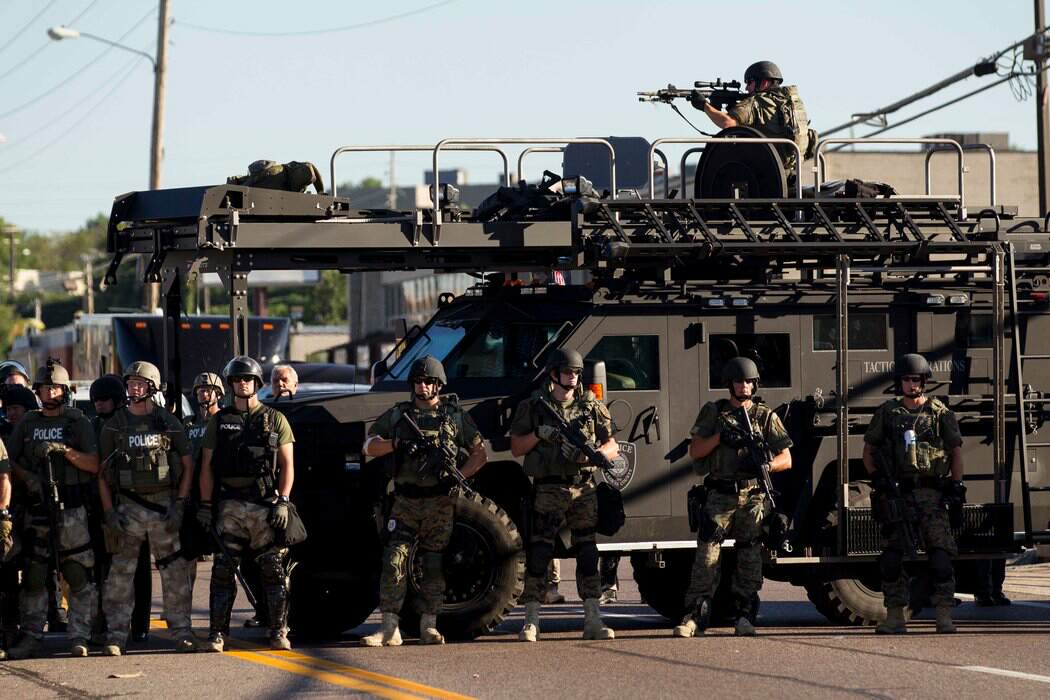
These protests, generalised into an uprising against the institutional racism and inequality that pervades capitalist America, elicited a heavy-handed and violent response by the militarised police. Specialised police units were deployed to confront the protesters. American police forces have been quietly and steadily acquiring military hardware for many years, as well as absorbing the lessons of suppression of civil dissent. Indeed, even mainstream corporate media outlets, such as the Business Insider, have noted the terrifying consequences of the militarisation of police forces:

Militarised police deployed in Ferguson

It is getting increasingly difficult to distinguish police officers from soldiers.

In fact, the residents of Ferguson were confronted not only by heavily armed robocop-style police, but also by a weapon normally deployed in war zones – mine-resistant ambush-protected vehicles (MRAP). Such vehicles have been developed to withstand improvised explosive devices, possess heavy blast-resistant surfaces and reinforced glass, and are used in various types of terrain, whether urban, rural or mountainous. MRAP vehicles, such as the one below, are part of the US military arsenal in Afghanistan, Iraq and were supplied to the Israeli army for use in their latest attack on Gaza:

This is Ferguson - a Latin-Americanised police force
This is Ferguson – a Latin-Americanised police force

Note the sniper at the top of the vehicle, ready to shoot down any person. Such a militarised deployment against a peaceful African American community stands in stark contrast to the softly-softly approach taken by federal authorities in their standoff with the scrounging and racist rancher Cliven Bundy, who has been flouting the American government and laws for so long. Bundy is only the tip of an iceberg – a terrorism problem the United States refuses to acknowledge. White supremacist groups, patriot militia, sovereign citizens groups and other states’ rights outfits have an obsession with guns, openly defy what they believe to be a tyrannical federal government, and spread their hateful views through social and electronic media. One wonders why such a deep malaise is allowed to continue, but the peaceful response of a marginalised African American community to a racist police shooting is met with heavy-handed police repression.

Interestingly, the National Rifle Association, (NRA) whose members are known for their strident denunciations of federal government tyranny and have warned about jack-booted thugs taking over the streets, have remained silent about the display of jack-booted thuggery against the African American population of Ferguson Missouri. The NRA, advocates of citizen sovereignty against an overwhelming government power, have remained conspicuously silent on the unfolding dystopian catastrophe witnessed by the black American community in Ferguson. But somehow, a bigoted rancher parasitically abusing the federal land system is worthy of armed support against attempts to bring him to justice.

While police violence against ethnic minorities in America is sadly nothing new, a number of commentators drew attention to the recent development of a heavily militarised police force. The latter has deployed military-grade equipment and used similar tactics to military forces around the world that have a history of repressive actions against civil dissent. In Counterpunch magazine, Cosme Caal, a community activist and scholar, spoke about the Latin Americanisation of the US police force. In Latin America, the United States actively assisted in the creation of militarised police forces in those countries ruled by tyrannical pro-American military dictatorships. The police became not so much a force for protecting and serving the community, but for policing and suppressing political dissent. Caal notes that this model of policing, fed by impunity from accountability for their actions, now serve as a bulwark of civil suppression. Allowed to imprison, torture and kill without any regard for civilian oversight, the police became a law unto themselves. Equipped with military-style hardware, they became the defenders of the elite and privileged, serving to violently repress any outbreak of unrest among the dispossessed and marginalised.

That model of policing, now being adopted in the United States, is intimately bound up with the deepening economic crisis gripping the capitalist countries. As more people are impoverished, lacking educational and social opportunities, the ruling class is becoming increasingly fearful of social and political unrest. The methods of the US ‘war on terror’, previously applied overseas, are now being practiced domestically. As Sean Ledwith, lecturer in politics and philosophy, wrote in his article for Counterfire:

On the 50th anniversary of the Voting Rights Act and the urban uprising in Watts, American streets once again resounded to the sounds of chanting protesters, tear gas canisters and police banging their shields. The shooting dead of Brown, an 18-year old, on August 9th in the St Louis suburb of Ferguson was the catalyst for almost two weeks of mass protest across the US over the intractable levels of racism that still afflict the country in what is supposedly its post-racial era.

The outrage over police brutality and racial profiling are horribly familiar but what was new about this recent scenario was the militarisation of the state response. Many Americans have made  disturbing comparisons between the scenes they witnessed on their own streets with what citizens in Baghdad, Fallujah, Kandahar and other far-flung locales have endured as the US leviathan has pursued its global projection of power.

The democratic facade of the US capitalist system is being stripped away to reveal the savage financial oligarchy that deploys power to protect its own wealth and privileges.

The comparison to the repression of civilians in Baghdad, Fallujah and Kandahar is apt. However, there is another comparison that needs to be made, in the light of recent events. The toolbox of racist repression in Ferguson can be compared to the tactics and methods used by the state of Israel in Gaza. Israel carried out a direct military assault on the Palestinians of Gaza, that is true, and that was of an intensity and savage magnitude outstripping the police actions in Ferguson. That much is true. However, the similarity in militarised responses, the deployment of barbaric levels of force against civilian populations and the use of mass incarceration indicate that the tools being used underscore the class power and racial hierarchies evident in the Israeli society and the United States. That is the finding of the Common Dreams activists and scholars Corinna Mullin and Azadeh Shahshahani in their article From Gaza to Ferguson: Exposing the Toolbox of Racist Repression.

The authors of the above article note that the United States is a national security state, a state of untrammeled power for the oligarchy, where democratic rights are being tramped, the intelligence apparatus increasingly surveils the wider population, the police act with impunity and constitutional provisions against the abuse of power are ignored, and entire communities, such as the African American community are being criminalised. At the time of writing, it has been over a month since the fatal shooting of Michael Brown, and while the identity of the police officer who perpetrated the crime is known, the authorities in St Louis have so far done nothing to bring the perpetrator and his accomplices to justice. St Louis county officials are delaying justice for the Brown family, and this basically means that justice is denied. It is no coincidence that more commentators are drawing the comparison between Gaza and Ferguson, after all, the United States basically underwrites the Israeli repression of the Palestinians, and violent policing of the occupied Palestinian territories bears remarkable similarities to the policing of the African American community. While America has exported violence overseas, that violence is now coming home.

It is increasingly the case that in the United States, terrorism is perpetrated not by the usual suspects (insert your favourite scapegoat here; Muslims, Arabs, radicals, anarchists, Communists…..) but by the police themselves. When the law enforcers behave in a systematically lawless manner, then this indicates a deeper malaise in the American capitalist system. As the activist Linn Washington wrote in his article for Counterpunch;

Today, politicians, press pundits and preachers across America, portray terrorism as having a foreign face. Yet, for far too many Americans, the terrorists that they encounter daily are the police.

The issues of class and race intersected starkly at Ferguson. President Obama, the first African American president, has now confronted the simmering issues of racial hierarchy reinforced by an underlying class structure in the second term of what was touted as a ‘post-racial America’. In Ferguson Missouri, we may see the weight of history: Missouri is after all shaped by its history as a slave state, the home of the Missouri Compromise of 1820, when pro- and anti-slavery factions battled it out over the issue of slavery. Missouri, one of the states that formed part of the slave-owners’ secessionist Civil War in the 1860s, resisted attempts at integration, and indeed has a long history of implementing Jim Crow laws, that is, legalised segregation. In more recent times, the black community has faced a more covert, underhanded type of segregation, whether it is access to education, restrictions on housing, and disproportionate levels of unemployment as compared to the larger white community. St Louis possesses one of the most segregated metropolitan areas in the United States, and this economic inequality is fueling the anger and resentment of the black community. The spark that lit the fuse was the racially motivated killing of the unarmed African American teenager by a St Louis police force that is still overwhelmingly white.

There is growing recognition that American capitalism is a class-structured society. Until the economic meltdown of 2008, it was near-impossible to discuss the issue of class. The impoverishment of larger and larger section of the population, and the preservation of privileges by the ultra-wealthy, laid bare the essentials of the class war, the war on the poor, that we are witnessing today. However, any discussion of class inequality cannot be separated from a recognition that the United States is a racially stratified society. Back in 1903, W. E. B. Dubois the great African American scholar, activist and first black American to graduate from Harvard with a doctorate, stated that “the problem of the Twentieth Century is the problem of the color line.” In the 21st century, that problem is still with us, and Ferguson demonstrates that the racial divide intersects with and reinforces the class divide. Not only is there systemic economic inequality, but that inequality is perpetuated along colour lines.

The interplay of race and class, and how that feeds the social discontent that erupted at Ferguson require a deeper discussion. That will be the focus of the next article. Stay tuned.


Hamas is fighting the legitimate struggle for Palestinian self-determination

The Islamic Resistance Movement – Hamas is the abbreviation from the Arabic – has constituted the democratically elected government of the Palestinian territories since January 2006. It swept to power in that year, winning a majority of seats in the Palestinian parliament, amidst recognition of the failure of the traditional secular nationalist Palestinian parties, in particular the Fatah party which had dominated the Palestinian leadership for decades. The Washington Post, hardly a friendly voice for the Palestinians, examined the 2006 election results, admitted that they were a stunning blow for Israeli and American officials, and the Palestinian Authority headed by Mahmoud Abbas consolidated its hold in the West Bank thus undercutting Hamas’ chance to assume power in that region.

Israel responded to the election results with economic warfare, imposing a blockade of Gaza, encouraging the Palestinian Authority to move against the incoming Hamas officials, and launched punitive raids into the occupied Palestinian territories in 2006. Israel, with the connivance of the American government, encouraged a mini-civil war between the Fatah group (the main component of the Palestinian Authority) and Hamas. It is no secret that the Bush administration conspired to undermine the democratic election of Hamas, and advised President Abbas to dissolve the Hamas organisation. Hamas was able to respond to these manoeuvres and consolidate its position in the Gaza strip, even with the Fatah-Hamas near-civil war over the 2006 and 2007 period. In June 2007, the split between Fatah and Hamas emerged as a split in the Palestinian government, with Fatah controlling the West Bank, and Hamas remaining in charge in Gaza.

This background is necessary in order to understand the latest onslaught by the Israeli military against the population of Gaza. The Palestinians in Gaza, suffering under an economic siege that has undermined basic living conditions, have been fighting for their very survival.

It is interesting to note that in 2006, immediately after the victory of Hamas in the Palestinian elections, several and repeated attempts were made by the Hamas government to establish diplomatic and economic channels with the United States, the European Union and other countries. The Palestinian Prime Minister, Ismail Haniyeh, wrote to former US President George Bush, offering to recognise the post-1967 boundaries of Israel, and offered a long-term truce. Cata Charrett, writing in an article called Understanding Hamas for the online magazine Mondoweiss, elaborated that Haniyeh proposed a truce, indicating that stability and security were top priorities for his government,  and called for an end to the economic blockade of Gaza on humanitarian grounds.

His letter has remained unanswered until today.

The latest Israeli incursion into the Gaza strip, dubbed Operation Protective Edge, is one part of the long-term strategy of Israel to undermine and demolish the Hamas government, and the chances of building a viable Palestinian state. A ceasefire has taken effect, and at the time of writing is still holding. This provides welcome relief for the people trapped inside Gaza. However, let us make no mistake, the Israelis deliberately targeted civilians, civilian infrastructure, and 2139 Palestinians were killed, 490 of them children. Thousands have been made homeless, with the United Nations stating that 20,000 homes have been rendered uninhabitable by Israeli shelling and air strikes. The Israeli Defence Forces (IDF) deliberately targeted the economic infrastructure, with factories destroyed, farmland ruined, and even livestock killed by aerial strikes. The Stop the War Coalition UK published an account of the devastation of the Gazan economy; croplands decimated, factories demolished and economic activity grinding to a halt:

GAZA’S ECONOMY will take years to recover from the devastating impact of the war, in which more than 360 factories have been destroyed or badly damaged and thousands of acres of farmland ruined by tanks, shelling and air strikes, according to analysts.

The same article continues:

Almost 10% of Gaza’s factories have been put out of action, said the Palestinian Federation of Industries. Most other industrial plants have halted production during the conflict, causing losses estimated at more than $70m(£42m), said the union of Palestinian industries. The UN’s food and agriculture organisation (FAO) said about 42,000 acres of croplands had sustained substantial direct damage and half of Gaza’s poultry stock has been lost due to direct hits or lack of care as access to farmlands along the border with Israel became impossible.

Even with the ceasefire in place, it will takes years for the Gazan economy to recover. Operation Protective Edge was just the latest in a string of Israeli offensives designed to inflict collective punishment, a crime under international law, on the Palestinians. As Palestinian intellectual Professor Rashid Khalidi wrote in the New Yorker magazine, Israeli Prime Minister Netanyahu made it clear during the latest attack on Gaza that his government demanded control of all the territory west of the Jordan river. The land, resources and wealth of that region was to be under Israeli control, nothing less than that. According to Netanyahu, the Palestinians must accept subordination, no question about that. Professor Khalidi elaborated that:

In the past seven or more years, Israel has besieged, tormented, and regularly attacked the Gaza Strip. The pretexts change: they elected Hamas; they refused to be docile; they refused to recognize Israel; they fired rockets; they built tunnels to circumvent the siege; and on and on. But each pretext is a red herring, because the truth of ghettos—what happens when you imprison 1.8 million people in a hundred and forty square miles, about a third of the area of New York City, with no control of borders, almost no access to the sea for fishermen (three out of the twenty kilometres allowed by the Oslo accords), no real way in or out, and with drones buzzing overhead night and day—is that, eventually, the ghetto will fight back. It was true in Soweto and Belfast, and it is true in Gaza. We might not like Hamas or some of its methods, but that is not the same as accepting the proposition that Palestinians should supinely accept the denial of their right to exist as a free people in their ancestral homeland.

Origins of Hamas

Hamas began in the context of the First Intifada (Uprising) by the Palestinians against Israeli occupation in 1987. There were Islamist-based Palestinian organisations prior to the First Intifada in Gaza and the West Bank. But they had been largely marginalised by the superior numbers and organisational capability of the secular nationalist parties, mainly Fatah, the main constituent party of the Palestine Liberation Organisation (PLO). The latter, founded in the 1960s, embodied the hopes and aspirations of the Palestinians, fighting against Zionism and Israeli occupation, and served as an umbrella organisation for the various Palestinian political groups. The PLO was never a socialist group, but it did contain Communist and socialist political currents. The PLO emphasised the complete liberation of all of historic Palestine from the Zionist rule.

However, while the secular nationalist parties like Fatah dominated the Palestinian cause, the religiously-based groups were not silent. The antecedents of Hamas reside in the Egyptian Muslim Brotherhood. The latter can be viewed as the parent organisation, which gave birth to the Islamist parties that eventually spawned Hamas. In 1948, in the immediate aftermath of the Nakba (catastrophe), the Gaza strip was nominally under Egyptian control. The cadres of the Muslim Brotherhood made their way into Gaza, to establish an Islamist counterpart among the Palestinians.

In 1967, when Israel took over the West Bank and Gaza directly, the Muslim groups in those territories merged, and began to organise in coordination. From 1967, the number of mosques and religiously-based schools in Gaza increased, along with social services, charities, helping the needy, medical clinics and welfare groups. The Islamist parties stressed the need to assist the downtrodden, and their standing increased among the people. In 1973, the Al-Mujamma al-Islam (Islamic Centre) was founded. This organisation is the direct ancestor of Hamas. In 1978, the Israeli occupation authority in Gaza formally recognised the Mujamma, this at a time when the PLO was ignored and slandered as a terrorist organisation. How ironic that today, Hamas faces the same snubs and slanders.

The Israelis at this stage looked upon the growth of the Islamist opposition as a necessary and beneficial development, because the Islamist groups provided a strong counterweight to the dominant secular nationalist Palestinian parties. The Israelis encouraged the growth of Al-Mujamma, even recognising it as a legitimate group and providing it funding. While it is incorrect to state that Israel created Hamas, the policy of the Israeli government to cultivate a religiously-based opposition to the secular parties in Gaza helped to lay the groundwork for the rise of Hamas. Israel’s tactic of tolerating the growth of politically Islamist parties corresponded to the wider US strategy of cultivating ties and encouraging the growth of politically conservative Islamist forces, such as Saudi Arabia, as a necessary blockage to the development of secular-based Palestinian and Arab nationalism. Islamist parties were a useful bulwark against the more politicised Arab and Palestinian movements. Clashes between the PLO and Mujamma supporters were not uncommon, and no doubt the Israelis looked upon such clashes with smug satisfaction.

The Mujamma organisation was not political, or at least looked up politics and fighting the occupation as a secondary issue. The main goal and activity of the group was to Islamise the society. New mosques and schools were built, charities started, medical services provided, youth and sports clubs opened, and community activities were associated with the mosque. Throughout the 1970s and 80s, the Mujamma group had been building up the trust and goodwill of the population in Gaza, permeating the social and economic structures of the society, and they were in a strong position to launch themselves as the Hamas organisation in 1987 amid the first intifadah.

Throughout the 1980s, the PLO had suffered a series of defeats, and ended up retreating from their strongholds in Lebanon, relocated to faraway Tunis. While it is out of the scope of this article to examine in detail the reasons for these setbacks, suffice it to note that the PLO leadership began to retreat politically from the core demands of the Palestinian struggle – the return of the pre-1948 refugees, the reversal of all the measures of Zionism, the one-state solution for the whole of Palestine, the failure to address the apartheid-like conditions of the Palestinians in the occupied territories.

As John Rees, organiser with the Stop the War Coalition UK, and editor of Counterfire online magazine states in his article:

The Palestine Liberation Organisation adopted a one-state solution as its aim in 1969. In January 1969 Fatah declared that it was not fighting against Jews, but against Israel as a racist and theocratic entity. The fifth national council of the Palestine Liberation Organisation in February 1969 passed a resolution confirming that the PLO’s objective was ‘to establish a free and democratic society in Palestine for all Palestinians whether they are Muslims, Christians or Jews’. Only successive attempts to compromise with US-inspired peace processes have moved the PLO away from this initial goal.

As the PLO withdrew from these basic demands, their popularity with the Palestinians in the West Bank and Gaza began to diminish. With the weakness of the secular nationalist PLO, the Hamas group was ready to step into the breach. While the Mujamma organisation largely abstained from politics, Hamas adopted an avowedly political approach, and proposed political solutions based on their religion.

Hamas charter

It was in this period of the First Intifadah that the Hamas organisation was established with the explicit political goals, namely the liberation of Palestine from Zionist colonisation, the return of the pre-1948 Palestinian refugees, and the foundation of a new independent Palestinian state. These goals were elaborated, along with the religious basis of Hamas’ worldview, in the foundational charter of that organisation. The Lillian Goldman Law Library of the Yale University Law School has kindly provided the full text of the Hamas charter. Go read the whole document – Hamas Charter 1988 – here it is.

This charter has been the obsessive focus of Israel’s supporters and Hamas’ detractors for the alleged inclusion of the goal of the destruction of Israel. Firstly, nowhere in this charter is that phrase ever used. There is talk about the liberation of historic Palestine, though what that involves is left unresolved by the document’s authors. The charter, written at the time of the first intifadah, represents the political thinking of Hamas at that time. This is the period when Hamas, moving from a purely religious interpretation of the Israel-Palestine conflict to a political one, responded to the realities on the ground. To depict Hamas as an intractable, unyielding menace to the very survival of Israel is more a matter of emotional sensationalism and not based upon a sound understanding of political and economic reality.

Khaled Hroub, director of the Arab Media Project at Cambridge University and a Palestinian refugee, authored a book called Hamas: A Beginner’s Introduction. He addresses the question of the charter, the target of such obsessive propaganda by Israel’s supporters.  Hroub wrote this book back in 2006, when Hamas’ political strategy was paying off electoral success. He states that any suggestion that Hamas, or any other Arab political party, intends on physically destroying Israel is naive and slanderously false. Hamas’ charter is actually irrelevant to the day-to-day operation of that organisation. Hamas has moved into the political sphere, and is responding to the challenges and obstacles of the political process.

In fact, let us clear up another misconception: No, Hamas is not ISIS and ISIS is not Hamas. That is the title of an article by Larry Derfner, feature writer for The Jerusalem Post, as well as the correspondent in Israel for the U.S. News and World Report. No, Hamas is not hell-bent on exterminating every single person that opposes its views, like ISIS. No, Hamas is not targeting ethnic and religious minorities, like ISIS is currently doing. No Hamas does not want to establish a worldwide caliphate, like ISIS intends on establishing. However, Derfner elaborates that the most important difference to note is:

the decisive one between Hamas and ISIS, of course, is that Hamas represents a nation under foreign rule, which means Hamas is fighting a war of self-defense against Israel. ISIS is trying to take over a nation, or nations, that are beset by civil war, so ISIS, being the most murderous, totalitarian and feared of any of the factions, is fighting a war of aggression.

The Hamas charter does contain anti-Semitic statements. It conflates Judaism with Zionism, makes a reference to the notorious and execrable forgery the Protocols of the Elders of Zion, and recycles long-refuted tropes about Jewish monetary influence inciting the French and Russian revolutions, Jewish financial power being a uniquely nefarious originator of major political upheavals. These statements are inexcuseable, but they are also irrelevant, along with the charter itself, because Hamas has developed its politics and worldview from the narrow dichotomy between ‘believers’ and ‘unbelievers’ into a more sophisticated understanding of imperialist politics and the role of western colonialism in creating the tragedy of Palestine.

Hamas has not repudiated its charter, and it has maintained that document as an historical artifact. Indeed, Hamas leaders and documents, especially in the lead-up to the 2006 elections, made no mention of any such calls for the destruction of Israel. Such claims never featured in any election documents, or in its 2006 election manifesto. In the run-up to the 2006 elections, Hamas released its platform to the public. The manifesto maintains its support for armed struggle, opposition to Zionism, and an acceptance of an interim Palestinian state should Israel withdraw to the pre-1967 borders.

It is not unusual for political parties to move away and develop from their original founding documents: the Australian Labour Party has in its founding platform statements that call for the socialisation of the means of production, but the party has implemented economic and political reforms that have paved the road to privatisation and corporatisation of government assets. There are many complex political reasons for this, and the course of these reforms is up for debate. The current ALP leader Bill Shorten has repudiated the description of his party as socialist, and is demanding that Labour further accommodate the needs of big business. The equivalent process overtook the British Labour Party in the 1980s, with that organisation moving away from its socialistic roots and adopted a pro-corporate agenda when in power. Once again, the evaluation of this course can be debated, and is being debated both within and outside these parties.

The purpose here is not to have these debates over again, but to assert that political parties adapt and change according to economic and political realities. However, there is one party in the Middle East that is implementing its charter until today.

The Likud party of Israeli prime minister Benjamin Netanyahu explicitly states in its charter that there will be no Palestinian state west of the Jordan river. The Likud charter goes on to state that the Israeli settlements in the West Bank and Gaza represent the implementation of Zionist values, and constitute an asset in the defence of the state of Israel. Netanyahu’s government has not repudiated this charter, but is actually making it a reality on the ground until today. The latest Israeli offensive into Gaza was another episode of what Israeli officials like to describe as “mowing the lawn”; just as the Palestinians in Gaza get themselves organised into something resembling even the possibility of a viable state, Israel moves in to mow the lawn, undermining any chance of a survivable Palestinian state taking hold.

It is interesting to note that Khaled Meshaal, the Hamas political leader, did state that his organisation was ready to peacefully co-exist with Jews, Christians, and all other ethnic and religious minorities. He elaborated that;

Asked by veteran interviewer Charlie Rose whether he could foresee living beside Israelis in peace, Meshaal said only a future Palestinian state could decide whether to recognize Israel.

“We are not fanatics, we are not fundamentalists. We are not actually fighting the Jews because they are Jews per se. We do not fight any other races. We fight the occupiers,” he said.

“I’m ready to coexist with the Jews, with the Christians and the Arabs and non-Arabs,” he said. “However, I do not coexist with the occupiers.”

Hamas has developed an understanding of the multidimensional nature of the Israeli occupation, and articulated a political opposition to the Zionist project of colonisation. Hamas has accepted the concept of a Palestinian nation state, but not abandoned the more generalised Islamic concept of the Ummah; the wider Islamic community composed of Muslims around the world.

Oslo and beyond

The Oslo Accords, signed in 1993 between the Israeli authorities and the PLO, represented the culmination of a long process of retreat by the Palestinian side. The PLO basically relinquished all the basic demands of the Palestinian liberation movement, while the Israelis made symbolic concessions. It is not necessary to go into the full details of the Oslo accords here; further information can be found in the article by the present author here. The salient point to note here is that the Oslo agreement, while being presented to the world as a mechanism of peace, is actually a device to undermine the legitimate grievances of the Palestinians, and undercut any possibility of an independent Palestinian state. Fatah and the PLO became an instrument of continuing the occupation, albeit by indirect means. Israelis were no longer directly deployed, even though the settlements remained and have expanded. Fatah, which eventually became the Palestinian Authority, was now responsible for policing the Palestinian territories. This abstention of leadership by Fatah allowed Hamas to step up and fill the gap.

The Israeli settlement expansion continued apace after 1993, Palestinian political prisoners still languished in Israeli jails, and the pre-1948 refugees remained stuck in refugee camps. Hamas began to campaign against the terms of the Oslo agreement, which they portrayed as capitulation to the occupiers. By 2000, with the eruption of the second major Palestinian intifadah, disillusionment with the Oslo process and the Palestinian Authority ran high. Hamas emerged as the undisputed leader of the uncompromising demands for Palestinian liberation. Its work among the poor, its social welfare services and educational programmes, and its unwavering commitment against the Israeli occupation won it adherents, and translated into electoral victory in 2006.

There are many criticisms to be made about Hamas’ underlying religious perspective, its stance on women, socially conservative positions on abortion, contraception, same-sex marriage, all the usual issues that involve the debates between the secular and religious. In this, Hamas is no different to the similar debates that occur in the Christian-majority countries, like the United States, Australia and Britain. The point to emphasise hear is that while Hamas is struggling for the survival of the Palestinians, it is the duty of all humanitarian people to support its legitimate fight against the Israeli assault and blockade of Gaza. To use a parallel example, the international community’s support of the East Timorese people’s struggle for independence did not hinge upon the East Timorese giving up their traditional Catholic faith. Hamas is fighting the honourable fight.

Mustafa Omar, an Egyptian socialist explains, support for Hamas is unconditional, but not uncritical. Hamas is fighting against a barbaric enemy, a powerful military force that is deployed against civilian infrastructure in Gaza. The disproportionate use of unrelenting force by the occupying power, Israel, is lost amidst a barrage of emotionally sensationalist claims about Hamas rocket attacks, fired randomly as a desperate defensive measure which may cause civilian casualties. Hamas militants have carried out rocket attacks, that is true. Israel has used the entire Gaza strip and the Palestinian trapped inside as guinea pigs for testing its military technology, with Israel being the largest per-capita arms exporter in the world. Israel can rightly claim that its weapons work successfully in combat, having been used in Gaza with maximum impact.

Having tested their weapons against a defenceless civilian population, Israeli armaments manufacturers sell their wares to the highest bidder. All this business activity could not be done without the partnership of the United States. As the Stop the War Coalition UK explained;

The Israeli arms industry operates in close cooperation with its bigger sister in the US. The military aid the US gives to Israel ensures this cooperation, and every conflict in the Middle East contributes more to the profits of US arms giants (such as Boeing, General Dynamics, Lockheed Martin, and Raytheon) than to the Israeli arms companies.

What has Hamas proposed in the middle of all this death and destruction? The activist and author Medea Benjamin lists the practical demands raised by Hamas while the latest Israeli assault on Gaza was occurring:

  • Withdrawal of Israeli tanks from the Gaza border
  • Freeing the prisoners arrested after the killing of the three youths
  • Lifting the siege and opening the border crossings to commerce and people, under UN supervision
  • Establishing an international seaport and airport under U.N. supervision
  • Increasing the permitted fishing zone to comply with international norms
  • Reestablishing an industrial zone and improvements in further economic development in the Gaza Strip

Benjamin explains that these proposals are not only reasonable, but a basis for constructing a durable peace settlement. It is time to talk with Hamas as a serious negotiating partner, and stop libellously dismissing it as a fanatical, uncooperative terrorist organisation. Hamas has based its appeals to the wider community on international laws and human rights, laws that the United States government has routinely broken. Hamas speaks for the Palestinians of Gaza – let us listen to them seriously.


Israel’s latest attack against the Palestinians – Gaza today resembles the Warsaw Ghetto of yesterday

Israel’s latest incursion into the Gaza strip, entitled Operation Protective Edge, is part of the long-term strategy of the Israeli state to blockade and collectively punish the Palestinians in that territory. Since 2006, the Israeli military and state has been maintaining a complete land, sea and air imprisonment of the Gaza strip Palestinian population, a retaliatory response to the democratic election of the Islamist movement Hamas as the government of the Palestinians. The blockade of Gaza has resulted in a humanitarian catastrophe for the Palestinians, with the United Nations Office for the Coordination of Humanitarian Affairs (UN OCHA) documenting the terrible consequences of this tactic. Back in 2009, the UN OCHA released a report stating that the Palestinians, locked inside one of the most densely populated areas in the world, are suffering a prolonged crisis, denying them basic imports, food, medicines, economic activity, the resultant unemployment, and breakdown of infrastructure. The Palestinians are living in conditions that are basically suffocating them, undermining the basic services and necessities for survival. The updated and ongoing reports of the UN OCHA can be found here.

Access to the Gaza strip is tightly controlled by a system of heavily reinforced military checkpoints, the main crossings between Israel and Gaza opened only with the permission of the Israeli authorities. Egypt’s military rulers, General Sisi, does his part in blockading Gaza, helping to imprison the Palestinians as punishment for their election of Hamas, the Islamist political party aligned with and borne out of the Egyptian mother organisation, the Muslim Brotherhood. The military dictatorship in Egypt has effectively sided with Tel Aviv in the latter’s latest offensive against Gaza, though this decision has earned condemnation from international quarters.

The continued strangulation of the Palestinian population in Gaza has eerie parallels with a similar episode during World War Two, an episode that has come to typify the savagery of that conflict, but also serve as an emblem of the resilience of the human spirit. The Warsaw Ghetto, deliberately established by the Germans after their invasion of Poland, served the function of an open-air prison for the surviving Polish Jewish population. This ghetto was blocked off from the rest of the city, enclosed by fortified walls, and access to the ghetto was strictly controlled by military checkpoints. Jewish organisations inside the ghetto tried to meet the basic needs of the imprisoned population, as all imports, movement of goods and services, economic activity and trade were all severely restricted by the Germans.

In 1942, the inhabitants of the Warsaw ghetto, through the various political parties that organised them, decided to rise up and resist the Germans, knowing full-well that they faced militarily superior forces. The Germans deployed the overwhelming might of their military to raze the ghetto to the ground. The heroism of the defenders, suicidal in their bravery, has gone down in legend as one of the most emotionally uplifting, terrifying and emblematic episodes of the twentieth century. The Warsaw Ghetto uprising makes for fascinating and moving reading. As the Australian socialist activist and intellectual John Passant states “The Warsaw Ghetto Jews had no chance of victory. But they fought to restore their humanity and to show that the Nazis were not unbeatable.”

The direct comparison of Gaza today with the Warsaw Ghetto of yesterday is not the sole invention of the present writer. The online magazine Counterpunch published an article in July 2014 entitled Gaza and the Warsaw Ghetto. The author of that article lists the basic similarities in tactics used by the Israeli state of today, and the German state of yesterday. For instance, read the following lines from the beginning of the article:

THE WARSAW GHETTO WAS THE LARGEST OF ALL THE JEWISH GHETTOS IN NAZI-OCCUPIED EUROPE DURING WORLD WAR II.  The Gaza Strip is the largest Palestinian ghetto in the Middle East and among the most densely populated parts of the world.

THE GERMANS CLOSED THE WARSAW GHETTO TO THE OUTSIDE WORLD IN 1940.  Israel disengaged from Gaza in 2005, but maintains exclusive control of Gaza’s airspace and territorial waters.  It controls the movement of people and goods in or out of Gaza.  As a result, the European Union and Human Rights Watch as well as agencies of the United Nations consider Gaza to remain occupied by Israel.

UNEMPLOYMENT WAS A MAJOR PROBLEM IN THE WARSAW GHETTO, AND OVER 100,000 RESIDENTS OF THE GHETTO DIED DUE TO DISEASE OR STARVATION.  The Israeli and Egyptian blockade of Gaza has devastated the economy and caused a shortage of basic medicines and medical equipment. In 2010, British Prime Minister David Cameron said that “humanitarian goods and people must flow in both directions.  Gaza cannot and must not be allowed to remain a prison camp.”

Another similarity between the tactics of the Israelis today and Germans yesterday is the formation of a ‘buffer zone’ in the north of Gaza. Israeli forces, during the latest assault on Gaza, demolished the suburbs that are within a three-kilometer area that is continuous with the Israeli border. The Germans created ‘buffer zones’ in the areas they occupied in Europe, the Israelis implemented a so-called ‘security belt’ in the south of Lebanon when they occupied that country back in 1980s. The security zones failed to achieve their objectives.

Of course historical analogies can be pushed too far, and comparisons can be drawn that are wildly exaggerated. However, it is clear from the conduct of the Israeli authorities against Gaza that the parallels with the Nazi German treatment of the Warsaw Ghetto are comparable and instructive.

Counterpunch magazine published another article in  July 2014, drawing out the explicit comparison between the Gaza territory and the Warsaw Ghetto. Dave Lindorff, an American activist of Jewish background, wrote that ‘Once it was the Nazis Leveling the Warsaw Ghetto; Now it’s Israel’s IDF Leveling Gaza’. He writes that the Israel Defence Forces are deliberately targeting hospitals, mosques, heavily populated areas and the casualties number women and children. The scale of the assault on Gaza, backed up by a widespread racial animosity throughout Israeli society, incited by various politicians and military figures. Lindorff explains that:

And like the horrific case of the destruction of the Warsaw Ghetto, here too we have a small-scale, improbable, resistance being put up by fighters who use home-made rockets, small arms and a network of tunnels to challenge their much better armed attackers. We also have people — ironically this time it’s Jewish citizens of Israel — dragging lounge chairs and refreshments out to hillsides in the evening to watch the fireworks as the IDF’s tanks, bombers and ships off the coast of Gaza pulverize this huge ghetto that is fully under Israeli control.

The comparison between Gaza and the Warsaw Ghetto helps us to understand that this is not a fight between equally matched military forces. The Palestinians, represented by Hamas, are definitely the outmatched and out-gunned party, responding to a military occupation and siege that intends to force them into submission. Israel possesses one of the most powerful, computerised, high-tech military forces in the world – a navy, air force and army that is more than a match for any of its neighbours. The weapons, drones, military hardware and computer software that enables Israel to conduct its attacks on the Palestinians come from the United States and Britain primarily. The United States has willingly provided the F-16 fighter jets and Apache military helicopters that Israel is using to assault Gaza. The US replenishes the parts for armoured vehicles, replaces the spent ammunition cartridges, and provides the Howitzers that Israeli forces use in their continued offensive in Gaza.

Let us not forget the complicity of Britain in Israeli crimes – the drone technology, targeting systems and ammunition currently deployed by the Israeli forces were manufactured by British armaments companies. As explained by a report in The Independent newspaper, republished by the Stop the War Coalition UK;

Among the manufacturers given permission to make sales were two UK companies supplying components for the Hermes drone, described by the Israeli air force as the “backbone” of its targeting and reconnaissance missions. One of the two companies also supplies components for Israel’s main battle tank.

The Hermes drone has been widely used during Operation Protective Edge, the ongoing Israeli military action in Gaza, to monitor Palestinians and guided missile strikes.

There is no mistaking the complicity of the United States and Britain in the crimes of the Israeli military, and their role in enabling the latter to continue the siege of Gaza is a crime in itself. Stop the War Coalition UK published the statement signed by hundreds of intellectuals, activists and prominent campaigners (among them South African Archbishop Desmond Tutu) stating that the western powers who arm Israel are complicit in the crimes of the Israeli state.

Seumas Milne, expert political commentator for The Guardian newspaper, states it plainly in his column; “Gaza is a crime made in Washington as well as Jerusalem.” The carnage unleashed by Israel’s powerful military would not be possible without the active cooperation of the imperial powers, in particular the United States and the United Kingdom. The majority of those targeted, and the majority of Palestinian casualties, are civilians. Israel’s leaders, Milne explains, are attempting to ‘mown the lawn’, a favoured description of their repeated offensives against the Palestinians in Gaza over the years. However, things have not gone according to plan. Not only was the rate of Hamas’ rocket fire unaffected, but the rate of Israeli military casualties, in comparison to their earlier wars, has increased dramatically.

John Rees, one of the conveners of the Stop the War Coalition UK, summarised the results of an article published by the respected IHS Janes security and defence magazine called ‘Palestinian militants inflict substantial casualties on Israeli forces in Gaza’. The Israeli ground troops, unlike previous campaigns, faced an enemy that did not melt away, but stood up and fought on their home ground (much like the imprisoned population of the Warsaw Ghetto). John Rees explains that in contrast to the previous Israeli attack on Gaza, Operation Cast Lead, the numbers of Israeli soldiers dying has greatly increased. During Operation Cast Lead (December 2008 – January 2009) ten Israeli soldiers died, four of them in friendly-fire incidents. During the most recent assault on Gaza, 53 soldiers have been killed.

Interestingly, Janes notes that with the new unity bewteen Hamas and the Palestinian Fatah movement, greater coordination and scope for the resistance has been the benefit. Hamas has adopted the training it has received from the Hezbollah party:

A key element of Hamas’s performance in this regard appears to be its emulation of the tactics of Lebanese Islamist group Hizbullah. A senior official in Hamas’s armed wing, the Izz al-Din al-Qassam Brigades, speaking to IHS Jane’s on condition of anonymity on 22 July, stated, “We have benefited from all the Iranian, Syrian, [and] Hizbullah tactical combat schools, and finally formulated [a] Qassam independent one that matches our situation and [leaves us] capable to respond to our enemy’s challenge.”

The costs of this incursion are starting to weigh heavily on the minds of the Israeli leaders. Make no mistake though, the suffering of the Palestinians has been, and continues to be, horrendous beyond description. However, just like the fighters in the Warsaw Ghetto, the Palestinians have taken the fight to the occupier, inflicting casualties and causing enough pain for the occupying forces to rethink their position. Indeed, as Paul Rogers’ article in the Stop the War Coalition UK notes, Israel withdrew its ground troops from Gaza because it was losing, facing the stubborn resistance of a population refusing to be cowed. Rogers explains that:

The Jewish population of Israel is about one-tenth of the population of the UK. This means that the proportional losses in twenty-eight days exceed the UK’s combined losses in six years’ fighting in Iraq and twelve years in Afghanistan.

The attack on Gaza is sadly not over, by no means. However, as Rogers has stated, the IDF has confronted a war of surprises, with Hamas, far from crumbling but actually maintaining its support among the population.

One of the stated reasons for Israel’s incursion into Gaza is to stop Hamas from firing rockets into Israel proper. Hamas has certainly fired into the Israeli state – but from November 2012, which ended Operation Pillar of Defence, until July 2014, Hamas did strictly observe the ceasefire. Israeli forces continued their aerial warfare however, striking any target they deemed was a threat or military installation. As Eric Ruder from the Socialist Worker explained in his article “Resistance is justified when Gaza is occupied”:

During this time, Israel continued to carry out air strikes against whatever targets it deemed legitimate, and Israeli snipers fired on–and killed–farmers if they strayed too close to the Israeli-designated “buffer zone” along the Gaza-Israel border. The terms of the cease-fire also stipulated that Israel would lift its blockade of Gaza–which instead intensified, especially after the Egyptian military took over power after toppling Muslim Brotherhood President Mohamed Morsi a year ago.

The nature of Hamas, its political program and vision, its origins and current situation, were only lightly touched on in this article. Setting the record straight about Hamas, obtaining a clear picture of this political party, and responding to the egregious lies perpetuated against by the Israeli political establishment and its supporters, is the subject of the next article. Stay tuned.


What do Detroit and Iraq have in common? Both are the targets of disaster capitalism

The title above comes from a thoughtful and perceptive article by Margaret Kimberley, writer and activist with Black Agenda Report. Her essay called ‘The Plunder of Detroit and Iraq’ was republished in the Common Dreams online magazine, a nonprofit reader-driven independent news outlet dedicated to building a progressive community, an antidote to the corporate-controlled media. Kimberley accurately points out that disaster capitalism, driven by the imperative of corporate profits, has created and is responsible for the humanitarian catastrophes that we are now witnessing in Detroit and Iraq. Kimberley starts her essay by stating that ‘the ugly face of empire and disaster capitalism is visible all over the world’.

Detroit deindustrialised

Detroit exhibits all the classic signs of a city that has been systematically deindustrialised over many decades. Once the hub of the car industry in America, a city that exemplified the best US labour, industry and technology, Detroit is now a bankrupted city, with urban decay, declining infrastructure, a diminishing population, and a financial system that is preserving its own wealth while leaving the residents to struggle with making ends meet. Dollars and Sense magazine, which publishes articles on economic justice, critiques of the mainstream bourgeois economics and primers on economics for activists, published an extensive analysis of the decline of Detroit back in 2013. The authors of that article correctly note that there were the standard conservative-driven reasons given for the blight of Detroit – greedy unions, incompetent black American politicians, people taking easy loans from the big banks knowing that they could ill-afford repayments. Perhaps all of these are partially valid.

However, the major share of the blame for the deindustrialisation and subsequent decline of Detroit rests on the shoulders of the corporate class, the owners of the large multinational corporations, the large financial institutions that not only systematically withdrew from Detroit and undermined the living and working conditions of the majority of people. The new financial managers of Detroit, led by the emergency manager Kevyn Orr, are deliberately shifting the cost of the financial burden onto the working people. Detroit’s plan of adjustment, introduced by the city’s creditors, involves privatisating the city’s public assets, massive cuts to pensions and health services, the sell-off of the electricity and sewerage systems, and most scandalously of all, selling off the assets of the Detroit Institute of Arts. In the meantime, the residents of Detroit will have to continue living in squalid conditions, recorded in a photo-essay here.

Meanwhile in Iraq

The nation of Iraq lies in tatters, fractured by sectarian divisions enshrined in the post-2003 invasion political establishment. The country underwent terrible destruction as a result of sanctions, and they took their toll on the population. Food, medicines, the necessities of life were denied Iraqis as they struggled to overcome the destitution brought on by crippling sanctions. For instance, water purification became virtually impossible, because chlorine was banned as an import. What happens to drinking water if it is not regularly purified? What bacterial diseases spread when water supplies become contaminated?

Iraqis bravely resisted the US invasion, and brought the troops of the marauding empire into defeat. So the US empire, just like the Roman empire of old, resorted to the tried-and-true tactic of divide and rule, inflaming sectarian divisions by rewarding political office on the basis of religious affiliation. The current Iraqi Prime Minister, Nouri al-Maliki, was installed with US support, even though his political party has strong ideological ties to Iran. Maliki implemented the sectarian division of the country, worsening relations between Iraq’s ethnic and religious communities. Meanwhile, he did nothing to restore the once-functioning health and electricity systems that made Iraq a standout in the Arab world.

The Baghdad government is now tottering precipitously on the brink of total defeat, after its much-vaunted and American-sponsored army was routed by the Islamist guerrillas of the Islamic State of Iraq and Syria (ISIS). While this is a stunning defeat for American (and British) foreign policy in Iraq, the ISIS guerrillas, buoyed by a burgeoning Sunni insurgency that began back in 2013, will only worsen the sectarian hatreds that are currently inflicting damage on the country. Margaret Kimberley of the Black Agenda Report correctly notes that the Islamist guerrillas, once financed by Washington, represent a growing threat not just to the American empire’s interests in the region, but also undermine the existence of a corporate-viable Iraqi state that can be subjugated to imperial dominance.

The invasion of Iraq was driven by deep capitalist interests intending on exploiting the vast mineral and economic resources of the Arab region. The plunder of Iraq, just like the devastation of Detroit, is designed to enrich a tiny financial minority class while the majority are left to struggle to their own devices. Margaret Kimberley points out in her article that;

Iraq was invaded with soldiers, guns and bombs. Detroit was invaded by the corporate “suits” who made a fast buck for themselves. The end result is the same for Michiganders and Iraqis alike. They end up suffering in a plundered society while other people make out like the bandits that they really are.

The Obama administration, while marketing itself as an anti-war government, has actually continued to expend resources on propping up and extending the imperial reach of the US empire, while impoverishing the American people at home. The demolition of viable societies in Iraq and Detroit are not the result of any innate human propensities, but rather the end result of a specific political programme to enrich a capitalist financial oligarchy at the expense of working people. As Kimberley explains in her essay:

…millions of Americans live an existence far from the myth of the great country. They are struggling to survive just like millions in the so-called third world. It is the gangsters who run the show in Baghdad and in Michigan too.

It is time to overthrow this criminal regime. Go read Margaret Kimberley’s full article here.


The Iraq war can no longer be ignored; the fall of Mosul and the end of imperial delusions of grandeur

The fall of Mosul, the second largest city in Iraq, to the Islamist guerrillas of the Islamic State in Iraq and Syria (ISIS), represents not just a defeat for the Iraqi army and the US-supported regime in Baghdad. It also stands as the end of a whole set of US imperialistic policies, designed to bring Iraq under its total control. The seemingly sudden dissolution of the Iraqi army in Mosul is a defeat for US imperialism that shatters decades-long policies that formed the backbone of US conduct in the Arab world, delusions of imperial grandeur and empire-building that must now be brought to an end. The capture of Mosul, Iraq, by Islamist rebels and Iraqi Sunni insurgents is a defeat for US imperial empire-building, on the same magnitude as the scattering of the remnant forces of the misnamed Republic of Vietnam from Saigon in 1975.

**************************

Only a few months ago, on this blog, the current author made note that the eleventh anniversary of the Iraq invasion was studiously ignored by the corporate media, promoting the impression that Iraq, while still having some remaining problems, has largely settled down into a functioning society. The implicit message in ignoring that anniversary was that the architects of the 2003 invasion were generally vindicated in their decision to go to war. Former UK prime minster Tony Blair, one of the main enthusiasts for the Iraq war, has made numerous comments in the media, defending his decision to lead Britain into the American-driven invasion.

All these imperial delusions have come crashing down, as the Iraq war literally exploded, and the consequences of that invasion are plain for all to see. The decision by the US and Britain to unilaterally invade Iraq has resulted in the destruction of that society. The seizure of Mosul by forces loyal to ISIS, represents the collapse of the US imperial project in Iraq.

The 2003 invasion, launched on the false pretext that Iraq possessed ‘weapons of mass destruction’, intended to install a regime that was compliant with US and British business interests. The Maliki regime, composed of CIA assets, pro-American politicians, war profiteers, and associated Kurdish warlords, now stands humiliated and in tatters, its armies refusing to fight the Iraqi insurgency. American and British imperial hubris stands condemned, as the army on which they spent billions of dollars proved ineffective in responding to insurgent attacks. As Jeremy Corbyn, MP for Islington North in Britain has stated, the overrunning of Mosul, followed by the quick seizure of other cities by the Iraqi insurgents, represents the unravelling of a century of imperialism. Focusing on the oil and gas resource of Iraq, and the wider Middle East, the US and Britain wanted to expand their economic and military influence across the region, and have devastated Iraqi society in the process. This set of policies now stands condemned, as the consequences of imperial intervention threaten to engulf not just Iraq, but the region as well.

Capture of Mosul

Patrick Cockburn, the veteran foreign correspondent for The Independent newspaper, detailed the initial fall of Mosul to the ISIS, and the subsequent developments in the rest of Iraq. His articles, republished in Common Dreams, are a valuable resource for an up-to-date analysis of the political and economic situation inside Iraq. Cockburn states that while ISIS guerrillas provided the front-line ‘shock troops’ in the capture of Mosul, they are just one component of a more generalised Iraqi, largely Sunni, uprising against the pro-American regime in Baghdad. While the emergence of ISIS as an important factor in Iraqi politics heralds the rise of an Islamist program for Iraq, the seeds of rebellion against the Maliki regime go back to 2012-13. Since 2013, peaceful, political demonstrations have been occurring against the sectarian policies of the Baghdad government. The latter responded with violent repression, and thus drove thousands of Sunnis into the arms of the insurgent groups.

The social and economic grievances of the Sunnis were ignored by Maliki, and he resorted to brutal, oppressive measures (much like President Assad in neighbouring Syria) to suppress any resistance to his rule. The Sunnis, disenfranchised and excluded economically and politically by the Baghdad government, have been agitating for a number of years to end the sectarian order established after the 2003 invasion. The growing Sunni revolt, documented by Cockburn, demonstrated that the Maliki regime had no popular support or legitimacy outside Baghdad and the associated Shia militias that have helped to prop up that government. Maliki was bound to fail to gain any traction for his heavily sectarian project. A number of different insurgent groups, some ex-Ba’athist officers, Iraqi nationalists, and others have all joined in the armed rebellion and helped in defeating the Iraqi army in Mosul and other northern Iraqi cities. As Patrick Cockburn stated, ISIS was not the only Sunni militant group to rise up; it was part of a multi-pronged, carefully coordinated armed uprising that left the Baghdad government aghast and paralysed by inaction.

The fall of Mosul, and the ease with which it was captured by the insurgents, confirms that Baghdad had no political support, and its army refused to fight for it. Thousands of Iraqis did flee the fighting in that city, and the mass movement of refugees increased as town after town fell to the ISIS guerrillas. Iraqis, particularly from the ethnic minorities, are wary of the brand of extreme Sunni fundamentalism and the vision of a caliphate promoted by ISIS. However, not all Mosul residents feared ISIS, in fact, they were more worried about the prospect of barbaric Iraqi army counterattacks. One resident informed The Guardian newspaper that:

I feel we have been liberated of an awful nightmare that was suffocating us for 11 years. The army and the police never stopped arresting, detaining and killing people, let alone the bribes they were taken from the detainees’ families.

“Me and my neighbours are waiting for the news that the other six Sunni protesting provinces falling in the hand of the Isis fighters to declare our Sunni region like the three provinces in Kurdistan.

It is not just The Guardian that is reporting this sentiment from Mosul residents. The loyal lapdog of the US empire, the New York Slimes, covering the ongoing offensive by ISIS in northern Iraq, reported that ordinary Iraqis were unified in their opposition to the Maliki government. The New York Slimes recorded the reaction of Iraqi and American officials to the scale and speed of the ISIS-insurgent uprising:

As the dimensions of the assault began to become clear, it was evident that a number of militant groups had joined forces, including Baathist military commanders from the Hussein era, whose goal is to rout the government of Prime Minister Nuri Kamal al-Maliki. One of the Baathists, Izzat Ibrahim al-Douri, was a top military commander and a vice president in the Hussein government and one of the few prominent Baathists to evade capture by the Americans throughout the occupation.

“These groups were unified by the same goal, which is getting rid of this sectarian government, ending this corrupt army and negotiating to form the Sunni Region,” said Abu Karam, a senior Baathist leader and a former high-ranking army officer, who said planning for the offensive had begun two years ago. “The decisive battle will be in northern Baghdad. These groups will not stop in Tikrit and will keep moving toward Baghdad.”

The lack of support for the Maliki regime is a searing indictment of the political system established by the Americans, and their associated Iraqi collaborators, since the 2003 invasion. The institutionalised sectarian division, the main feature of the Baghdad government, has further worsened relations between the Sunni and Shia communities, and between the Muslim-majority and the Christian minorities. The Shia parties, such as the Islamic Dawa party of which Maliki is a leader, failed to be inclusive and build political support among the population. The reason that the Iraqi army dissolved so quickly is that nobody was willing to take up arms and sacrifice their lives for a despised regime.

ISIS, an offshoot of  Al Qaeda, advocates a Sunni fundamentalist vision, and works to establish a caliphate in the areas that it controls.  Whether it has the support of  the local population for its narrow platform of a Sunni fundamentalist, religiously-based political order remains to be seen. However, since taking Mosul in June 2014, residents have reported that life is returning to normal. Time magazine reported that the residents of Mosul are getting on with their jobs, resuming their businesses and that life is actually getting somewhat better. In spite of the warnings of the implementation of strict, literalist interpretations of Islamic Sharia law, residents are reporting an improved atmosphere. From the Time magazine article is the following snippet:

“Do you know how it was in Mosul before ISIS came? We had bombings and assassinations almost everyday. Now we have security,” said Abu Sadr, who asked to be identified by a nickname, from his home in Mosul’s Hay Al Sukar neigbourhood. “I’m going to work, going to the market, like normal, and people are coming back to the city.”

According to Abu Sadr it is basically life as usual in Mosul. There is little of the tyrannical Islamic Sharia enforcement the group’s name has become synonymous with. Abu Sadr has seen Pakistani, Afghani and Syrian fighters amid the Iraqi ISIS recruits, but says the fighters have yet to adorn the city with their signature black flag. They fly them only above their checkpoints, which some residents say are fewer than the army had there, two weeks ago.

The fact that ISIS rule is seen as less threatening, even though the Islamist guerrillas espouse a brand of extreme Sunni chauvinism, indicates the widespread hostility to the Maliki government. This does not mean that the sectarian nature of ISIS is to be downplayed; far from it. But this does demonstrate that the central state in Baghdad offered nothing to the people in Mosul and other parts of the country.

Sectarian order comes crumbling down

However, this does not mean that ISIS will be any more successful than Maliki in restoring the basic services necessary for a functioning society. Though they are off to a good start; Mosul has a consumer protection office where people can air their grievances, amnesty has been offered to those from the security services should they lay down their arms, and social services are being provided. However, while Mosul, Tikrit, Fallujah and other cities have fallen easily, Baghdad will not be so easy. As Professor Juan Cole writes, the insurgents have picked a fight they cannot win in Baghdad, if they do not appeal to the Shia masses in the south of the country. Without a power base to sustain them, the Iraqi insurgents can cause damage, make some gains in Baghdad, but they cannot win the city on their own steam. Grand Ayatollah Ali Sistani, the pre-eminent Shia authority in Iraq, called on all Iraqis, regardless of religious orientation, to rise up and organise a sturdy defence of Baghdad against the ISIS guerrillas. Thousands have responded to the call. Various Shia religious parties, including the Mahdi Army, the militia of the Sadrist bloc headed by nationalist cleric Moqtada al-Sadr, are forming brigades to defend Baghdad and the holiest Shia shrines located in the south of the country from attacks by ISIS.

It is interesting to note that Sistani, while a Shia, did not include any reference to jihad, or any sectarian appeals, in his statement. He specifically asked that Iraqis join the national army, not private or political-party-based militias, and he appealed to a sense of patriotism and nationalism. He went so far as to call ISIS ‘terrorists’, a designation not taken lightly in the political climate of the Arab and Islamic worlds. He reiterated that the defence of the country was paramount. This message, coming from an important and revered religious figure like Sistani, is important because it demonstrates that Arab nationalism still has a resounding resonance in Iraq. Sistani did not directly mention Maliki, but in his pronouncements, it is clear that Sistani is finding fault with the sectarian political order that arose in the aftermath of the US invasion.

Responsibility for the current crisis resides with the imperialist powers

The Iraqi state is going through its worst crisis since the worst days of the Iraqi insurgency and subsequent sectarian warfare in the mid-2000s. Maliki and his associated Shia politicians certainly shoulder a heavy burden of blame for the current impasse. Maliki and his Shia sectarian policies have resulted in a state where the main institutions of the army, police, parliament, and associated militias are controlled by Shias. But this is only one part of the story. The ultimate responsibility for the sectarian fracturing of the country lies with the policies of the United States. As Ashley Smith of the Socialist Worker newspaper writes, “The principal cause of this crisis is three decades of U.S. imperial policy that culminated in Bush’s 2003 invasion.” In his extensive analysis, Smith notes that the first Gulf War of 1991, followed by years of crippling sanctions, devastated a functioning society that provided healthcare, education and services for its citizens. Iraq never fully recovered from deleterious effects of the 1991 aerial bombing campaign, a programme of aerial warfare on a par with the Allied bombing of German cities during World War Two.

It is true that sectarianism existed prior to the 2003 invasion. The Ba’athist party built a Sunni top-heavy state, with the top levels of political and military power going to Sunnis. The lucrative government contracts to conduct business were usually awarded to Iraqi Sunnis. However, each town had its own mix of religious and ethnic groups, and there was nothing like the fratricidal sectarian warfare that we see today. The responsibility for the explosion of sectarian violence in Iraq resides directly with the US and Britain, fomenting ethnic and religious divisions in order to fragment a determined opposition. The traditional tactic of divide and rule was implemented by the US occupation authorities, backed up by savage repression. In an article written in 2013, Ashley Smith of the Socialist Worker explained that the US adopted the Lebanese model for Iraq, attempting to Balkanise the country, exacerbate ethnic tensions and apportion power according to sectarian loyalty. Sectarian polarisation was not the product of ‘ancient hatreds’, or the result of a ‘clash within a civilisation’ as the New York Slimes columnist David Brooks once opined.

As Sami Ramadani, Iraqi exile and senior lecturer in sociology at the London Metropolitan University explained, the sectarian hatred is promoted by the imperialist powers, and this partition would be a recipe for endless wars. Iraq is not a random aggregation of disparate ethnic and religious groups all straining for the first opportunity to slaughter each other, Ramadani elaborates in his article. He does not spare the Ba’athist party from blame, criticising its Arab-centric ideology and its marginalisation of the poorest segments of society. The Ba’athist party had no love for the Kurds, and possessed a strong anti-Shia undercurrent in its political operations. The largest mass political organisation, and the most multicultural, was the Iraqi Communist Party, until decimated by Ba’athist repression in the 1970s.

Ramadani reserves his most scathing criticism for the US invasion and its aftermath, holding it responsible for the worst upsurge of violent sectarianism in Iraq’s history. Ramadani wrote that;

The most serious sectarian and ethnic tensions in Iraq’s modern history followed the 2003 US-led occupation, which faced massive popular opposition and resistance. The US had its own divide-and-rule policy, promoting Iraqi organisations founded on religion, ethnicity, nationality or sect rather than politics. Many senior officers in the newly formed Iraqi army came from these organisations and Saddam’s army. This was exacerbated three years ago, when sectarian groups in Syria were backed by the US, Turkey, Saudi Arabia and Qatar.

It is this officer class that this month abandoned Mosul and a third of Iraq’s territory to the terrorists of Isis, beefed up by thousands of foreign fighters, members of Saddam’s Ba’ath party, and the Islamic party (a branch of the Muslim Brotherhood). It has also become clear that leaders of the Kurdistan regional government have expanded their control and implemented a de facto ceasefire with the sectarian insurgents.

Iraq’s partition would only benefit the arms manufacturers, oil companies and war profiteers.

The ultimate responsibility for the calamitous state of Iraq today lies with the long history of imperialist interference in the Arab and Islamic worlds. The 2003 US invasion is just the latest in a long line of imperialist interventions, starting with the redrawing of boundaries at the end of World War One, without the consent or input of the Arabic-speaking peoples. As the Ottoman Turkish empire collapsed, Britain, France and the other powers rushed to carve out spheres of influence for themselves, with the Arabs and Kurds failing to gain self-determination.

Mick Armstrong, writing for the Red Flag newspaper, correctly observes that the imperialist states, determined the dominate the resource-rich areas of the Middle East, resorted to divide-and-rule tactics, propping up proxy forces that were amenable to their economic and political interests. Armstrong writes of how the British, given the mandate to govern Iraq, formed alliances with friendly pro-British Arab forces, installing a puppet king from the Hashemite clan as their ruler in the newly formed Kindgom of Iraq. Whenever the Iraqis rose up to resist this arrangement, as they did in the 1920s, the British resorted to aerial bombing to bring the recalcitrant indigenous people back into line.

Sectarian policies, implemented by the United States, are only the latest incarnation of imperialist meddling in Iraq. The sordid consequences of this long history of violent interventions by outside powers is now plain for all to see. The capture of Mosul is not only an indictment of the US occupation’s divide-and-conquer strategy and inflammation of sectarian tensions. It is also a searing indictment of the 2003 US invasion, an invasion that is still causing casualties, because it destroyed an otherwise functioning society. The crimes of imperialism in this region are becoming more glaring in the light of the debacle the US has suffered in Iraq. As Seumas Milne of the Guardian explained in one of his many articles on Iraq, the Arab and Islamic worlds are living with the disastrous consequences of imperialist attempts to control their resources and futures.

The Iraq war was not just some ‘tragic mistake’ or ‘error in judgement’ as many corporate media pundits would have us believe. It was a deliberate, coldly calculated predatory crime that resulted in millions of deaths, the outflow of refugees, and the poison of fratricidal sectarianism taking hold. While ISIS is a takfiri, Sunni fundamentalist group that will be unable to appeal to a broad segment of the Iraqi population over the long run, the political and economic order against which they are fighting is a criminal regime born of a violent occupation and sustained by rampant sectarianism. The grievances of Iraqis against imperialist interference in their affairs are real and legitimate. It is time to listen to the Iraqis and let them determine their own future.


John Pilger’s Utopia – uncovering the heart of darkness in the ‘lucky country’

Pilger’s latest documentary about the ongoing plight of the first Australian nations is confronting, powerful and disturbing. Every Australian should watch it.

**********

The fiercest critic of my writings and constant reader of this blog is comrade Sonia. She frequently berates me for not writing about the country of my birth, Australia. She contends that I spend too much energy and attention on international issues, and not nearly enough time on important issues at home. Well, after much careful thought, comrade Sonia is absolutely right. This one is for you.

**********

Back in the 1970s when I was in school, we participated in school activities and ceremonies commemorating Anzac day. While we did not attend school on the actual public holiday, the following school day involved lessons about the Anzacs. Part of the commemorations required getting all of the senior students to salute the Australian flag. We lined up alongside the flagpole, watching the fluttering Union Jack being raised, and we dutifully saluted as it was hoisted in silence. The school assembly would listen to readings of stories about the Anzacs, the Australian soldiers who served in overseas wars, usually at the service of an imperialist power, as cannon-fodder, fighting and dying under the flag that we saluted.

Little did we know that there was another war, a war that was never explained to us, but a type of warfare directly relevant to our experience as Australians. It was a war conducted on our continent, the consequences of which are still with us today. This war is ongoing; the tactics may have changed, but the effects are just as deleterious.

Some forty years later, I watched a screening of Utopia, the latest documentary by veteran Australian journalist John Pilger. This is the fourth time that Pilger has explored the issue of the first Australian nations, documenting the genocide, dispossession and brutality of the English war of conquest and its continuing effects. Utopia is a powerful, searing indictment not only of the British invasion and subsequent dispossession of the indigenous nations, but the ongoing denial of that war and the continuation of that occupation by other means. The fact that indigenous Australians still suffer lower life expectancy than non-indigenous Australians, die from vaccine-preventable diseases in greater numbers, and live in squalid, decrepit conditions in outback Australia is not only documented by Pilger, but also stands as an indictment of the wilful ignorance of these conditions by the wider Australian community.

Pilger cleverly takes episodes from the lives of Australians, both indigenous and non-indigenous, to demonstrate his case that widespread ignorance and racism still pervade the wider white Australian community. A revealing segment in the documentary is when Pilger, on the misnamed ‘Australia Day’ in 2013, walks through the streets of Circular Quay in Sydney, asking random people why they are celebrating on a day which should rightly be remembered as the beginning of an invasion. The vox pops-style street questioning is a tactic at which Pilger is brilliant. He asks one man, his face dutifully painted with Union Jack flags and wearing appropriate ‘Aussie’ flag t-shirt, why he is celebrating this Australia Day. Stunned, the man belligerently asks why Pilger is bothering with such a question. As Pilger explains that actually 225 years ago on this day, the invasion and dispossession of the indigenous people began, the man sneers, turns away and dismisses Pilger with the phrase ‘see ya later mate’. He reserves one last parting shot for Pilger; out of the side of his mouth he arrogantly spat out the words ‘you’re full of shit…’, and with that the conversation ended. White Australia still has difficulty facing up to the reality of how Australian capitalism was built, and how it is continuing to suppress the first Australian nations.

Utopia is a community that Pilger visits. It is located some 200 kilometres north-west of Alice Springs. Indigenous families live here in ramshackle buildings, with no running water inside, no transport, no regular health service and no electricity. Infectious diseases are rife due to the unsanitary conditions, and the health care workers allocated to this community are doing their best with the limited funding and equipment they have. The kitchens, toilets and bathrooms, if they can be called that, are malfunctioning and unhygienic. It is not uncommon for families to sleep outdoors with mattresses on the ground. Cockroaches and pest infestations are regular occurrences, with cases of cockroaches crawling into the ears of adults and children.

This is the economic and social chasm that divides non-indigenous Australians from the first nations. As a contrast to the impoverished, Dickensian conditions of the indigenous people, Pilger takes a trip to Palm Beach, located in the northern suburbs of Sydney. He interviews a hotelier at that beach, whose hotel has rooms overlooking the waterfront. She proudly explains to Pilger that during peak times, she has a brisk business, charging 30 000 dollars per week for the choicest rooms. Yes, 30 000 dollars per week.

Pilger takes aim at the false pretenses and devastating consequences of the Howard-era 2007 NT intervention, a campaign to reassert and extend the authority of the Australian capitalist state, and its business interests, over land that belongs to indigenous communities. After a media campaign composed of lurid, sensationalised – and completely false – allegations of pedophile rings forcing indigenous children into sexual slavery, former Prime Minister John Howard launched a military-police intervention, driving indigenous communities off their land, suspending the operation of the Racial Discrimination Act, eroded the social welfare measures, pitifully inadequate as they are, available to indigenous people, and opening up vasts tracts of land to commercial exploitation.

It just so happens that the Northern Territory is incredibly rich in natural resources, particularly uranium. The mining companies, the large transnational corporations that dominate the Australian economy, were beneficiaries of this intervention. While the Howard government began this intervention, the subsequent Labour governments of Rudd and Gilliard did nothing to stop it. Subsequent investigations into the allegations of child sexual abuse in the indigenous communities found no evidence of pedophile rings, sexual slavery or child trafficking. The central justification of the intervention was demolished, yet the policies implemented in its wake continue.

Pilger reveals a side of indigenous struggle rarely commented on by non-indigenous Australians – industrial action by organised working class indigenous workers. Pilger interviews Arthur Murray, a cotton picker who along with his comrades, went on strike in the 1970s for equal pay and to protest dangerous working conditions. Indigenous workers were always paid lower than their white counterparts, working in unsafe conditions, while turning a profit for the Australian companies that exploited the resources of indigenous land. Murray and his fellow workers were dismissed as Communist troublemakers and agitators. Pilger emphasises the struggle by the indigenous stockmen employed at Wave Hill cattle station, where in the mid-1960s, Gurindji stockmen walked off the job for equal pay. It was the longest strike action in Australian history, lasting from August 1966 until 1975. The Whitlam government at the time finally handed back at least a portion of the cattle station land to the indigenous Gurindji owners. The divisions of race, always important in Australian capitalism, are based upon and magnified by the divisions of class. Pilger does talk about the mining companies, those corporations that exploit the resources of this land, but continue to deny the presence and rights of the original owners.

There is so much more in Pilger’s documentary, that you have to see it for yourself. As part of the larger colonial-settler project of occupying Australia, skin colour became an obsessive preoccupation. Race and racial divisions were invented to further widen the antagonism between the first nations of Australia and those who have come from overseas. I referred to the heart of darkness in the title of this article; and this expression has usually been used to refer to the darkness of the conquered people, whether they be the indigenous people of Australia, or in the context of the colonisation of Africa, the dark-skinned inhabitants of that continent.

But Pilger’s documentary taught me that this obsession with race is completely distracting and unnecessary. The heart of darkness has nothing to do with skin colour; the darkness is the imperialist project itself, the building of a settler-colonial society on the backs and suffering of the original nations, whether in Australia, Africa, or Israel for that matter. The darkness is in our minds and hearts, not in the colour of anyone’s skin. Constructing an unequal economic and political system, reserving privileges for a tiny minority class of financial-energy-banking oligarchs, while the majority sinks into poverty, is the dark ideology enveloping our society. Denying justice to a dispossessed people, undermining their ability to work, live and educate themselves, reveals a dark fanatical ideology at the heart of Australian capitalism. Pilger calls this the secret history of Australian apartheid.

After watching Utopia, it is clear to me that the Australian flag, its Union Jack, is a butcher’s apron. I will not be saluting it anymore.


Do not believe the hype about recovery – unemployment and inequality are persistent and growing

Previously on this blog, the current author wrote about the issue of unemployment, and how it operates as the revolving door of the capitalist system. Following on from this subject, it is necessary to examine how unemployment has not only become recurrent, but also how the sheer scale of the problem, and the longevity of unemployment periods, have increased.

An article in the Workers World newspaper entitled “Marxism and long-term unemployment” has prompted an examination the role and impact of unemployment more closely, in particular, the increase in inequality. The article above references the work of economist Heidi Shierholz of the Economic Policy Institute, in particular her article on “Is there really a shortage of skilled workers?”

This article demolishes the myth, peddled by the corporate class and their media mouthpieces, that workers are unemployed because of a skills mismatch. The capitalist-corporatist class claims that workers do not have the necessary matching skills, or a wide enough range of skills, to meet the demands of the job market.  The study conducted by Shierholz found that no matter what the skill level of the workforce, unemployment has sharply increased over the years 2007 to 2013. Quote from the Workers World story;

The unemployment rate for workers with less than high school education was 10.3 percent in 2007 and 15.9 percent in 2013. For high school graduates, the unemployment rate was 5.4 percent in 2007 and 9.6 percent in 2013. For workers with some college, the unemployment figures jumped dramatically from 4.0 percent in 2007 to 7.3 percent in 2013; for college graduates, it went up from 2.4 percent to 4.5 percent and for those with advanced degrees, it went from 1.7 percent to 3.2 percent, that is, almost double.

Courtesy of the Workers World newspaper article, we have the following chart, which demonstrates that at all levels of educational achievement, workers are experiencing high periods of unemployment:

High levels of unemployment

So no matter what the level of education achieved by the individual worker, unemployment remains high relative to 2007.

We can see the following chart from the Shierholz study;

High level of unemployment in all occupations

High unemployment is afflicting workers in all occupations, not just some selected industries. And it is not just that workers are being laid off in increasing numbers. The number of job openings is shrinking, while the number of unemployed is rising.

Shierholz, like the other economists at the Economic Policy Institute, is a Keynesian. That is not necessarily a bad thing when it comes to analysing the capitalist market, but it does mean that the fundamentals of the capitalist orthodoxy remain untouched. The extent to which the capitalist economy has recovered since 2008 can be gauged by the following observation; the ruling class has still accumulated wealth, while the rest of us are struggling with unemployment, poverty and a growing difficulty to make ends meet. It is a recovery for the rich, but recessionary conditions for the rest of the population, as Richard Escow put it in an article for Common Dreams. The majority of us have missed out on sharing the wealth from this alleged recovery, and this leads to the next point – you do not have to be a Marxist to understand that we are being fooled by the one percent into believing that we are participating in this recovery – but it helps. Those are the introductory words of an article by Professor Richard Wolff, an emeritus professor of economics at the University of Massachusetts, Amherst. While the large banking and financial corporations have recovered, indeed increased, their profits since 2008, the rest of us contend with high and persistent unemployment.

The purpose of citing the statistics above is to refute a long-standing claim of the capitalist economists; namely, that those who live a comfortable lifestyle and have ‘made it’ are the deserving recipients of wealth rewarded for their hardwork, business intelligence and financial wherewithal. In other words, the current unequal relations in the capitalist system reflect a meritocracy, where only the most diligent and conscientious are rewarded with financial success. That leads to the following conclusion, that those who are poor have only themselves to blame. Their laziness, lack of financial knowledge and apathy are the root cause of their dire financial circumstances.

Any discussion of persistent mass unemployment has to address the inequalities reproduced by the capitalist system. In the Socialist Worker online newspaper, Dylan Monahan wrote an article entitled ‘Snapshots of inequality’. In this overview, Monahan provides a compilation of observations about the growing levels of economic inequality in the United States. Responding to the claim that workers, through persistence and financial knowledge can lift themselves out of the working class and into the ruling elite – what economists grandiosely call ‘intergenerational earning elasticity’ – Monahan points out that the United States, and indeed the other European capitalist countries, has very low social mobility. In fact, it is social immobility that has become a defining feature of the capitalist system.

The snapshot of inequality provided by Monahan in his article also contains another compelling observation;

Since the 1970s, the productivity of U.S. workers has only increased while hourly compensation has remained more or less the same. This yawning gap between productivity and wages benefits the richest 1 percent, which owns 42 percent of the country’s financial wealth. The bottom 80 percent of the population, by contrast, owns barely 5 percent.

Taken together, these figures tell us that U.S. workers have worked harder and harder over decades, while gaining nothing more in wages–in fact, they have lost ground as a consequence of the Great Recession–nor in the financial wealth their labor produces.

It is not the case that the American worker has become ‘lazy’ or ‘inefficient’ and thus deserving of their impoverished status. You may find the detailed explanation that higher productivity does not result in higher wages here on the Washington Post’s economics and politics blog, hardly a bastion of pro-Communist Bolshevik propaganda.

The recovery hype serves multiple purposes – lulling the 99 percent into a false sense of security, soothing the anxieties of bourgeois economists whose careers have been built on promoting capitalist economics as the only sensible course, and reassuring those of us who are suffering that recovery is just around the corner and achievable. This has not meant that the recognition of unemployment and inequality has gone away – US President Barack Obama admits that poverty and inequality are still major issues in his speeches for public consumption. However, the explanation of the persistence of these problems is always reduced to the individual – after all, capitalism is a meritorious system, where the hardworking are justly rewarded, aren’t they?

There is another explanation about how and why unemployment persists at such high levels. This explanation was first elaborated more than one hundred years ago by a certain German philosopher and political economist. In his voluminous works about the capitalist system, he elaborated that the unemployed are a ‘reserve army of labour’, temporary workers to be used and discarded according to the imperative of profit maximisation by the capitalist class. Full employment is never the normal state of the capitalist system, notwithstanding the rhetorical commitment to such a goal by the politicians. Since the 2008 economic debacle, his analysis regarding the law of capitalist accumulation has received renewed consideration. The working class are partially replaceable by new technologies, automation and software. A portion of the workers can retrain and find some employment with the new technology, but the overall trend is to replace people with technological adaptations, robots and algorithms. Economic recoveries are increasingly jobless, with greater numbers of workers unemployed for longer periods. To understand unemployment and inequality in the capitalist system, we can do no better than by starting with the writings of the following person;

The heavyweight champion of the world