Shakespeare comes to Baghdad – the Iraq war continues

William Shakespeare (1564-1616), the great English playwright and dramatist, wrote a number of historical plays concerning various periods in English history. These plays are not as well known and less-frequently performed than his comedies, tragedies and romantic works. One of his main historical plays is Henry VI (Parts one, two and three). The play examines the course of English political and social life after the death of King Henry V, and the effects of English losses in the Hundred Years’ War. England had lost the bulk of its territories in France, and the political repercussions in England manifested themselves in a series of intrigues and machinations by various factions of the English ruling class. These conflicts reached a head with the Wars of the Roses, when two competing branches of the one royal family (the Plantagenets) fought an inter-dynastic civil war for political and economic supremacy.

Parts Two and Three of the Henry VI trilogy examine the role of the King, his inability to stabilise the political situation, the arming of the various rival houses (Lancaster and York), and the eventual explosion of armed conflict. It is a gripping, tumultuous series of plays, at once enthralling and disturbing. The infighting among the English landed nobility in the wake of English losses of land and resources in France is portrayed sharply by Shakespeare, and evokes powerful emotions. What happens to the ordinary people of a country when its ruling class fragments into warring factions? After inciting English nationalism for a war of conquest in France, once the territories are lost, all nationalist feeling evaporates. The welfare of England as a nation is no longer the paramount objective, but the advancement of the narrow, sectional interests of various factions of the dynastic clans that made up the ruling elite of England.

What is the relevance of this historical play for contemporary times? Patrick Cockburn, the expert foreign correspondent for The Independent states it plainly:

Want to know what Iraq is like now? Check out ‘Henry VI’, parts I, II and III

That is the title of his article in The Independent online newspaper, where he examines the eerie similarities between the conflict for supremacy in Baghdad with the historical account of the fight for victory within the English ruling dynasty during the Wars of the Roses. The corporate media has largely ignored the human tragedies of the Iraq war since 2008, mainly because of a well-crafted myth; the surge. The addition of an extra 30 000 American troops in Iraq back in 2007, so the story goes, successfully reduced insurgent attacks on US troops, providing extra muscle to deal with the Iraqi insurgent groups. Actually, as Mike Whitney explains in his article in Counterpunch, the ‘surge’ was a publicity exercise aimed at disguising the shift in tactics of the American military. What actually occurred was the ethnic and sectarian cleansing of Baghdad. Whitney goes on to detail how the US political and military leadership, faced with a stubborn insurgency that could not be defeated, changed tactics to one of ethnic divide-and-rule. The US created sectarian-based death squads from the local population, mainly from the Shia community, and sent them to fight and torture insurgents.

The change in tactics was not accidental, because the US has vast experience in training and arming para-military death squads that operate outside the law – they have been using this tactic for years in many Latin American countries. In fact, the main American military commander in Iraq at the time, General David Petraeus, employed Colonel James Steele, a retired US Special Forces veteran. Steele has had vast experience in death squad tactics, because he actually studied and implemented counterinsurgency warfare in El Salvador back in the 1980s. Now the Pentagon is (ostensibly) investigating the links between the torture chambers in Iraq and the political and military leadership of the United States. There cannot be any cross-sectarian reconciliation in Iraq until all the details about the torture chambers and death squads of the US dirty war in Iraq are fully exposed and culprits punished.

The irony of the situation is that prior to the 2003 American invasion of Iraq, there was no sectarian animosity. Various ethnic communities mingled, intermarried and did business together. Under the rule of Saddam Hussein, a Sunni privileged-elite did emerge, but that was based more on the political loyalty to the Ba’athist party. To advance in Ba’athist-dominated Iraq, joining the military or the police was the surest way to gain steady employment and benefits.

With the 2003 invasion of Iraq, the US military and political command fueled sectarian hatred in order to divert the energies of the largely Sunni-led insurgency. What has all this got to do with the surge and the apparent reduction in US casualties? As Mike Whitney explains in his Counterpunch article, the main Shia insurgent force, the Madhi Army led by nationalist and populist cleric Muqtada al-Sadr declared a ceasefire for a year. The US military authorities bought off a section of the Sunni insurgency by enlisting them in so-called ‘Awakening Councils’ to attack and defeat al-Qaeda linked groups. The systematic ethnic cleansing of Iraqi Sunnis from Baghdad, carried out by the Shia-dominated regime of current Iraqi Prime Minister Nouri al-Maliki, was well underway in 2007 and 2008. These factors combined succeeded in reducing the number and intensity of attacks on US troops. The vaunted ‘surge’ did have a purpose;

the surge was used to cover an equally-heinous war crime, the massive ethnic cleansing of Baghdad’s Sunni population, millions of who were either killed, tortured or forced to flee to Jordan or Syria.

The entire article by Mike Whitney can be read here in Counterpunch online.

Failure to address the crimes of ethnic cleansing, torture and rendition makes a mockery of US claims to have brought democracy to Iraq. The recent protests, mainly by Iraqi Sunnis, have attempted to combat the sectarianism of the Maliki administration and has gained the support of the Shia cleric and politician Muqtada al-Sadr. Into this political powder-keg, Sunni extremist groups (linked to the petro-monarchies in Saudi Arabia and Qatar) are trying to stoke the fires of a Sunni-based sectarian backlash. Reconciliation will be impossible unless the criminal role of the United States is fully revealed and the perpetrators brought to justice.

Let us make one last observation; David Frum, the Bush-Cheney administration speechwriter and author of the now-famous phrase ‘Axis of Evil’, has just written an article confirming what the anti-war movement stated was the main motivation of the American drive to war. The anti-war activists were routinely vilified, ridiculed and slandered for even daring to suggest one overriding motivation for the US to occupy Iraq. While all wars have multiple motivations and agendas, reflecting the priorities of the various factions of the ruling class, the one claim for this Iraq war (the claim most stigmatised and attacked) has now been confirmed by Frum; Iraq would be an additional reservoir of oil as an alternative to exclusive dependency on Saudi Arabia.

Read the whole article by Glenn Greenwald here.

Let’s not forget that Iraq is still the issue

Patrick Cockburn, veteran foreign correspondent for the Independent newspaper and analyst of Middle Eastern politics, has written a stinging article about the current deplorable state of political and economic affairs in Iraq. Ten years after the 2003 American invasion, Iraq remains a deeply fractured state, with the Shias in power but not in control of a country wracked by poverty, the breakdown of social services and mired in corruption. Cockburn rightly emphasizes that the international community, preoccupied with the Syrian civil war, has forgotten that Iraq is still facing a humanitarian tragedy. Cockburn’s article was reprinted in the political online magazine, Counterpunch.

Cockburn begins his article with a stark assessment:

Iraq is disintegrating as a  country under the pressure of a mounting political, social and economic crisis, say Iraqi leaders.

They add that 10 years after the US invasion and occupation the conflict between the three main communities – Shia, Sunni and Kurd – is deepening to a point just short of civil war. “There is zero trust between Iraqi leaders,” says an Iraqi politician in daily contact with them. But like many of those interviewed by The Independent for this article, he did not want to be identified by name.

While the new ‘liberated’ Iraq technically acquires 100 billion dollars in oil revenue, most of that money disappears into the pockets of a corrupt political-military bureaucracy, financial contractors and speculators. There is construction going on in Baghdad – of military outposts and police stations. However, in the working class district of Sadr City, Cockburn found frequent flooding and untreated sewage, with all the health consequences that this state of affairs entails.

This kind of corruption – Cockburn calls it ‘institutionalized kleptocracy’ in another of his articles –  means that all Iraqi ‘governments’ installed by American military forces have failed to provide electricity, clean water or sanitation to its residents, something that was unthinkable under the Saddam Hussein regime. The autonomous Kurdistan region in the north, while presented as an economic model, is also riven with corruption and theft of public funds. The privatisation of the oil sector, legislated by the American-backed Kurdish political parties, has provided wealth to a minority, while the facade of progress is maintained by the rise of skyscrapers and visits by foreign delegations from the UAE, Turkey, Germany and France. As one Kurdish critic of the regime put it to Cockburn:

“We are making the same mistake with the Turks today as we did with the Americans and the Shah in 1975. We are once again becoming over-reliant on foreign powers.”

For all their professions of independence, let us not forget that the Kurdistan Regional Government (KRG) still depends heavily on obtaining a share of Iraqi oil revenues proportionate to its population. While Kurdish influence in Baghdad has fallen, the KRG has built economic and political links with the old enemy, Turkey – a counterweight to Baghdad, but successive Turkish governments have had no hesitation in using their armed might to kill and suppress the autonomous Kurds in the north of Iraq. The Kurds have pursued deals with foreign oil corporations, but Iraqi Prime Minister Nouri al-Maliki has stated that if the KRG follows through with their plans, they will face the Iraqi army.

Prime Minister Maliki rules the country as an autocrat, relying on the Shia-dominated, heavily sectarian police and army to brutally crack down on protests and dissent. The use of secret prisons, torture chambers and widespread police presence is well documented in Maliki’s Iraq. It should come as no surprise that ‘democracy’ is just a catchphrase in Iraq today, because the Maliki regime has had training and support from the experts in police repression and torture – the United States. The Guardian reported earlier this month that high-level Pentagon officials were responsible for arming and training the Iraqi units responsible for the torture and repression of dissidents throughout the 2006-07 stages of the Iraq war. General David Petraeus in particular is a veteran of counterinsurgency wars, having learned his craft in Latin America, and implementing the same death-squad techniques in Iraq in the 2000s. As Cockburn goes on to explain, Prime Minister Maliki:

He (Maliki) has sought to monopolise control over the army, intelligence service, government apparatus and budget, making sure that his supporters get the lion’s share of jobs and contracts. His State of Law Coalition won only 24 per cent of the votes in the 2010 election – 2.8 million  votes out of 19 million registered voters – but he has ruled as if he had received an overwhelming mandate.

The current Iraqi regime, boxed inside the Green Zone, makes no secret of its sectarian allegiances. Shia slogans and pictures dominate the landscape, and the Sadrist movement, headed by cleric and nationalist Muqtada al-Sadr, maintains a fractious alliance with Maliki. While the Sadrists are driven by nationalistic and populist considerations, they are wary of instigating an intra-Shia civil war. The Sadrists combine social activism with an intense religious piety, and are seeking to transform themselves from an insurgent army (they did the heavy fighting back in the 2004-08, inflicting serious defeats on the Americans) into a respectable political and social force in the country. The Sadrists and their social base strongly oppose the Maliki regime’s monopolisation of power in the army and police, but against attempts to bring down the current power arrangement. The Shias are in power, but they are divided and not necessarily in control in today’s Iraq.

The blame for the current parlous nature of the Iraqi nation must be placed firmly on the shoulders of the United States ruling class. The 1990s witnessed an eruption of American militarism, part of which was the 1991 attack on Iraq. Through the use of its weaponry and subsequent economic sanctions, the US wanted to reduce a reasonably industrialised and educated Arab society to a pre-industrial level. The invasion of 2003 brought untold misery and suffering for the Iraqi people, with the reduction of health care, education, and interestingly a sharp reversal of the position of women in Iraqi society. The Iraqi people have paid a terrible price for the depredations and attacks of US imperialism. Since December 2012 however, there have been ongoing protests by Iraqis against the precarious situation, demanding their rights in a non-sectarian, democratic way.

Go read Patrick Cockburn’s entire article in Counterpunch here.

Unresolved issues, Fallujah and Iraqi protests

The Washington Post, the ‘liberal’ mouthpiece of the US ruling class, published an interesting article earlier this month examining the latest round of protests to erupt in Fallujah, Iraq, against the current Iraqi regime of Prime Minister Nouri al-Maliki. In similar tactics used by other Arab protesters in this Arab Awakening, the mainly Sunni demonstrators in Fallujah have risen up because of unresolved grievances since the armed truce of 2008-09 and the purported withdrawal of American forces in 2011. Although the US withdrawal was accompanied with great fanfare, the US has mandated a more discreet, clandestine presence in Iraq through its intelligence services, special force operatives and armed mercenaries. The withdrawal was more about removing the immediate, direct presence of the US and rebranding the occupation in more disguised form. But make no mistake, the withdrawal of US forces from the major cities of Iraq represents a serious defeat for US policy in that country.

The current peaceful protests in Iraq, triggered by the sacking and suppression of Iraqi Sunni politicians in Maliki’s coalition government, actually reflect wider political and social grievances that stem from the destructive US invasion of that country and the failure of the current Iraqi government. The Sunni Iraqis feel disenfranchised and ignored by the current Maliki administration, and have campaigned to remove the sectarian influence of the Shia-dominated Baghdad government. Maliki has accused the protests of being orchestrated by external powers, namely the Sunni regimes of Qatar and Saudi Arabia. His accusations are unfounded and reflect a desperate attempt to deflect attention from the real, unresolved grievances of the Iraqi population. The protesters denounce the sectarian hostility of the Maliki government, the widespread corruption and use of torture, the lack of employment and education, the breakdown of basic social services, and the general economic downturn that has afflicted Iraq since the US invasion.

The Iraqis on the streets of Fallujah are motivated by the historic and unbroken line of Iraqi Arab nationalism. The Iraqi people have carried out several nationalist uprisings throughout the twentieth century. The Iraqis first rose in 1920 against the British colonial regime and its puppets, the royalist dictatorship of King Faisal I. In 1958, the British-supported monarchy was overthrown in a nationalist revolution, and ushered in the period of Republican Iraq and Ba’athist Party political domination. It is no secret that the rise and rule of Saddam Hussein, a Ba’athist official, was supported and nurtured by US intelligence agencies, namely the CIA. Hussein was a key asset for the United States throughout the 1980s in Iraq’s long and savage war against Iran. The Ba’athist party controlled the police state apparatus of the regime, and committed its worst crimes against the Iraqi Kurds and Shias while receiving military arms and largesse from the imperialist powers. The Ba’athist regime promoted Iraqi nationalism, through its educational policies, identifying the Babylonian and Islamic heritage of the country with the Hussein regime.

The first American attack on Iraq in 1991, and the subsequent sanctions regime, reduced the economic and social health of the country. But the 2003 US invasion brought death and destruction to a relatively developed society, destroying the electricity, health and education infrastructure of the country. The American-installed regime, having swept out the Ba’athist Party from power, resorted to extreme violence, torture and sectarian killing to suppress the population. After the mass insurgency by the Iraqi people throughout the mid-2000s, the Maliki regime came to an arrangement of sorts to end the immediate violence and include various Shia militias in a new political setup. However, Maliki is entirely dependent on the United States and Iran, the latter having gained an increased presence in the country with the removal of the Hussein regime. Iraqi government forces, trained and armed by the United States, have attacked the recent protests.

It is important to view these protests not just as a ‘Sunni’ concern, but rather a resurgence of Iraqi Arab nationalist political motivation. The demands of the protesters are not confined to a purely sectarian viewpoint – they are articulating basic demands for an improved economic and political system. Among their list of demands is the release of political prisoners, and end to torture and the death penalty, the provision of health and electricity services to impoverished communities, to stop corruption and to fight against sectarianism.

Patrick Cockburn, writing in Counterpunch, has explained that this revolt is motivated by domestic concerns, grievances that have remained unaddressed since the 2003 US invasion of Iraq. He writes that Maliki does not have the force to suppress this revolt;

It is unlikely the Maliki government would succeed where Saddam and the US failed. It has military superiority but not dominance in Iraq, fully controlling only about half the country. It has no authority in the Kurdistan Regional Government’s three provinces or in the Kurdish-held disputed territories further south. Its authority is contested in the Sunni majority provinces and cities in western and central Iraq.

Go read Cockburn’s complete article here.

The Iraqi revolt has demolished the myth peddled by the corporate media that the Iraqi war is ‘all over’. The protesters are responding to the unhealed wounds and divisions caused by the US occupation and its compliant tool, the Maliki regime. They give hope that the Iraqis are rising up to assert their legitimate demands to repair the damage done by the US war and sectarian division.

The prime minister, the weapons salesman and the hypocrite

The British Prime Minister, David Cameron, traveled to the Persian Gulf countries back in November 2012, the royalist dictatorships that make up the Gulf Cooperation Council. He spoke to the rulers of the various petro-monarchies, including the United Arab Emirates and Bahrain. Speaking to the media, he defined the purpose of his trip – to encourage British weapons sales to those regimes, to smooth over any difficulties that British armaments manufacturers might have in their dealings with the Gulf states, and to increase lucrative contracts for the British Aerospace systems company (BAE). The Guardian newspaper elaborated on the trip, stating that:

“Speaking to students in the UAE’s capital, Abu Dhabi, Cameron said: “I’m a supporter of the Arab spring, the opportunity of moving towards more open societies, more open democracies, I think is good for the Middle East, for North Africa.”

The same story in the Guardian explained that the British government, while paying lip service to the Arab awakening, values its most important strategic allies in the Gulf region, namely regimes such as Saudi Arabia, Bahrain and the United Arab Emirates. Saudi Arabia and the Gulf countries have been generous recipients of British military hardware, and Cameron did his best as a traveling weapons salesman and prime minister.  In fact, Cameron was quite unapologetic about British arms sales, stating that the UAE should replace its declining fleet of French-supplied Mirage jets with the latest hardware from Britain. In 2009, Saudi Arabia assisted the Yemeni government to violently suppress anti-government demonstrations in that country by lending Yemen UK-built fighter planes and military equipment. Saudi Arabia also assisted the violent crackdown of the Bahraini uprising in 2011, and all the while the corporate media minimised the brutality of the Bahraini government’s suppression. The British government sold millions of pounds worth of military hardware directly to the Bahraini state during the 2011 political unrest. Cameron met with the Bahraini King in London during the 2011 London Olympics, where King Hamad bin Isa Al Khalifa was an honoured guest.

The British foreign secretary, William Hague, opined that while his government had raised concerns about the appalling human rights record of the Bahraini and Saudi Arabian regimes, he assured the House of Commons that Saudi forces were only sent in to Bahrain to guard military installations and not to participate in the suppression of demonstrations. Apparently Saudi forces were just helpless bystanders, caught up in defending the fragile Bahraini dictatorship from the maelstrom of violence unleashed by the anti-government demonstrations. Hague continued:

On Saudi Arabia, Hague said the government had raised concerns about its treatment of women and foreign workers. But 99% of Britain’s exports to the kingdom consisted of Typhoon jets. “They are not relevant to our concerns about these rights,” the foreign secretary said.

Early in January 2013, PM Cameron made a quick trip to his friend and ally, the petro-monarchy of Saudi Arabia, to discuss further economic and political cooperation. The question of weapons sales was top on the agenda, but their discussions also encompassed the growing spheres of energy and security cooperation. The BBC article explained the importance of the visit:

Saudi Arabia is the UK’s largest trading partner in the Middle East with annual trade worth £15bn a year. It has £62bn invested in the UK economy.

Without a hint of irony, Cameron went on to deplore the ‘appalling bloodshed’ on the streets of Syria, and called for renewed efforts by the Arab League to deal with the tyrannical regime of Bashar al-Assad.

When George Galloway, Respect Party MP and sitting member for Bradford West, asked the Prime Minister why the government fully supported the ongoing French intervention in Mali against supposedly ‘Islamist extremist’ groups, but was quite happy to continue its support of Islamist extremist groups that are waging a war against the Syrian regime of Bashar al-Assad, Cameron sneeringly dismissed Galloway’s question, and attacked the latter as a supporter of Arab dictators. Apart from being a perverse accusation by Cameron, the British PM is studiously ignoring (or outright denying) that support for dictatorships in the Arab world is precisely long-standing British government policy.

Glenn Greenwald stated it plainly – the smear tactic used by Cameron, tarnishing opponents of war and militarism as apologists of dictators – shuts down debate and avoids the crucial issue. Opponents of the 2003 American invasion of Iraq were branded ‘Saddam supporters; those who opposed the NATO intervention in Libya were derided as ‘Gaddafi supporters;’ and fifty years ago, those who campaigned against the American war on Vietnam were maligned as ‘communist dupes’. By suppressing debate on the imperialist powers and their policies in the Arab and Islamic world, we are engaging in an act of self-delusion and hypocrisy, seeing US and its associated allies (such as Britain) as a force for ‘good’ in the world. When it comes to supporting dictatorships in the Arab countries, surely there is no better advocate for those regimes than David Cameron. Interestingly, over the two-year period 2010-2011, Britain exported $142 million worth of military hardware to the former Gaddafi regime in Libya. The secret police in Libya under Gaddafi were receiving training from British military personnel. And let us not forget that the widely despised Mubarak-regime in Egypt was fully supported by the United States. Former US Secretary of State Hillary Clinton went on to proclaim in 2009 that Mubarak was a ‘personal friend’ – a touching reminder of just whom is considered a worthy ally by the imperialist states.

Go read Glenn Greenwald’s excellent article in full here.

The British prime minister is to be given credit for his multitasking skills – he combines the roles of politician, weapons salesman and hypocrite very elegantly.

Is the war on terror going to end? Obama says no…

The National Defence Authorisation Act, updated by the Obama administration for 2013, has been signed into law. It provides for the indefinite detention of any person suspected of ‘terrorism’ offences, prohibits the transfer of the remaining Guantanamo Bay detainees from that facility, and allows the US military to detain any person, even US citizens without any recourse to civilian courts and legal access. Obama, the ‘antiwar’ candidate of 2008, has not only continued the Bush-Cheney era ‘war on terror’, he is ensuring that its continuation, its corrosive effect on civil liberties, and the undermining of the already fragile democratic rights, will go on spreading its toxic effect.

The signing of this legislation represents a generalised attack on all civil liberties and basic constitutional practices. While the ‘war on terror’ was begun under the stewardship of Bush and Cheney, the Obama administration has ceaselessly expanded its provisions, and the assault on democratic rights has metamorphosed into an endless array of overseas unmanned drone strikes and targeted assassinations. The wondrous nature of the unmanned aerial vehicles (UAV) has been the subject of lyrical praise in the corporate media, a media that celebrates the explosion of US military adventures abroad while hailing the creeping police-state measures at home. America’s robot wars, raining missiles and drone strikes in Yemen, Somalia, Afghanistan and other countries, is the logical outcome of a shadowy war that has no definition and with no end in sight. The only guiding principle of the ‘war on terror’ – renamed by Obama ‘overseas contingency operations‘ – is to extend the rule of the financial-corporate elite at the expense of the working people and undermine democratic rights.

The $633 billion dollar budget provided by passing of the National Defence Authorisation Act 2013 will go towards the continuing US occupation of Afghanistan, a country severely mauled by the US-sponsored ‘war on terror’, and its civilians will continue to bear the brunt of the Karzai occupation regime. The Karzai clique, installed and backed by foreign guns and bombs, is rightly regarded as a puppet of its imperialist sponsors. After eleven years, Afghanistan’s population still lives in dire poverty, the rebellion shows no signs of abating, and the US military machine has left its deleterious impact on the country. Afghanistan was the immediate target of the war on terror, and is still suffering under the heavy blows of the US occupation regime.

One prominent feature of the ongoing Afghan war in 2012 has been the increasing number of so-called ‘Green on Blue’ attacks – Afghan army soldiers who turn their guns on their alleged benefactors, the NATO occupation troops. The drone strikes, the daily humiliations of Afghans by US soldiers has understandably fueled resentment of the foreign occupying forces. Even the New York Times, the loyal lapdog of US empire, had to admit a simple truth that is obvious to everyone but the empire’s fervent supporters – people under foreign occupation will inevitably end up despising their occupiers, no matter the best intentions of the foreign troops. Sending US troops crashing and killing into other countries only escalates the anti-American resentment at the policies and murderous result of US foreign policy, a lesson that seems to be lost on the Obama administration. How long will it be before we see similar hatreds and resentments arise in Yemen, where that other democratic ally of the United States – the royalist dictatorship of Saudi Arabia – has joined the US drone war on Yemen by providing its own air force jets in cooperation with US forces.

Outsourcing torture was a policy begun by Bush-Cheney, but refined and extended under Obama. The ‘black sites’ – secret prisons where terrorism suspects were imprisoned and tortured, were established in countries that had friendly relations with the United States, such as Poland, Mubarak-era Egypt and interestingly, Qadhafi’s Libya. Torture became normalised, and it has become an acceptable method of dealing with incarcerated individuals. No less a figure than prominent Harvard law professor Alan Dershowitz, a vociferous supporter of America’s wars overseas (and Israel), made the case that there are times when torture is regrettably necessary in dealing with terrorism suspects. It was Obama’s own targeted assassination of Osama Bin Laden that opened the way for further impunity for torturers at home and abroad. One quiet achievement of the Obama administration in the last days of 2012 was the five-year extension of the Foreign Intelligence Surveillance Act (FISA), an act that continues the ability of the US government to monitor and record the emails and phone calls of any American citizen deemed to be in contact with an officially designated ‘terrorist’ organisation, or having a conversation with a ‘terror’ suspect. This practice has come to be known as ‘warrantless eavesdropping’ because under FISA, a court order from a civilian court to authorise the surveillance is unnecessary.

Obama’s administration has demonstrated its sheer contempt for democratic rights and civil liberties. Anyone deemed an ‘enemy of the state’ can be arrested and detained without due process. These legislative attacks have been accompanied by a cultural change, with the demonisation of Islamic communities, the targeting of the Arab and Muslim ‘other’ which only serves to encourage racist attacks and the vilification of the Islamic world. Having a distinctive, stereotypical cultural enemy is a necessary component to win public support, and undermine the ability of dissenting viewpoints to be heard. Any criticism of the ‘war on terror’ is met with howls of ‘traitor’, and the increasingly Islamophobic political climate stifles opposition to the police-state measures of the US ruling class. However, there are very courageous individuals, such as the Egyptian American pharmacist Tarek Mehanna. Sentenced to 17.5 years jail for a spurious and baseless ‘terrorism’ offence, he has written a very thoughtful and intelligent critique of the US ‘war on terror’ and its militarist adventures in Iraq and Afghanistan. While we may disagree with a religious viewpoint, it is Mehanna’s articulate defence, his understanding of the political thought of our times, and his willingness to stand up against injustice are to be commended. His writing demonstrates a deep understanding of the US political and military system, something to which can all aspire.

Read Tarek Mehanna’s full statement here.

Another war criminal bites the dust

In the news today, the Australian Broadcasting Corporation reported that retired US General Norman Schwarzkopf has died. The report goes on to describe his background, and includes lavish praise of the deceased general by his former political masters:

“A distinguished member of that Long Gray Line hailing from West Point, General Norm Schwarzkopf, to me, epitomised the ‘duty, service, country’ creed that has defended our freedom and seen this great nation through our most trying international crises.”

They were the words of former US president George Bush Senior. The media coverage focused extensively on the personal qualities of Schwarzopf, his alleged devotion to freedom, and his crowning achievement, the expulsion of Iraqi troops from Kuwait in 1991. He commanded 540,000 troops in addition to another 200,000 allied forces, so the battle against the Iraqis was particularly one-sided. The long-term Emir of Kuwait was restored to his throne, and his dictatorial regime has continued to accumulate massive wealth while the majority of the labour force are imported from Asian and other countries. Never matter the fact that the al-Sabah ruling clan of Kuwait is among the richest families in the world. All that foreign labour ensures that the wealth remains in the hands of a tiny minority. The al-Sabah family is in good company – its wealth rivals that of the other US allies in the region, the despotic monarchies of Saudi Arabia and Qatar.

Schwarzkopf was credited with ‘restoring pride’ in the American military, having taken a beating after their defeat in Vietnam. He was awarded with a ticker tape parade, promotion, and went on to give lectures about leadership around the world.

The esteemed general was commanding US troops as they pushed Iraqi forces out of Kuwait, along a stretch of road connecting Kuwait with Basra that quickly became known as the ‘highway of death’ in the corporate-controlled media. This is Schwarzkopf’s handiwork for which he should be remembered:

Demolished_vehicles_line_Highway_80_on_18_Apr_1991

American forces attacked and murdered retreating Iraqi forces in February 1991. And this attack was only the latest in the continuous aerial bombardment of the entire country of Iraq, an aerial terror bombing that destroyed the electricity grid, hospitals, communication centres and schools. The aerial bombardment of the country, beginning on January 17 1991, was intended to subdue the entire population of the country. The brutal assault on Iraq, conducted from a safe distance, resulted in 88,000 tonnes of bombs dropped on the country. The intention of such bombing is calculated terror; overwhelm the target country, much like the World War Two-era German blitzkrieg tactic of lightning war. This aerial assault exposed the lie of ‘surgical strikes’, a much-ballyhooed concept promoted by the corporate media to sanitise war for public consumption.

This particular highway was the scene of a ‘turkeyshoot’ in the words of one US soldier, obviously enjoying the mass slaughter of Iraqis as they scrambled out of Kuwait. The corporate media in Australia, oblivious to the casualties, invited the audience to marvel at the power and awesome spectacle of American missiles and guns raining death on their victims. In later years, a number of investigators examined that particular killing was deliberately instigated by US forces, with the long Iraqi columns trapped by US war planes, having taken out the vehicles at the beginning and end of the convoy. A Commission of Inquiry for the International War Crimes Tribunal, found that the victims were not resisting, and that the slaughter was militarily pointless but was done to score political points on the world stage.

Schwarzkopf joins the ranks of other war criminal murderers like Graziani, Franco and Kesselring for the horror and brutality of the mass slaughter they inflicted.

And now for my own sincere thoughts and condolences for this man, I can only recycle the words of the great Italian novelist, Dante Alighieri: Schwarzkopf – burn in hell.

Too big to fail becomes too big to indict

The UK-based British multinational bank HSBC, was investigated by a number of federal authorities over a number of years in the United States. HSBC executives were found guilty of money laundering for Mexican and Colombian drug cartels, and breaking a range of banking laws in the US and elsewhere. HSBC has been ordered to pay a fine of $1.9 billion dollars, and agreed to a deferred prosecution arrangement, whereby the bank agrees to an internal audit and clean up its internal practices over the next twelve months, and the Department of Justice agrees to withhold pressing charges. The fine sounds like a gigantic pile of money, but it does represent five weeks income for the HSBC bank. These kinds of deferred prosecution arrangements are not uncommon, and let the principal culprits of financial fraud off the hook.

HSBC was the place to launder money for the financial elite, and clearly its own anti-money laundering provisions failed to identify and stop fraudulent practices. Relying on the internal auditing procedures of the HSBC to detect and remove corruption is like putting the fox in charge of the hen-house. But what is even more galling about this deal is that the Department of Justice announced it will not prosecuting any of the HSBC executives involved in such widespread embezzlement and corruption. The reason given by Assistant Attorney General Lanny Breuer is that HSBC is too big to indict. Back in 2008, at the beginning of the capitalist economic crisis, we were informed that the large financial institutions like Lehman Brothers, Citigroup and others were ‘too big to fail’ and thus required the measures collectively known as quantitative easing – meaning pumping billions of taxpayer dollars to prop up the failing banks and financial companies. Now, four years later, when evidence of brazen criminality by the financial elite is uncovered, no-one is to be prosecuted because the bank in question is ‘too big to indict’.

The New York Times article that explored the HSBC scandal explained it this way:

“State and federal authorities decided against indicting HSBC in a money-laundering case over concerns that criminal charges could jeopardize one of the world’s largest banks and ultimately destabilize the global financial system.”

You can find the quote here. So the message is quite clear; there is one set of laws for the poor and downtrodden who are to be prosecuted to the fullest extent of the law, and there is another law for the financial mafia at the apex of the social pyramid, whose crimes are too large to prosecute. The Obama administration has consistently shielded top executives and bankers guilty of criminal practices from prosecution. HSBC made money by laundering the profits from the narcotics industry, while the very cartels whose money was laundered are targeted by a ‘war on drugs’. In the United States, a person in possession of illegal drugs can be arrested and prosecuted, and their assets confiscated. However, the largest banks are involved in laundering money from the drug syndicates that are profiting from this illegal and socially destructive trade.

Matt Taibbi explains in his article how the poorest segments of US society are bearing the brunt of the ‘war on drugs’, and they are routinely prosecuted to the fullest extent provided by the American legal system. One such person, Cameron Douglas, arrested for possession, received a sentence of five years gaol. Taibbi goes on to elaborate:

“His jailers kept him in solitary for 23 hours a day for 11 months and denied him visits with family and friends. Although your typical non-violent drug inmate isn’t the white child of a celebrity, he’s usually a minority user who gets far stiffer sentences than rich white kids would for committing the same crimes….”

The message from this sordid episode is quite clear; prosecuting the rich and powerful is too disruptive to the entire financial system, so it is better to let them get away with their crimes. However, those too poor to protect themselves will be subject to the full force of the law. In a capitalist system, we are witnessing a two-tiered system of justice, where in the pursuit of profits, the financial mafia that dominates the capitalist system can reap enormous rewards, even from an industry as lethal and destructive as the narcotics trade. The democratic principle – equality before the law – is  only applicable when the culprits are too weak or powerless to subvert the course of justice. The financial robber barons, whose brazen criminality is laid bare, can afford to escape prosecution. HSBC is not the only bank to engage in such fraudulent practices – Citigroup, Bank of America, JP Morgan Chase and others all participate in widespread money-laundering. Politicians that pose as ‘law and order’ candidates would do well to learn from this episode – the capitalist barons are a law unto themselves.

This criminal behaviour by the financial barons also raises another disturbing question – why did the financial regulators fail to perform their jobs? Why did not the Federal Reserve, the Securities and Exchange Commission (SEC) and the Office of the Comptroller of the Currency investigate these cases of malfeasance and prosecute the individuals responsible? After all, the definition of the Office of the Comptroller of the Currency is “a US federal agency that serves to charter, regulate and supervise the national banks and the federal branches and agencies of foreign banks.” Is it because there exists a nepotistic and incestuous relationship between the big financial institutions and banking regulatory authorities? Back in August this year, the US Justice Department announced that it would stop investigating and not prosecute any employee of Goldman Sachs despite its financially criminal practices during the height of the 2008 global financial crisis. Just to make sure that everyone knew where it stood, the Obama administration backed up the announcement by stating it had cleared Goldman Sachs of any wrongdoing.

Obama’s consistent protection of banker barons that plunder, deceive and evade responsibility has earned him the title the ‘black Rockefeller’, in the words of Professor Cornel West, a long-term African-American activist and philosopher. Professor West was alluding to the Rockefeller clan, an industrial and banking family that made its fortune in the oil industry, and is currently associated with the banking group of JP Morgan Chase.

In the ancient Roman Empire, an elite class, the aristocracy, composed not only the wealthiest segment of society, but also occupied the most important political positions of the Roman body politic. The patricians, as they came to be known, dominated the electoral process with their considerable financial power, influenced the political decision-making process to pass laws enabling them to make and perpetuate their wealth, removing any obstacles to their ability to plunder and reap privilege. This cesspit of corruption and crime was obvious to the tribunes of the people, and many attempts were made to reform this system, notably by the Gracchi. Tiberius and Gaius Gracchus were brothers and tribunes who confronted the financial aristocracy in their attempts to reform the Roman system, and alleviate the burdens on the lower classes.

The current Augean stable of American finance capitalism is a cesspit of corruption and criminality reminiscent of the Roman empire’s plundering aristocracy. It is time for the vice-like grip of the financial elite on the economic and political system to be broken, by the mass uprising and mobilisation by working class, a continuing indignado movement that holds the minority elite accountable.

Economic crises, failing occupations and ending world orders – brief comment

In 2008, the worldwide capitalist economy experienced a significant downturn, a major collapse, highlighted by the spectacular fall of large multinational corporations like Lehman Brothers. The capitalist world became engulfed by the most serious economic catastrophe since the great depression of the 1930s. Four years after the collapse of major financial institutions in the United States, the European Union is experiencing a similar economic contraction. Greece, Spain, Portugal, Italy, Romania, the Baltic states – all are going through severe economic problems and depression.

Four years on, the capitalist institutions and their political parties have thrown everything they can think of to shore up the tottering financial architecture. Has anything been resolved? Well, someone who knows is Sir Mervyn King, the governor of the Bank of England. He delivered a speech recently where he stated that Europe, and the capitalist world in general, is still going through a worsening economic crisis, and we are still on the edge of a precipice. King stated that there is ‘a large black cloud of uncertainty hanging over not only the euro area but our economy too.’ He stated that the big banks right around Europe are in need of ‘major recapitalisation’ – which is economist-speak for major inflows of public money into the private banks to prop them up.

King explained that over the last few years, the financial and political authorities have ‘thrown everything bar the kitchen sink’ at the economic problems of capitalism. He spoke of a large black cloud of uncertainty hanging over the Euro area, and also over the British economy. In today’s circumstances, King opined, we need a ‘temporary bank funding scheme’ to tide us over the bad times. In other words, we need to re-nationalise the failing banks, without actually calling it nationalisation, and then return the financial institutions to the private control of that class responsible for the creating the economic crisis.

But there is another explanation that King seems to be missing, and one that helps us understand the economic and political quagmire that we are in today.

Veteran political commentator for The Guardian Seumas Milne states it plainly; the era of the ‘new world order’ is over. The end of this ‘new world order’ means that the era of unregulated, financialised capitalism is over. The consequences of unfettered capital movement, the removal of all restrictions on private investment and financial speculation, is now quite clear. The position of the United States as an unchallenged hegemon is finished, with the emergence of a multipolar world, and the rise of Russia, China, India, Brazil (BRIC countries) as an alternative economic pole. Milne highlights a number of factors that have led to the current capitalist crisis, one of them being the disastrous war in Afghanistan. The United States and its allies are still there, eleven years on, with no end in sight, and it is getting worse. Barack Obama, posing as the antiwar candidate in the elections of 2008, is responsible for a major escalation of that conflict, and the US-backed Afghan authorities are tottering, with their control barely extending beyond the capital city, Kabul. Lesley Smith, writing in the Socialist Worker online newspaper, details the ongoing problems of the US occupation of that country:

The U.S. government has spent nearly $600 billion on the war, yet the Taliban insurgency is unbowed. Afghan National Security Forces, which the U.S. is training, hold their overlords in contempt. In a wave of “green-on-blue attacks,” Afghan soldiers have killed 51 American GIs so far this year. And the Afghan people continue to suffer extreme poverty, disproving claims about the successful reconstruction of the country.

The main objective of the US war on Afghanistan was to establish bases in that country, and extend America’s imperial reach into the oil-rich regions of Central Asia, pushing back against Russia and China.  With a stronger US presence, US policy-planners intended on influencing the development of the oil reserves in the Caspian Sea and monopolise the energy resources of that region for the benefit of the US economy. But the stubborn resistance in Afghanistan has meant that US troops and money have been tied down in an unwinnable war, draining vital resources from the United States and demonstrating the limits of US power.

Milne also highlights another important event that signaled the decline of US military power – the 2008 Russia-South Ossetia war. In that year, the US-sponsored regime of Georgian President Mikhail Saakashvili launched a military attack on Russian forces in the breakaway region of South Ossetia. The latter had separated from Georgia back in the early 1990s, refusing to live under a Georgian regime that denied its autonomy and preferring to be ruled by Moscow. Saakashvili, having come to power in a US-orchestrated regime change ‘Rose Revolution’ in 2003, quickly oriented to the West, loudly proclaimed Georgia’s intention to join NATO, and made repeatedly belligerent pronouncements about confronting ‘Russian aggression’ and reconquering the South Ossetian region. Saakashvili quickly became the favourite former-Soviet republic political leader, feted in London, Paris, Brussels, and other European capitals. Well, there was one other Georgian political leader who was once hailed by Western politicians, but let’s not get into that subject right now….

Saakashvili’s government wasted no time on building up its military forces, with one-third of the regime’s budget dedicated to the military. In flowed weapons, training and technical assistance from the United States, Israel and NATO countries, all with the goal of pushing their proxy-darling regime into a war with Russia.  Fanatical right wing US Republican Senator John McCain early on declared his support for Saakashvili, and egged on the latter to attack Russian forces in South Ossetia. McCain still professed his support for Saakashvili well after the Georgian defeat, and the US neoconservatives vociferously defended the Georgian regime as its loyal proxy. But something unexpected happened – the proxy dutifully went to war, and lost.

Now a number of political commentators have noticed that the ‘rose’ has lost its petals. Last month, the dutiful US puppet Saakashvili conceded electoral defeat and pledged to cooperate with the new government. The 2008 episode reveals that not only do the US empire’s flunkies eventually fail, but that there services are no longer required if the empire fails to meet its objectives. The failure of the Georgian offensive indicated that the days of uncontested US military power were over. The aura of US invincibility had been punctured, most clearly in the case of Iraq and Afghanistan, but tellingly in the South Ossetia-Georgia conflict. No longer would ex-Soviet states be easily absorbed by the principal imperialist military bloc, NATO.

In an interesting revelation, Wikileaks that the US embassy in Tbilisi, the capital of Georgia, not only fully supported initiating Georgia’s war with Russian forces in South Ossetia, but also willingly lied on behalf of its Tbilisi  client in international forums to protect Saakashvili from any repercussions that such a war might incur. The Georgian government had exceptionally close ties with Washington and received billions of dollars in military support and financial aid. The US embassy was the hub of a conspiratorial enterprise to initiate a war with Russia to expand the criminal predatory ambitions of US imperialism.

In this ongoing crisis of the neoliberal capitalist economic model, Milne advises that we need to build a new economy from the ashes of the old one along more democratic, egalitarian lines. The economic catastrophe and growing ecological crisis are warnings that the capitalist system is not only destroying itself, but is also threatening life on the planet. The insoluble contradictions of capitalism are making social ownership ever more urgent and possible.

Go read Seumas Milne’s full article here.

Iranian protests, sanctions and nuclear hypocrisy – a brief comment

The Guardian newspaper, in its online edition, carried a news report of clashes between demonstrators and riot police on the streets of Tehran. The protesters in Tehran were complaining of the worsening economic conditions aggravated by the Western-imposed sanctions that have begun to bite into the Iranian economy. The riot police used tear gas and batons to disperse the rebellious crowds, and the Grand Bazaar, in response to the heavy-handed tactics of the police, went on strike and businesses closed their doors. Discontent with the deteriorating economy has caused social turbulence in Iran’s past, and there is no doubt that the Iranian regime has no answers to the problems besetting the lives of ordinary Iranians. Workers have been fired from various manufacturing industries, particularly the car industry. The once-thriving oil sector of the economy has also suffered, and the rial, the Iranian currency, is gradually losing its value.

The point of this is to emphasise that the Iranian government is a dictatorship, ruling in the interests of a narrow, capitalist class. This financial elite, made up of businesspeople and mullahs, is only concerned with preserving and extending its privileges while the workers suffer imprisonment and torture for the supposed crime of speaking out against the regime’s atrocities and organising into trade unions to improve the lives and conditions of ordinary people. The US-led sanctions have increased the prices of basic staples, thus making it harder for working people to make ends meet. The terrible decline in the value of the rial, occurring dramatically over the last few days, is evidence that the sanctions are hurting the economy. The workers and oppressed people of Iran need and deserve our support. But this leads to the next point – the main reason cited by the imperialist powers for the imposition of sanctions is Tehran’s alleged progress towards a nuclear bomb. The corporate-media never tire of repeating the accusation that were it not for these sanctions, the Iranian regime would have acquired nuclear weapons and thus presented a major escalation of a military threat to the region.

So why this urgent concern on the part of Washington for an alleged nuclear weapons programme in Tehran? I think Glenn Greenwald gets it right: the United States intends on preserving a monopoly on nuclear weapons, to facilitate its bullying of smaller powers and thus expand its geostrategic objectives in the Middle East. As Greenwald point out in his perceptive comment piece, the true reason the US wants to prevent Tehran from acquiring nuclear weapons is because the Iranian regime will not be so vulnerable to US pressure. Greenwald examines the history of Washington’s purported ‘concern’ for the profusion of nuclear weaponry, and explains that nations that wish to defy the imperial ambitions of the US, such as Iran, China, and so on – respond to US pressure by bringing nuclear weapons into the equation. Greenwald highlights the thinking of American policy planners in the following quote from the American Enterprise Institute:

“When their missiles are tipped with warheads carrying nuclear, biological, or chemical weapons, even weak regional powers have a credible deterrent regardless of the balance of conventional forces … In the post cold war era, America and its allies, rather than the Soviet Union, have become the primary objects of deterrence and it is states like Iraq, Iran and North Korea who most wish to develop deterrent capabilities.”

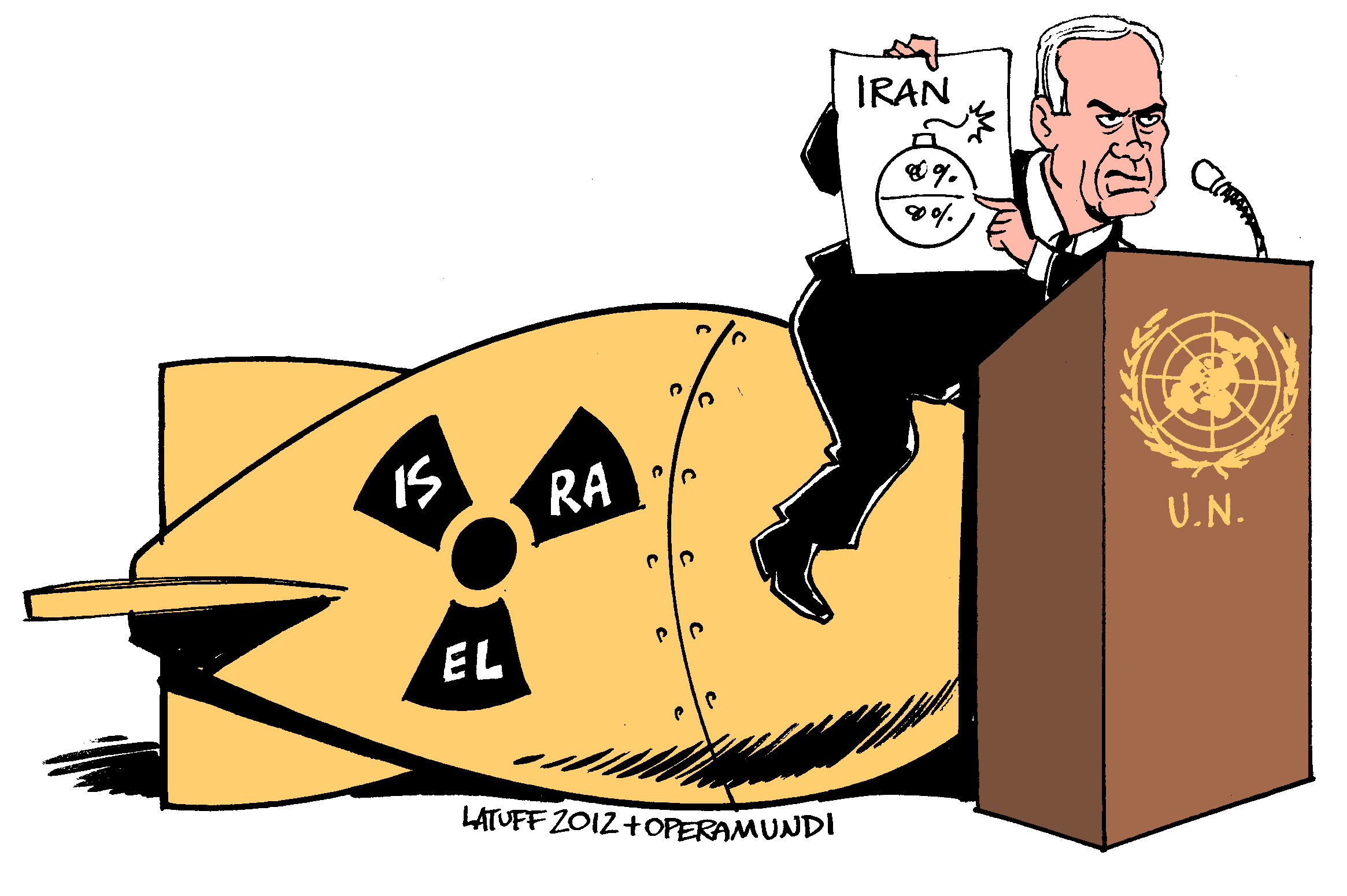
Iranian President Ahmadinejad, in addressing the United Nations General Assembly, made the point that even if Tehran acquired a nuclear weapon, it could not redress the military balance of forces weighted heavily in Washington’s favour. No calculating, cynical politician, (and Ahmadinejad surely is one) would start a war which effectively meant committing national suicide. Economic sanctions certainly undermine the economy, make life harder for the ordinary people, but do not actually reduce the nuclear ambitions of Tehran. Israeli Prime Minister Benjamin Netanyahu made a belligerent, comical appearance at the United Nations, threatening to launch unilateral military action against Iran should the latter acquire a nuclear weapon. The hypocrisy of a belligerent, war-mongering politician speaking about the menace of Tehran’s nuclear weapons can be summed up as follows:

Netanyahu speaks at the United Nations about the Iranian nuclear bomb threat

Greenwald cites the hawkish sentiments of US politicians who elaborated their thinking in a Washington Post article:

“[A]n Islamic Republic of Iran with nuclear weapons capability would be strategically untenable. It would threaten U.S. national security … While a nuclear attack is the worst-case scenario, Iran would not need to employ a nuclear arsenal to threaten US interests. Simply obtaining the ability to quickly assemble a nuclear weapon would effectively give Iran a nuclear deterrent.”

So the main concern of the US policy makers is not to rid the world of nuclear weapons, or support the legitimate aspirations of the Iranian working people, or to alleviate their economic suffering. Their main concern is that if Tehran acquires a nuclear weapon, they cannot be bullied into making concessions to US imperial interests.

Go read the whole article by Glenn Greenwald here.
Heroes, villains, the Washington Post and historical amnesia

The Washington Post carried a long story on September 15 eulogising the former American ambassador to Libya, J Christopher Stevens. The article praised the personal qualities of Stevens, his intelligence and fortitude in helping the Libyan rebels to overthrow the dictatorship of Muammar Qadhafi. Stevens was killed by unidentified gunmen who attacked the American embassy in Benghazi, as part of a generalised wave of attacks and demonstrations against  US embassies and consulates throughout the Arab and Islamic worlds. The immediate cause of the demonstrations was the release of the vile, repulsive film ‘Innocence of Muslims” produced by Christian rightist elements intent on provoking anti-Islam sentiment, and further worsening tensions between the Islamic communities and the western world. The film was the immediate trigger, but underlying the protests are deep-seated grievances about the criminal and predatory role of US imperialism in the Middle East. Be that as it may, let us get back to the case of Stevens. An endless chorus of effusive praise has been heaped on the murdered ambassador, who was described as a man of honour, upholding and promoting the best American values and a champion of Libya. Stevens is touted as a hero, cut down by fanatical murderous villains.

Let us be clear that no happiness or joy is derived from the death of ambassadors and consular officials. But we must ask difficult questions about why such an attack on the US consulate took place, and why the former US ambassador’s death is being given such promotional coverage and praises heaped on upon the slain man. When the US Secretary of State Hillary Clinton, was presented with the news that the former Libyan dictator Qadhafi had been killed by a lynch-mob, after being captured and sodomised, she responded with the Caesar-like turn of phrase, “we came, we saw, he died.” After gloating over Qadhafi’s death, is it appropriate for the gunmen who killed the US ambassador to stand over the corpse of the slain official and gloat “we came, we saw, he died?”

Barry Lando over at the Truthdig publication, asks another relevant question – have the Chinese or Russian embassies been the targets of mobs of unruly demonstrators, attacked by armed militants, its consular officials and embassy staff killed, and its flag burned? The United States ruling elite certainly has financial and military interests in the Middle East, so perhaps its defenders argue that the US troops and bases need to be there to protect those interests. China and Russia also have heavy investments in the Arab world, in Islamic countries, investing in construction contracts, buying up mineral resources, transferring techincal know-how to the Arab and African countries. So where are all the Chinese and Russian military bases, intelligence personnel and soldiers throughout Africa and the Middle East? There is however, a vast and growing empire of bases and military fortifications throughout the Middle East and Central Asia, operated and maintained by the United States:

US bases in the Middle East and Central Asia

J Christopher Stevens worked to extend American imperial overreach throughout the Middle East, not for the sake of any humanitarian values or altruistic purposes. He was a political operative for US imperialism, ready to make deals with whomever served the US interests. He worked closely with the former Libyan government of Muammar Qadhafi, readily providing his services to enhance Qadhafi’s political trajectory from Third World Arab nationalist to opportunistic proxy of the imperialist agenda. From the early 2000s, Qadhafi joined the ‘war on terror’ and cooperated with the secret rendition of  those suspected of ‘terrorism’ offences. Clinton did actually welcome Qadhafi as a useful ally for the United States back in 2009. The Qadhafi government and their US partners discussed various areas of cooperation,  including which detainees should be handed back to the Libyan authorities after they had been tortured and brutalised by American forces.

Stevens had no trouble in promoting the American values of investment and profiteering, which involved propping up the Mubarak-torture regime in Egypt, and uncritically supporting the state of Israel in carrying out its creeping colonisation of Palestinian land. Not a word of complaint did Stevens ever utter about the ongoing Israeli blockade and siege of the Palestinians in the Gaza strip. That crippling blockade has resulted in mass unemployment, the deprivation of foodstuffs and medicines for the inhabitants of Gaza, and the immiseration of an entire generation of Palestinians. Stevens upheld the values of plunderous investment as the US was carrying out its near-genocidal war and occupation of Iraq, with all the attendant worsening of sectarian tensions and fratricidal killings in that conflict.

Once the popular uprisings in the Arab world took hold, Stevens, ever the cunning political operative, changed sides and began liaising with the pro-western rebel groups organised under the political umbrella of the National Transitional Council (NTC). He organised the disparate militias into a fighting force, and took up his new mission in Benghazi with zeal. The war to liberate Libya from the tyrant Qadhafi quickly became a proxy war of the imperialist powers to plunder the oil wealth of the country, oust the main competitors of the US, Russia and China, and return Libya to its neo-colonial status under the former King Idris. In one of the ironies of history, while China was one of the last countries to withdraw their support for the Qadhafi regime, they have made a return to Libya though the security situation remains unclear. Stevens led the charge to resurrect the American presence in Libya – because that presence in the form of a US military base had been expelled back in 1970 shortly after Qadhafi took power. Under the tutelage of Stevens, the entire US military-intelligence apparatus began to insinuate its way back into the country, thus fulfilling the anthem of the US Marine Corps, ‘from the halls of Montezuma to the shores of Tripoli’.

US Senator John McCain declared that the Libyan patriots fighting the Qadhafi regime are definitely not al Qaeda, and that they should be supported. Stevens served to coordinate military supplies, intelligence gathering and training for the pro-American rebel groups organised by the NTC. Stevens helped to assemble the Libyan defectors, CIA assets, al-Qaeda fundamentalist fighters and associated anti-Qadhafi exiles into a cohesive force.  The same forces hailed by McCain as ‘patriots’ were the ones responsible for the murder of Ambassador Stevens. The constant litany of tributes to Stevens’ idealism and courage cannot disguise the cynical and cold political calculation of the imperialist powers in advancing their interests in the Arab and Islamic worlds. The hypocrisies and deceptions of the US in its constant drive for imperial interest cannot be hidden, even by the eloquent writers of the Washington Post. Historical amnesia is one of the devices used by the mouthpieces of corporate imperialism to airbrush the ugly, sordid machinations of US imperialist intrigues. The particular apologist for US imperialist crimes, Roger Cohen, wrote a glowing tribute to Stevens, noting that he met Stevens in 2011, and wished the latter a great July 4 celebration of American independence day, replete with hamburgers, beer and fireworks. The odious lapdog Cohen omitted to mention that for ordinary Libyans, their diet on July 4 2011 consisted of bombs, missiles, blood, guts and pain.  The corporate-controlled media have built a falsified history of the career of this calculating political agent of imperialism based on historical amnesia. The militants who killed Stevens may be villains, but they did not kill a hero. They were actually implementing the methods and values that Stevens spent his life promoting.