Vanity prizes, egomania, and craving legitimacy – Trump’s FIFA and Nobel awards

It is not often that a Nobel prize is regifted, and features on the corporate media news cycle. But there are exceptions to this rule. Nobel peace prize winner for 2025, Maria Corina Machado, regifted her prize to US President Donald Trump. A farcical ceremony, Trump the egomaniac craved the recognition of that prize, and Machado the faithful Venezuelan MAGA servant, overinflated his already swollen ego.

Fragile egomaniac that he is, the mango Mussolini in the White House craves legitimacy. International awards are one way of gaining that much desired recognition. Machado’s regifting of the Nobel peace prize is not the first time such an event has occurred. Norwegian Nobel prize for literature winner (1920) Knut Hamsun, regifted his award to Nazi Propaganda Minister Joseph Goebbels in 1943.

An influential novelist, Hamsun’s work inspired generations of writers, including figures such as Hemingway, Maxim Gorky and Stefan Zweig. He was also a Nazi sympathiser, expressing the view that Hitler was a warrior fighting for the survival and dignity of the white Christian civilisation.

In 1920, Hamsun was considered one of the most important writers in the world. By 1945, he was universally reviled. Hamsun, hailed by Isaac Bashevis Singer as originator of modern narrative in the 20th century, became a propagandist for white supremacy and Nazism.

Trump’s undeserved Nobel follows up on another equally farcical and ridiculous award; the manufactured FIFA prize given to Trump by the football chief Gianni Infantino. The ceremony, fawning and disgraceful in equal measure, was actually quite telling. Failing the Nobel prize, the sports body invented an award, providing Trump with a symbolic victory for personal favouritism.

Were there other nominees for this award? What were the criteria for success? None of these questions have been answered. The links between the actions and practices of FIFA and ethical values have been tenuous at best.

When you bestow an award on a person or organisation, you are not only providing the recipient with legitimacy and recognition. You are also stating to the world the kind of behaviour you find acceptable. You are attaching your name and reputation to the behaviour of the recipient, giving them your seal of approval.

December last year was the 135th anniversary of the Wounded Knee Massacre. Nearly 300 unarmed Lakota men, women and children were killed by US soldiers, specifically from the US 7th Cavalry. The indigenous people were surrendering when the massacre occurred. The incident took place in South Dakota.

This particular killing has been a sore point in relations between the US authorities and indigenous communities. Why am I relating this incident? 19 soldiers who partook in this specific massacre were awarded Medals of Honour. 31 troops in all were awarded for their service in the campaign against the Lakota people.

Prior to this incident, the editor of the Saturday Pioneer, a South Dakota newspaper, L. Frank Baum, expressed his opinion that the ‘red Indians’ need to be exterminated to secure the safety and tranquility of the white race. After the Wounded Knee Massacre, Baum wrote in yet another column that of course we have wronged the Indians, but now, let’s finish the job and wipe out this untameable race, for the security of the white civilisation.

You will be familiar with Baum, not for his work as a propagandist for white supremacy and genocidal violence, but for his authorship of the children’s book The Wonderful Wizard of Oz, the basis of the internationally successful 1939 movie.

Baum never fired a gun in anger; he never murdered anyone. Through his regular writings, he made genocidal violence committed against the indigenous people normal, distasteful perhaps, but nevertheless necessary. A propagandist for white supremacy, I sometimes wonder what the difference is between Baum, and the German propagandist Julius Streicher.

There has been a longstanding campaign by military veterans, indigenous advocacy groups and human rights organisations to have the Wounded Knee medals of honour revoked. Pete Hegseth, the current secretary of defence (who likes to think of himself as war secretary), firmly rejected any moves towards revocation.

Hegseth’s decision protects the murderers, and their reputations. He is helping to preserve a lie; that Wounded Knee was a valiant, praiseworthy battle. Revoking the medals of honour will not eliminate racism or solve all the problems of the indigenous communities in one stroke.

It will be a first step towards reconciliation. Expressing remorse for criminal actions reveals the conscience motivating the person. Maintaining those medals of honour for the Wounded Knee Massacre, Hegseth is indicating the type of conduct he finds acceptable.

Did we not prosecute and hang Nazi German civilian and military leaders at the conclusion of the 1945 Nuremberg trials for similar criminal conduct?

Un-inventing something is impossible; unlearning something is realistic

If you could un-invent something, what would it be?

The urge to un-invent particular innovations or technologies is understandable. We like to imagine a world without afflictions or problems. If we could just reverse a specific invention and wish it away, its harmful impact would be removed.

If we could un-invent the atomic bomb, for instance, we could remove the terrifying spectre of global thermonuclear conflict. If there were no nuclear weapons, the lives of thousands of radiation poisoning victims, afflicted by terrible diseases due to exposure to nuclear weapons testing, would be spared.

However, that way of thinking, noble and commendable as it is, is misguided. We cannot un-invent a technology or innovation, but we can unlearn our destructive ways of using it. For the record, I support the total banning of nuclear weapons.

I am aware that technology can be used to benefit humanity, rather than contribute to our destruction. There is nothing peaceful about nuclear weapons proliferation, and I understand that nuclear technology itself is deployed in medicine and other non-military areas. Nuclear decay processes are used in specific energy generators for certain types of spacecraft. Nuclear processes are used in medical diagnostic imaging techniques.

Let’s not use the ‘peaceful atom’ claim to distract us from the very real dangers of nuclear weapons. It is instructive to note that many of the scientists and physicists who worked on nuclear fission, back in the 1930s, spoke out against the use of that invention for military purposes. I wrote about their efforts to convince authorities of the need to cease military applications of nuclear technology here.

Unfortunately, the US government and the associated scientific-military establishment chose to surge ahead with the Manhattan project, and the rest is history. Only last year, the US Energy Department suggested that a new Manhattan project is required to develop generative artificial intelligence (AI).

The wrong lesson is being promoted by the US authorities. If you want to use AI, that is fine. Please do not turn the race for AI into a ferocious international competition based on paranoid fears. AI can be democratised so that multiple nations can access and develop that technology, not a zero-sum-game race for the winner to take it all.

We need to unlearn the compulsion towards the militarisation of technology. We need to learn international collaboration so everyone can benefit from emerging technologies. The United States, in its pursuit of nuclear weapons, held a monopoly on that technology for decades.

It has used nuclear blackmail to threaten other countries which break away from US-based financial structures. Since Hiroshima, the US has menaced the Global South with nuclear weapons, pushing its financial prescriptions on unwilling countries.

Indeed, the more the US and other big powers menace the Global South, the further the poorer nations are encouraged to pursue nuclear weapons. Nuclear proliferation has actually increased since the early 1990s. With the dissolution of the Soviet Union, scientists and experts from that bloc have passed on their skills and expertise to other nations. Seeking employment, they have found renewed purpose in the Global South nations.

Ironically, with all the tensions between Iran and the United States, it is instructive to note that Tehran’s nuclear ambitions were seeded by the United States. In the 1950s, former US President Dwight Eisenhower implemented an Atoms for Peace programme, transferring nuclear technology to the pro-Western Shah of Iran.

We should unlearn the behaviours that drive us to pursue technological superiority for the purpose of national monopolisation. Rather than deploy innovations to generate even more corporate profits, we can make the improvement of the human and ecological conditions the main priority of our efforts.

Black and white archival photos tell stories we should learn about

Old black and white photos are a treasure. They constitute an archive of stories which help us to understand the present.

In this day and age of TikTok reels, our memories are short, and our attention spans even shorter. So, if you will bear with me, the current article is an attempt to remedy that situation.

I have selected photos from 1930s Germany, which relate to distinct missions conducted by that nation’s government. My selection is not extensive, nor is it meant to be definitive. There are multitudes of old archival photos to choose from. I have selected photos that shed light on relatively unknown and underappreciated episodes from Nazi history.

The German Antarctic expedition

German Antarctic Expedition

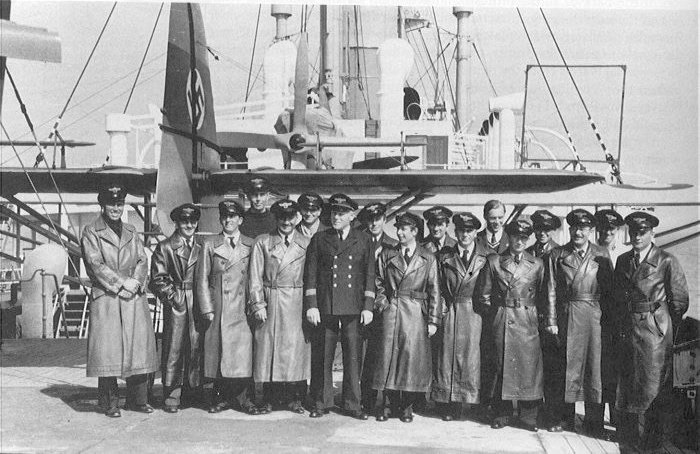
The image above refers to a little known overseas mission by the Nazi government; an initiative to set up shop in Antarctica. The reasons underlying this mission were both political and economic. Antarctica has been, and still is, a subject of geopolitical competition. Numerous nations, including Australia, have staked claims to Antarctic territory.

Germany did undertake expeditions to Antarctica in the past. Setting up a whaling and fishing station there meant that Germany could reduce its dependence on the import of fish, industrial oils and dietary fats. Britain’s maritime traffic in the southern oceans was extensive, and Germany could target that traffic from an Antarctic base.

Here are some of the crew of the MS Schwabenland (motor ship) that traveled to Antarctica:

German crew about to head to Antarctica

Germany’s Antarctic territory, named New Swabia, has been the subject of multiple conspiracy theories, amplified by ‘documentaries’ on cable TV. Stories of secret military bases, storage of UFOs and alien technology, and missing millions in Nazi gold bullion have made the rounds for decades. All of it is very entertaining, but lacks any connection with reality.

New Swabia, Germany’s territorial claim to Antarctica, is now governed by Norway’s Queen Maud Land, under the Antarctic Treaty System

A Nazi travels to Palestine

Antarctica may have been of commercial interest to Nazi Germany, but it was not the only territory targeted by German missions. A little known but highly instructive episode is the secretive Nazi outreach to Palestine; no, not to the Palestinians, but to the budding Zionist Israeli settlement activity.

Commemorative coin of the Nazi mission to Palestine

The Nazi government made clear its intention to make Germany and Europe Judenrein – Jew-free, or ‘clean of Jews.’ The Zionist Federation of Germany (ZfD) wanted Jewish emigrants to Palestine, building up new Jewish settlements for their exclusive state. Here was a marriage of convenience in the making.

The coin above, on the Star of David side, says ‘A Nazi travels to Palestine.’ On the swastika side it says ‘And tells about it in the Angriff.

Der Angriff (Attack) was an official Nazi newspaper in Berlin.

The coin, issued by propaganda minister Joseph Goebbels, refers to the six month long trip of SS officer Baron Leopold von Mildenstein, and his wife. They were accompanied by their sponsor, Kurt Tuchler, an official from the ZfD, and his wife. Building Zionist settlements in Palestine, free from non-Jews, was in a way a mirror image of the white supremacist goal of constructing a foreigner-free Europe.

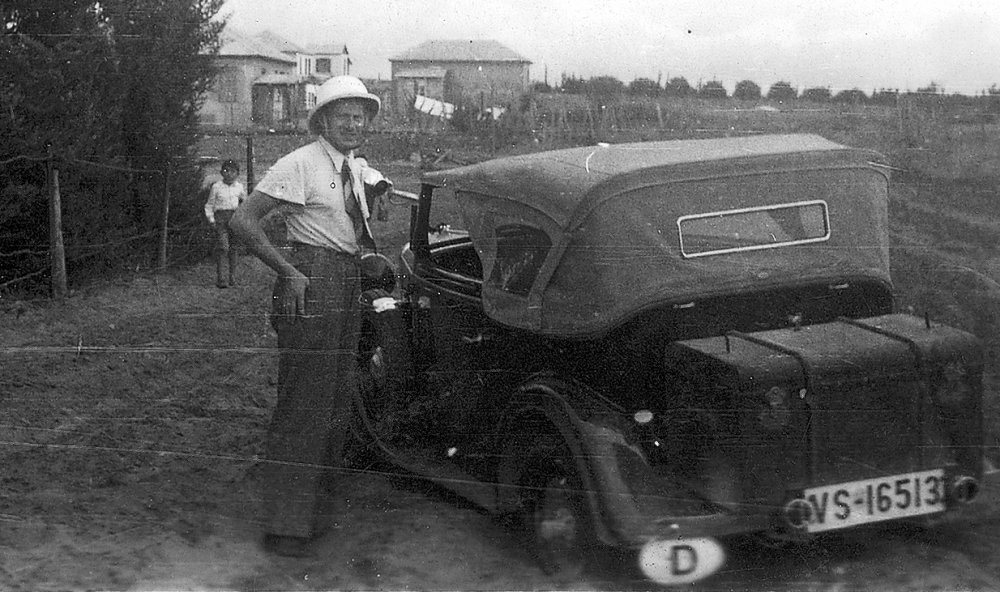
Two sides of the same coin….here is Mildenstein in Palestine

Baron von Mildenstein in Palestine

The British authorities, who were governing Palestine at the time, restricted the number of Jewish emigrants to that nation. Sensing a mutually satisfactory solution, the Nazi authorities and the Zionist federation deemed expulsion of the Jewish population to Palestine arrived at a convenient arrangement. However, with the outbreak of WW2 in Europe, the Nazi government lost interest in Zionism.

Nazi mission to Tibet

Motivated mostly by strategic political calculations, the Nazi mission to Tibet was underpinned by strong pseudoscientific theories. It was also part animal trophy hunting, and part drunken revelry.

Led by SS officer and zoologist Ernst Schafer, his team collected thousands of animal specimens, bones, birds and similar trophies. There were also one of the first European teams to shoot a panda bear.

However, hunting animals was not the only consideration underlying this expedition. Linking with Tibet could provide Berlin with a friendly outpost, from which to attack British India.

Ernst Schafer and his colleagues with Tibetan dignitaries

Accompanying Schafer, along with Tibetans and Nepalese Sherpas, was Bruno Beger, SS officer and racial anthropologist. Why did he join this mission?

The Nazi team were looking for evidence of Aryan ancestry, which they claimed were Nordic people from India and Tibet. While it is beyond the scope of the current article to disentangle each strand of racist pseudoscientific rubbish regarding the fabrication of an Aryan race, let’s just make a quick distinction.

Aryan, a Sanskrit word meaning ‘noble’, referred to an ethnicity in northern India. Aryan refers to proto-Indo-European languages. From this linguistic category, the Europeans transformed it into a racial one. Adding their own myths about the Volk (folk) of the German racial national community, the Nazi ideologues pursued any connection, no matter how tenuous or imaginative, to this mythological community of racialised Aryan ancestors.

After the destruction of Atlantis, the purported original home of the ancestral white Nordic race, the survivors fled and settled in remote locations for safety, one of them being the roof of the world, Tibet. The latter, a feudal outpost of China, became a Shangri-La type mythical land, where esoteric beliefs, Llama Buddhist doctrines, and the European fascination with the exotic East melded into one.

Various European racist intellectuals adopted the Aryan race taxonomy, supposedly proving that humanity could be classified into biologically distinct racial categories. By the time the Nazis took power, the Aryan concept had expanded to include Nordic white supremacist notions. Tibet became part of this pseudo archaeological fixation, with notions of the ancestral white Nordics leaving their traces in that land.

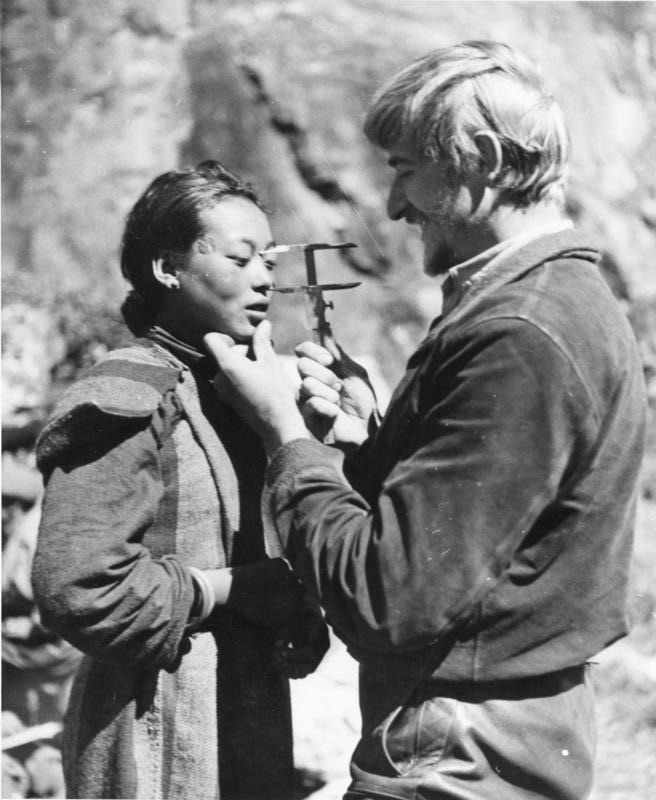
Bruno Beger taking skull measurements

In the photo above, Beger is taking the skull measurements of a Tibetan person. Racial anthropologists, in pursuit of a taxonomic hierarchy of humans, tried to classify races according to their supposed physical characteristics. Beger and his associates collected measurements such as the one depicted above in their hundreds, hoping to find Aryan ancestry among Tibetan people.

Their attempts were unsuccessful.

Oh, and just one quick observation. You may remember that ridiculous movie from the 1990s, Seven Years in Tibet. It is based upon the exploits of Austrian Nazi SS officer, Heinrich Harrer. If you want something entertaining, or enjoy having sexual fantasies about the ageless Brad Pitt, be my guest.

However, learning about Tibet from that movie is the equivalent of trying to understand the Holocaust by watching Hogan’s Heroes. Oh, and the mountains in that movie, which are supposed to be the Himalayas? They are actually the Andes in South America.

I hope that these archival photos provided a glimpse into historical episodes that rarely receive any kind of publicity or examination.

Josef Mengele was a ruthless Nazi doctor, but he was no outlier; he built upon eugenics policies first developed in the United States

Dr Josef Mengele (1911 – 1979), Nazi officer and doctor, became the epitome of medical evil. A member of the SS, Dr Mengele conducted grotesque experiments on concentration camp inmates. Deploying his medical knowledge in the service of eugenics, Mengele was dubbed the ‘angel of death.’

I will not describe his experiments in this article. If you are interested in the details, you may find descriptions of Nazi human experimentation here.

How could a doctor, who had taken the Hippocratic oath to do no harm, become such a medically harmful person?

Mengele was exceptionally cruel, and his medical practices gruesome, but he was no outlier.

Earlier, we mentioned eugenics. Let’s keep that in mind, because that particular pseudoscience will form an important part of our story.

Eugenics, the false belief that the human stock can be improved by the selective breeding of those with desirable heritable characteristics, was applied as a racial doctrine and supported by anthropologists from the United States. The society to which the Nazi hierarchy looked for inspiration in applying eugenicist legislation and doctrines, was the United States. After all, the US had a long history of implementing racially oppressive laws.

After the defeat of Nazi Germany in 1944, Mengele fled Europe, escaping to Argentina thanks to a clandestine network of former SS officers. He avoided having to stand trial as a war criminal in the subsequent Nuremberg trials.

Dying of natural causes in 1979, I remember his case. No, not him personally, I am referring to the case of forensically identifying his remains. They were located by investigators in the mid-to-late 1980s.

Teams of investigators from West Germany, Israel and the United States launched a coordinated effort to find and identify Mengele. There had been numerous rumours and gossip surrounding his whereabouts over the decades. His remains were examined, and confirmed to be those of Mengele, in 1992.

Mengele, motivated by fanatical racial hatred, used concentration camp detainees as guinea pigs, because he regarded nonwhite people as inferior races. He was not alone in this belief; more than half of German doctors at the time joined the Nazi party. Mengele was not just a ‘bad apple’, there was institutional complicity and cruelty.

The forced euthanasia programme, forcible sterilisations, the implementation of Nazi racial laws into medical practice – these were all possible because legions of desk murderers, facilitated the machinery of institutionalised medical murder. Numerous care staff, concentration camp personnel and nurses assisted Mengele and other Nazi doctors carry out his nauseating medical procedures.

What explains this ethical collapse of an entire profession, and indeed the wider society? It is easy to simply shift the blame onto a few rotten individuals. If Mengele was evil, then how did he rise through the medical profession and Nazi party hierarchy?

I think there is an explanation which avoids simplistic ‘people are evil’ arguments. The ideology of eugenics was dominant and widespread not only in Germany, but throughout Europe and especially in the United States.

Aleš Hrdlička, the bone and brain collector

We all know about Mengele, but how many of us know about Aleš Hrdlička (1869 – 1943)?

A Czech-born American anthropologist, Hrdlička (pronounced hurd-lich-kah) was a prominent intellectual in the late nineteenth and early twentieth centuries in the United States. He was a proponent of eugenics, and regarded nonwhite races as biologically inferior. A member of the American Academy of Arts and Sciences, and the American Philosophical Society, his counsel was sought by none other than the president, Franklin Delano Roosevelt (FDR) himself.

The first curator of physical anthropology for the Smithsonian museum, he traveled to remote indigenous communities in search of bones and skulls. He disinterred the remains of indigenous peoples so he could examine their brains, and bone structure. Medical schools across the country would send him the bones of indigenous corpses, the trephined skulls of the native peoples in other parts of the Americas, all for him to collect and study.

Regarding the indigenous as one of the inferior races to be examined, his reputation as an expert only increased. He became known as the bone collector, and the Smithsonian natural history museum still retains his extensive collection of bones. The indigenous people regarded him as a ghoul, taking advantage of their dead and using them as materials for his pseudoscientific theories.

No, he never conducted medical experiments on people. But he did, for instance, cut the heads off the bodies of indigenous people killed by Mexican soldiers. In Peru, he collected 2000 skulls for his collection. In 1904, at the St Louis World Fair, where exhibiting indigenous people as exotic artefacts was commonplace, he made plans to acquire the brains of the detained indigenous people once they were dead.

Indeed, in 1942, as the FDR administration was turning away Jewish refugees from Europe, Aleš Hrdlička was tapped by FDR to head up M project. What was that? The Migration Project, FDR wanted to ensure that only immigrants of good stock, white and Northern European immigrants, would be settled in the United States.

FDR did not want large numbers of Jewish refugees settling in the United States, and Aleš Hrdlička provided the eugenicist ideology to support that view. FDR and Hrdlička conducted a voluminous correspondence, the latter explaining his views that Japanese had less developed brains than white Europeans, which made them more childlike but good at warfare.

The fleeing European Jewish population would be spread thin and far throughout the world. Proposals were explored to settle Jews in Argentina, northern Australia, Madagascar and regions of sub-Saharan Africa. The president publicly lamented that had the US adopted this kind of racial screening of immigration in 1925, the nation would not currently have the large populations of inferior immigrants bedevilling the country.

As Europe’s Jews were being slaughtered, the FDR administration did its utmost to ensure that Jewish people fleeing Nazi persecution would be turned away.

Mengele was an extreme example of the eugenicist policies being vigorously implemented in the United States. The malignancy of Mengele was not an individual aberration, but arose as a result of widespread pseudoscientific theories about race and racial hierarchies. Nazi Germany’s case, while horrifying, was not original.

As I wrote a few years ago, the United States provided an inspirational template for Nazi legislators and medical professionals to follow in the field of eugenics.

If you do not want your writing to sound like AI, read lots of books

Algorithmic precision is great, but it is not great writing.

Over the years, we have witnessed the rise of generative AI tools, ChatGPT and so on, which have made the creation of essays and marketing content fast, easy and accessible. Writers have been impacted by the ubiquity of these tools; anyone with access to a laptop or mobile device can almost instantaneously create blocks of web copy.

However, there is a catch – people are cottoning on to AI-generated content. It sounds robotic, stilted and emotionally flat. Humans have emotions, nuance, subtleties and passions. These are a necessary part of writing. AI detection tools are proliferating, and sometimes, human-created content is being flagged as AI-written.

Humans pour their heart and soul into a good piece of writing, only to have it tagged as AI-generated. Must be frustrating to see that. No, it is not that AI is malicious, it just does not care. It has no ethical basis.

The boundaries between human-written content and AI-generated communication are becoming blurred. Widespread scepticism among readers and audiences is the reaction. Did a person really write this, or an AI-word machine? There is so much AI slop out there, it is drowning out the human voices.

AI can and does hallucinate sources, and fabricate information – fake news, to use the favoured term of Trump and his supporters.

How do you as a writer standout from the AI slop?

I am by no means a successful writer; I do not have ten bazillion followers on X/Twitter or Instagram. But I think I know a thing or two about writing with credibility. Here is my suggestion: read lots of books, and you will find your own voice to stand out from the AI tsunami.

You may find numerous webpage articles advising you on how to avoid sounding like ChatGPT by modifying your writing. That is all commendable advice, and I do not wish to contradict any of that.

Reading lots of books across different genres gives you an insight into varying styles of writing, a way to approach difficult subject matter, and inspiration for creating your own unique content.

If that sounds a bit airy-fairy, think again. Let’s explore this line of thinking. The following are prominent examples of persons who, each in their own way, made a remarkable contribution to the world of literature without the use of AI.

In 2016, singer-songwriter Bob Dylan won the Nobel Prize for Literature. Wait a minute, a musician wins a prestigious prize for literature? Dylan is not a novelist, he writes song lyrics. Yes, that is true. Dylan is primarily a lyricist. His lyrics, over the decades, are so powerful and unique, they have made an indelible impact on literature.

The Nobel committee did not make a category mistake, as multiple critics suggested at the time. They recognised that Dylan crafted his own distinctive voice as a poet-lyricist. His win, in 2016, was during the first election campaign of Donald Trump. Giving a prize to an antiwar lyricist, a musician whose lyricism encouraged the hippie-flower-power 1960s generation, was a subtle rebuff to the MAGA republican side.

In fact, Dylan is not the first poet-lyricist to be awarded the Nobel Prize in Literature. In 1913, the first non-European and literary giant Rabindranath Tagore (1861- 1941) won the prize for his remarkable poetic and lyrical talents.

Born in Bengal, Tagore’s poetry formed the basis for the national anthems of three nations – India, Bangladesh and Sri Lanka. His output was prodigious, writing plays, short stories, novels and lyrics. His content continues to be adapted for films, songs and plays. A true Renaissance man, he was largely self-taught – all without the aid of the internet, podcasts or AI.

Later in life, Tagore ventured into the world of physics. No, he never became a physicist, nor did he ever work in a laboratory. He kept up a fruitful correspondence with Albert Einstein, both men being interested in the philosophy of physics. They met face to face in 1930.

Why would Tagore meet up with a physicist? Tagore was expanding his philosophy, and finding his unique voice. While he never gave philosophy or science lectures at a university, he understood the importance of these topics for creativity in literature. His work was unmistakable, and he only increased his audience outreach, and stature as a writer, by bravely exploring new territories.

Am I suggesting that every writer should go out and win a Nobel prize? No I am not. If you win that prize, then congratulations, more power to you. If you do not, that is perfectly okay; do not lose any sleep over it.

I am suggesting that literary creativity is a skill which is increased by reading a wide variety and range of books. If you use AI to organise your notes, brainstorm ideas, or generate that boilerplate email which needs to be sent to one hundred recipients, that is fine. If it saves you time and expense, good luck to you.

Creative writing involves more than just correct grammar and sentence structure. Those things are incredibly important to be sure. Finding your own voice will take time and effort. It will take mental friction and problem solving. You will go down many roads, only to find they are cul-de-sacs. That is okay; these journeys give you valuable experience and insights.

With increasing reliance on social media for our daily fix of information about the world, the ability to read a book thoroughly has undergone a decline. Let’s revive that ancient skill. By reading widely, we will sharpen our literary creativity.

The right of nations to self-determination, strategic friendships and Somaliland

The right of nations to self-determination is a basic democratic principle. Every nation has the right to decide its own future. In April last year, I wrote about the emerging state of Somaliland, located in the Horn of Africa. It is on the coastline of the Red Sea. Well, it seems I am not the only person contemplating the rights of Somalilanders.

Israeli Prime Minister Benjamin Netanyahu has also been cogitating on this question. More than that, he has taken action, declaring formal recognition of Somaliland on Boxing Day, 2025. Surely this is a momentous undertaking. Should not we be cheering for Somalilanders, congratulating West Jerusalem on enforcing a basic democratic principle?

Somaliland has been an autonomous statelet since 1991. Israel is the only country in the world to formally recognise its independence. Is not this a brave move?

Let’s not pop open the champagne bottles just yet.

Israel’s recognition of Somaliland is not driven by altruistic, humanitarian considerations, but by cynical, strategic motivations of foreign policy. Disguising its decision as a humane gesture, there are definitive economic and political considerations underlying such a manoeuvre.

As we will see, this is not the first or only time the Israeli government has used the rhetoric of national self-determination to hide manipulative socioeconomic calculations.

Let’s start with a map. This shows Somaliland, located in northwestern Somalia, in the Horn of Africa:

Somaliland and Somalia

Since the 19th century, the Horn of Africa has been the site of inter-colonialist competition. Britain seized the northwest portion of Somalia in the late 19th and early 20th century. Italy took control of the rest of the country. Control of maritime traffic to and from the Red Sea was of crucial importance.

The Bab-el-Mandeb strait leads out of the Red Sea to the Gulf of Aden. Britain established a colony in Yemen, directly opposite to Somaliland, across the way from the Bab-el-Mandeb strait. Somaliland became a foothold for Britain in the Horn of Africa, and its importance for control of a strategic waterway was clearly understood by the authorities in Whitehall.

I think we can see the big geopolitical picture here.

The nation unified in 1960, after the British finally withdrew. Somalia has had a chequered history since then, and the Somaliland secessionist cause never went away. Former Somali strongman, General Siad Barre, waged a protracted bombing campaign against secessionist movements in Somaliland throughout the 1970s and 80s.

With the collapse of central authority in Mogadishu, the Somali capital, in 1991, Somaliland secessionists took advantage of the chaos and declared independence. Since then, the enclave operated as a semiautonomous unit, with its own government, currency and foreign policies.

What has all this got to do with Israel?

The Israeli government has, at least since the 1950s, pursued allies outside of the Arab world, namely in sub-Saharan Africa. The newly independent nations of black Africa found a new purported friend in Israel. The latter, the friend who calls only when they want something, sought to outflank the Arab states which surround and confront West Jerusalem. Actually the seat of the Israeli government at the time was Tel Aviv, but you get the picture.

Israel’s African outreach was articulated in the policy documentation and private diaries of its political establishment. Sub-Saharan African nations have traditionally supported the struggle of the Palestinians. Undercutting the international community’s support for the Palestinians only strengthens the Israeli government’s hand.

Daniel Malan, apartheid South African prime minister, visited Tel Aviv and met with David Ben Gurion in 1953. That was just the beginning of a mutually beneficial partnership. Apartheid South Africa received crucial military, economic and diplomatic support from Israel.

Ben Gurion, Moshe Dayan, Levi Eshkol and other Israeli leaders never made a secret of their tactics in cultivating strategic relationships. In 1954, Tel Aviv intended to support a new state in Lebanon – one only for the Maronite Christian minority. Exacerbating sectarian tensions, Ben Gurion made clear that he wanted such a state in South Lebanon. Why? To sign a ‘peace treaty’ with that nation, and gain access to the Litani river as the northern border.

A partitioned Lebanon, with a Maronite Christian secessionist state, would break down the bonds of Arab nationalism, form a friendly buffer, and provide Tel Aviv with economic opportunities.

It is no secret that Israeli leaders have deliberately cultivated relations with, and cynically supported, the independence ambitions of the Kurds, particularly inside Iraq. A non-Arab minority, the Kurds have found a vociferous advocate of their national self-determination in Israeli prime minister Benjamin Netanyahu.

Somaliland’s capability as a forward base against the Houthis in Yemen is not lost on the Israeli government. The Houthis, actually they should be called the Ansar Allah movement, and Israeli forces have exchanged fire in the past.

There is another potential benefit in recognising Somaliland; the latter can form a potential dumping ground to relocate displaced Palestinians. While officially denied, the proposal to simply remove Palestinian refugees to a faraway reserve is not without plausibility.

If Prime Minister Netanyahu was serious about the right of national self-determination, he could start by stopping the Israeli military’s assault on Gaza, and recognise the existence of an independent Palestinian state. Then maybe his alliances with non-Arab nationalities not reek of hypocrisy.

Multicultural ethnic identity is something my fellow Australians struggle to understand

Being a child of Armenians from Egypt has led to many conversations about ethnic identity with my fellow Australians. They struggle to understand how it can be that my parents, who are ethnically Armenian, were born in Egypt and are Egyptians by birth. A person can have a multicultural background and still be Australian. You can be one, and also be both. Ethnic identity is not a zero sum game.

Perhaps the following will help the readers understand. Meet Isabel Bayrakdarian, a Lebanese-born Canadian operatic soprano. Born in Lebanon to Armenian parents, the family moved to Canada when she was a teenager. A graduate in biomedical engineering, she has dedicated her life to music. An operatic soprano, she has performed in numerous concerts. She currently lives and works in the United States.

She has a multicultural background, and has never repudiated neither her Armenian heritage, nor her Lebanese childhood. Her Canadian adolescence did not stop her from becoming a citizen of the United States.

In Lebanon, Armenians have lived, worked, contributed to the nation, and have intermarried with Lebanese people. They sought sanctuary from genocide, war and famine in the early 1900s. The Lebanese, which was actually part of Syria at the time, welcomed the Armenian refugees, even though Lebanon was experiencing food shortages itself.

They were never told to ‘fit in or fuck off’, or ‘go back to where you come from’ as I have been told on multiple occasions by my less-educated and uninformed fellow Australians.

The Carnegie Endowment for International Peace published an evaluation with which I agree: don’t underestimate Lebanon’s Armenians.

I have been considering this topic of ethnic identity in the diaspora for decades, but its relevance has resurfaced in recent months with the revelations regarding Ghislaine Maxwell. As you are all undoubtedly aware, she was an enabler of the pedophile Epstein. This saga, while consuming vast amounts of attention and media coverage, is not my concern.

Yes of course, I can see that justice for Epstein’s victims is important. But the Epstein network is not of any importance to me, but rather Ghislaine’s father, the late Robert Maxwell.

I became familiar with Maxwell senior, the media mogul, businessman and migrant success story in the 1980s. He died in 1991, apparently of suicide. Whether that is true or not, I do not know. What I do know, and remember distinctly, is his funeral. Why? Maxwell is buried in Israel, and his coffin was draped with the Israeli flag.

His burial spot is important, because it is the Mount of Olives in East Jerusalem. This is a biblically significant place, and is the spot where Jesus ascended to heaven, if you want to believe that story. Maxwell’s funeral was a singularly lavish ceremony, attended by former Israeli prime ministers, Mossad intelligence officers, and dignitaries from the Israeli political establishment.

But wait a minute, Robert Maxwell was a posh-speaking, English educated entrepreneur and friend to British political figures. Buying up huge media corporations, his power and influence would be equaled only by Rupert Murdoch. A former soldier in the British army, his meteoric rise, political connections and economic influence in Britain was legendary. Why is he buried in a sacred place in Israel?

Born in 1923, Maxwell began his life as Czechoslovak-born Jew Jan Ludvig Hyman Binyamin Hoch. Escaping the Nazi occupation of his homeland Czechoslovakia, he joined the British-aligned Czech and Slovak Army. Proving his courage and resourcefulness as a soldier, Hoch began his career, and his multicultural identity, as a British officer and Allied agent.

Maxwell reinvented himself as an upper crust, educated entrepreneur in Britain, speaking with the smooth intonation of a BBC newsreader. He began his financial career as a publisher of scientific papers and journals. Prior to his stewardship, scientific publication was in the doldrums. Heading Pergamon Press, Maxwell transformed the publication of scientific papers into an ultra-lucrative business.

In fact, today’s publish-or-perish culture in scientific journals began as a business model under Maxwell. His imprint however, was not confined to academic publishing. Branching out into media ownership, he became the owner-operator of Britain’s leading newspapers. The late Australian journalist John Pilger, having worked in a Maxwell-owned publication, detailed the inner workings and dictatorial methods of the British-assimilated Maxwell.

Nobody questioned Maxwell’s ethnic identity. No-one demanded that he assign percentages to each of his ethnic components. Are you fifty percent Czech Jewish, fifty percent British? How about one-third for each component? Maybe 70 percent Jewish, 15 percent Czech, 15 percent British? If you regard that exercise as ridiculous, of course it is.

Whatever else he was, it is clear that he was one thing – a crook. He swindled millions of pounds from the pension funds of the 350 or so companies he owned. He was arguably the worst embezzler in Britain’s corporate history.

There is an episode from Maxwell’s life which sheds light on his national loyalties. In 1948, as an intermediary for the Zionist movement in Israel, Maxwell facilitated the transfer of military aircraft from the new Czechoslovak government to Tel Aviv. The Israelis were attacked by Arab armies in 1948, and aircraft from Maxwell’s native Czechoslovakia provided the fledgling Zionist state with decisive military air power.

The Czechoslovak authorities provided equipment and training for the new pilots from the Yishuv, the pre-1948 Israeli population and emerging statelet in Palestine. The first pilots trained by the Czechoslovak military arrived in Tel Aviv prior to the May 1948 eruption of the Arab-Israeli war. David Ben-Gurion, speaking in 1968, stated that without Czechoslovak aircraft and armaments, the state of Israel would not have survived.

Maxwell’s identity and loyalties were never questioned by the London authorities. He moved from one ethnic community to another without any interruption.

Ethnic identity is not something that is made up of percentages or proportions. There is no recipe, like baking a cake, with particular ingredients each in its own required portion to contribute in making up the totality. Ethnic identity emerges in practice, with multiple influences and variations.

Yes, we all come from somewhere. It is good to know a person’s ethnic origins. But our identity is not something static, fixed forever in statuesque rigidity. Ethnic identity can change over time, and the ways we express it change as well.

Somali women in the 1970s knew more about politics than today’s readers of the Murdoch press

Every so often, a particular Facebook meme is recycled and recirculated about an important sociopolitical issue that it is worth discussing. To be certain, I ignore the vast majority of Facebook memes. They can be created by anybody calling themselves a digital creator and with a mobile device. Do they all deserve equal attention, let alone a response?

The best way to respond to all of that is denying it attention. Starved of oxygen, memes will normally wither on the vine. However, one meme (actually a series of memes) harping on a particular theme is worth reviewing.

What am I talking about? The recurring meme of women in Iran from the 1960s and 70s wearing westernised dress, bikinis at the beach, and generally sporting the clothing and fashions they liked. The point of such posts is to highlight the contrast between women under the Shah, when they could wear whatever they liked, and today, after the 1979 revolution.

The post-1979 Tehran government forces women to wear the headscarf, or hijab, in public. We are invited to lament; look how bad things are for Iranian women today, as opposed to back then.

You may find examples of such vintage photos here. They are very interesting as historical artefacts. They demonstrate what clothing was predominant in the 1960s in Iran. Please do not use these pictures in a cynical manner to portray the Shah’s time as a golden age of women’s freedom, in contrast to the current Islamic theocratic fashion totalitarianism.

The Murdoch media, which comprises a huge chunk of the dominant corporate media, has a particular hobby horse of enjoining its readers to ‘look how bad things are for women in Muslim societies’. They take a grain of truth, wrap it up in distortions, half-truths and stereotypes. Sadly, millions of readers absorb these contents, which have the same impact on the mind as ultra-processed fast food on our physical health.

Women in Iran have bravely resisted the forcible imposition of the hijab. They have demonstrated tremendous courage in defying the social conservatism of the authorities. No, the wearing of the hijab should not be compulsory, but a matter of personal choice. None of the monotheistic, Abrahamic cousins (Judaism, Christianity and Islam) should be the sole organising principle of an entire society.

Here is something else about Iran that we would do well to understand; currently, 70 percent of graduates in science, mathematics, engineering and technology in Iran are women. Under the western-supported Shah of Iran, female literacy stood at 42%. Today, thanks to the efforts of the revolutionary authorities, that figure stands at 98%.

Does the crime of femicide (female homicide) occur in Iran? Sadly, yes it does. The intentional murder rate of women in Iran stands at 0.59 per 100 000 women. A terrible figure, and each death is an individual tragedy, to be certain. Let us consider the femicide rate in the United States, which is at 2.1 per 100 000 women, and the figure for black and indigenous women murdered is even higher.

Let’s stop with the statistics, because they can get overwhelming, and return to images. I am going to share an image (not created by me), which will highlight a crucial dimension ignored by the Murdoch media; international solidarity.

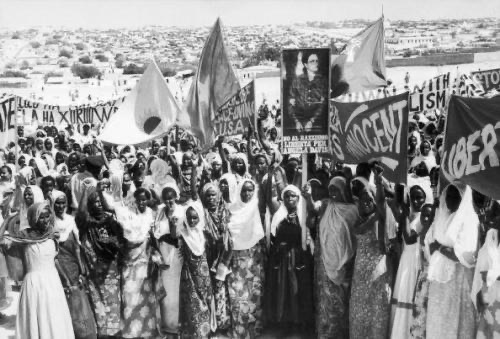
The following is a photograph, taken in 1972, of Somali women in Mogadishu, protesting for the release of African American scholar and activist, Angela Davis:

In this photo, you will see numerous Somali women wearing the headscarf. Somalia was a politically unified nation in 1972, when this picture was taken. Somalia is a Muslim majority nation – and these women in the capital city, Mogadishu, were protesting for the release of black American activist Angela Davis.

But wait a minute, is not Davis a Marxist and feminist, strongly opposed to all forms of religious obscurantism and gender discrimination? What are these women, the majority of whom are Muslim, doing protesting for the freedom of a black Marxist located thousands of miles away? Would not Davis be shouting and screaming for the abolition of the hijab, to liberate these poor, unfortunate oppressed Somali women?

Somali women, back in the 1970s, understood black solidarity and racism. They understood the nature of US imperialism, and the legacy of European colonialism in Africa. They protested not only for the release of Davis, but also in support of Malcolm X and Martin Luther King.

They knew about the struggle for civil rights in the United States, Rosa Parks and Medger Evers. They understood that black Americans fought for the US military in both world wars, only to be rejected and cast aside by their racially segregated society when they returned home.

So please, stop emotionally manipulating the ‘concern’ about Muslim women as a cynical exercise in inciting public opinion for a regime change war in Iran?

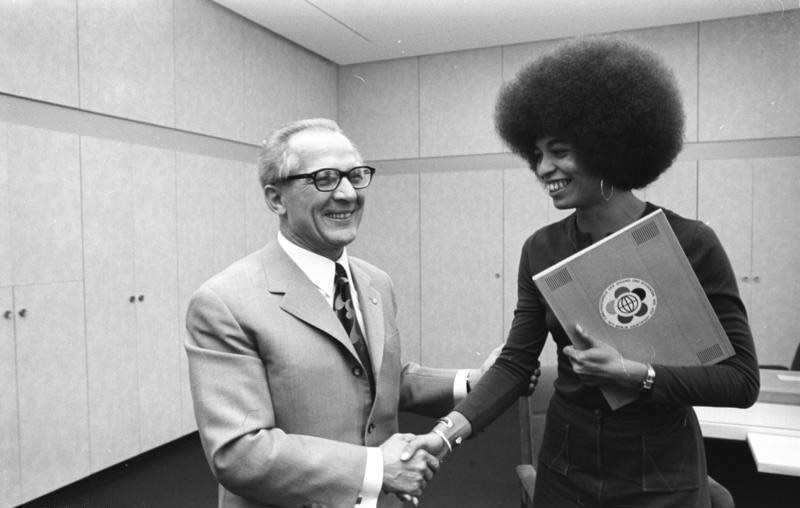
Angela Davis did receive international support for her cause, even from old white men. There was one old, white German speaking head of state who lent his support for Davis; Erich Honecker, the last head of the now-dissolved German Democratic Republic, known as East Germany.

Here they are:

When sharing memes on social media, let’s be aware that what we are doing is making thoughtful connections. The imperialist empire already has its megaphone, shouting its propaganda into our households everyday. How about we use our social media presence not for recycling the empire’s mindset, but for building links of solidarity between communities.

Let’s stop being mouthpieces for the Murdoch media conglomerate. When we examine Iran, or any Muslim majority nation, let’s do so with an open mind, and not the Daily Telegraph-fuelled ‘look how they treat their women’ obnoxious ignorance, backed up by copious amounts of alcohol consumption.

Solomon Grayzel, Elie Wiesel, Gerald Schroeder, and wishing I had advice on approaching these authors’ works

Let’s start with the late Byelorussian-born Jewish American scholar Solomon Grayzel (1896 – 1980). He wrote numerous books, but one in particular made an impact in our household, A History of the Jews (1968). A sweeping examination of the Jewish people and their triumphs and tribulations, we had a well-thumbed copy of that particular paperback in our lounge room bookcase.

Presenting the foundation of the Zionist state of Israel in 1948 as the triumphant pinnacle of Jewish history over their antisemitic persecutors, he covered all the important and decisive twists and turns of their tortuous history from Babylonian captivity until modern times. He made one important observation that has stayed with me, regarding the relationship between the Jewish people and the United States.

Grayzel observed that without Jewish immigration, and immigrants in general, the US educational and university system would atrophy and die. Without the pipeline of immigration from Europe, the United States would wither and die on the vine – at least, their educational, scientific and publishing establishments. He was not wrong.

I was very young when I first read his book, and could not formulate my own thoughts on the subject. If Israel is a triumphal conclusion of the Jewish people’s struggle against genocidal antisemitism, why did the establishment of that state require the genocidal expulsion of the indigenous Palestinians?

I wish I had advice at the time on how to respond to Grayzel’s assertions. No, not because I was on an egotistical trip to prove my credentials and surpass Grayzel’s status as a historian. I am definitely not an expert in Jewish history. However, I did want to understand the underlying motivations of Grayzel’s framework, if only to be better prepared next time round.

A tiny firecracker about a big bang

Gerald Schroeder (1938 – ) is an Orthodox Jewish physicist, author and lecturer. Born in the United States, he moved to Israel in 1971 where he resides and works until today, in 1990, he published the first of what turned out to be multiple books trying to reconcile modern science with Orthodox Jewish religious doctrines, Genesis and the Big Bang.

Schroeder was not the first to try to reconcile the Big Bang theory with the biblical account of creation in Genesis. Pope Pius XII, in the 1950s, tried to suggest that the Big Bang (which was not actually an explosion) was scientific confirmation of the creation ex nihilo mythology in the Bible. Georges Lemaitre himself, Belgian priest, cosmologist and the founder of the Big Bang, strongly repudiated such an interpretation.

Schroeder valiantly tries to suggest, for instance, that the days mentioned in Genesis do not refer to our common understanding of 24-hour time periods, but denote time dilation, a concept known to physicists. This is a phase of Big Bang chronology during the microseconds in the initial frame of reference.

Schroeder is stretching the linguistic boundaries. A day may refer to millions of years, geological time eras, or the quark-gluon plasma in the immediate vicinity of the Big Bang.

That is all very creative, but does not amount to much. Indeed, Schroeder is attempting to demonstrate to his readers that he possesses vast scientific knowledge. He certainly does, but that does nothing to prove his case.

Indeed, Schroeder’s expertise is not in question, it is his philosophical approach that is dubious. He wants us to return to the pre-1850s state of science, when the overwhelming majority of scientists were devoted creationists, and upheld the literal inerrancy of the Bible. Louis Agassiz, for instance, was a fervently religious person. He was also the preeminent scientist in the fields of anthropology and biology.

Agassiz, a scientific authority in the United States regarding the Earth’s natural history, strenuously opposed biological evolution, mocked Darwin’s books, and upheld that the plan of creation divided humanity into superior and inferior races.

I wish I had advice from someone who could guide me through all the complexities of this topic, without being overwhelmed.

Elie Wiesel, the international intellectual limited by his nationalism

Elie Wiesel (1928 – 2016) was a Romanian born American intellectual and speaker. He survived the horror of the concentration camps in World War 2, and wrote numerous books about his experiences. He gained a kind of moral authority as a Holocaust survivor, and was promoted as a leading light in dark times.

Speaking out about human rights, and defending the victims of genocide, his internationalist vision had one enormous blind spot. He ignored the plight of the Palestinians, vociferously defending the Israeli government from all criticisms. His ultranationalist perspective lead him to see every criticism of the Israeli government’s practices as motivated by antisemitism.

The hidden hand of Judeophobia was the demon he perceived in every attack on the Israeli political establishment.

Receiving the Nobel Peace Prize in 1986, he went on to support every US intervention overseas, such the American war on Iraq (in 1991, and 2003). He is not the first Nobel recipient to advocate for war. But he was outstanding in turning the Holocaust into a secular religion, a sacrament that was beyond human rationality or understanding.

True, the horrors of the Holocaust are confronting and challenge our ability to explore the inhumanity. Wiesel did his utmost to turn the Holocaust not into an object for understanding, but into an ideological prop for the criminal policies of the apartheid Israeli government.

Wiesel had his opinions, and that is fine. Turning his books into required reading in educational curricula, promoting his documentaries and interviews on television as the perspective of a morally upstanding intellectual – these do not insulate him from critical scrutiny.

His views were not those of just another scholar. Interviewed and promoted by Oprah, Wiesel gained an international audience and similarly highflying reputation. He helped to turn the Holocaust into a kind of exceptional theology. The genocide of European Jews was the ultimate mystery, according to Wiesel.

Questioning the irrational bases of religions, and theology, should be part of every adult’s intellectual maturity. The Holocaust may be the ultimate mystery, but the motivations of Wiesel are not. His Zionist nationalism ensured that he excluded the Palestinians from his ostensible internationalist vision.

Creativity is not just for writers of fiction

How are you creative?

Nonfiction writers require a strong ability to be creative. Let’s examine this answer.

Being creative is normally associated with writing fiction. The novelist writing the next blockbuster, or the short story writer compiling the next compelling story. Creating an original narrative, coming up with new characters, interweaving leitmotifs and themes – these are the bread and butter of fiction writing.

Artists, sculptors, painters are all creative people. Let’s make an observation here; good nonfiction writers are also creative.

Creativity is a requirement for writers of fiction, but it is not confined to the production of fictional materials. It is true that nonfiction writers cannot make up facts. If I wrote an article claiming that Napoleon Bonaparte invaded India and Pakistan, I would lose all credibility and be laughed out of town.

There is a large field of studies in the social sciences examining racism and in the United States. It is a valuable resource for anyone who wishes to understand the complexities of race, racism, slavery, segregation, immigration and so on in that country. Pretty dry stuff, how is that creative?

Ta-Nahesi Coates, the African American writer, wrote a highly original and creative book regarding the topic of racism and the experiences of racial minorities in the US. His 2015 book, Between the World and Me, is addressed to his adolescent son, he examines what it is like to grow up black in a racially stratified society.

His advice to his son is a book which showcases Coates’ perceptions and observations, his skill as a writer, and is a masterpiece of literary journalism. His book is read and consulted by academics and students across the English-speaking world. It involves serious subjects, and is definitely not fiction, but is a creative work. To write such a book, a person requires more than just a dry recitation of facts, but a highly creative mind.

The late great political scientist and historian Raul Hilberg (1926 – 2007) dedicated his working life to documenting and exploring the Holocaust. His books have become the go-to references for anyone who intends to understand such a complex, horrific, serious subject. Surely there can be no room for creativity or imagination in examining the Holocaust?

No, there is no space for Holocaust denial. Hilberg strenuously rejected any attempt to diminish or minimise the seminal importance of the genocide of European Jews. Yet Hilberg was a creative writer. Did he fabricate claims or hallucinate facts, in the same way generative AI does? Of course not.

Hilberg demonstrated his remarkable creativity in his 1996 book The Politics of Memory: The Journey of a Holocaust Historian. A wide-ranging memoir, he explains his background, his formative years, his experiences in writing and publishing, and his lifelong struggle to have the Holocaust taken seriously as a topic of study.

We do not realise it now, but Hilberg’s books, especially his major study, The Destruction of the European Jews, were rejected by multiple publishers. Nobody was interested in reading about such a depressing subject; mass killings, gas chambers, starvation, concentration camps, treating people as just numbers – who needs all that?

Hilberg demonstrated his resilience and creativity in making the Holocaust an object of popular curiosity not just among those directly impacted by, and survivors of, that particular genocide. To put it plainly, it does not have to happen to you to make it matter to you.

Hilberg’s creativity resides in his efforts to ensure that post-World War 2 generations do not forget about the magnitude and importance of the Holocaust. The scale of the suffering should not blunt our ability to make sense of it.

Having a true story to tell is great, but it is not enough. Creating a narrative arc, developing your voice, elaborating the cast of characters with all their motivations and emotional complexities – these are all required to write a compelling body of nonfiction.