We all realise how much the weather impacts our lives – do not allow Trump to close down the weather service

The National Weather Service, in the United States, is one division of the National Oceanic and Atmospheric Administration (NOAA). It collects and analyses data regarding weather patterns and the climate. Our daily weather updates and forecasts – will it be hot or cold, sunny or rainy, will there be snow, sleet, or drought – depend on the vital work of the NOAA and the weather service.

The weather app, a ubiquitous feature on our mobile devices, gather and provide the latest information about the weather. We make decisions regarding our day by including, among other things, weather forecasts.

Not only that, but bodies such as the NOAA collect and analyse vital data regarding the incidence, frequency and magnitude of severe weather events – hurricanes, droughts, tropical cyclones, tornadoes, heavy rainfall, prospects of flooding – with advance warning of severe weather events, people can be prepared, emergency evacuations undertaken, and first responders can be equipped to deal effectively with the adverse impacts.

The Trump administration, under the guise of cost cutting, is threatening to close all that down. Our up-to-date weather reports might become a thing of the past. It is not just me, a loonie leftie, saying this – the Bulletin of Atomic Scientists, the publication of the Union of Concerned Scientists (UCS), is sounding the alarm.

Since the Trump administration assumed office, thousands of jobs have been cut from the NOAA. The crucial work of scientists has been impacted, decimating vital research into climate change, marine ecosystems, and water and air quality. The NOAA, created in 1970 by then Republican President Richard Nixon, has a wide mandate to collate and evaluate data regarding the natural environment, and make recommendations regarding the deployment of government resources.

Hollowing out the NOAA, as well as gutting federal agencies dedicated to tracking and informing the public about climate change, is part and parcel of the Trump/MAGA cult’s obsessive denial of the science of climate change, and the paranoid delusion that any form of government spending represents creeping ‘socialism.’ Gee, I was always told that political interference in scientific affairs and institutions was a hallmark of authoritarian regimes, such as the USSR or China…..

Indeed, the MAGA cult in power has had to confront another powerful communist woke menace that believes in climate change – the US military. The Department of Defence, at least as far back as 2015, noted that due to the increasing levels of moisture and rainfall, coastal cities such as Miami are at increasing risk of being inundated.

In an article for the New Yorker magazine, Elizabeth Kolbert wrote that army engineers are studying various proposed solutions for the incrementally rising sea levels at the Miami coastline. The US army noted that there is no question that human-induced global warming is having a direct impact on sea levels, thus threatening coastal cities.

The Trump administration can scream about ‘woke’ climate change as much as it wants, there is no denying that the Department of Defence is taking climate change impacts seriously. Be that as it may, the Pentagon has now turned its myopic sights on the US military, downgrading climate change mitigation strategies elaborated by the military. References to climate change are being steadily expunged from military-affiliated websites.

Ironically, among the many installations threatened by an increasing frequency of flooding and hurricane are Florida’s military bases.

The NOAA is an essential independent agency for fighting the climate emergency. Would the US military, and first responders to weather emergencies, be better prepared or worse if the NOAA was gutted and abolished?

I am old enough to remember the 1986 Chernobyl nuclear accident on the territory of the former Soviet Union. This particular meltdown, and the Moscow authorities’ response to that disaster, were widely mocked and denounced in our corporate-controlled media. Here was concrete evidence that the Kremlin, so we were informed, could not care less about the health and safety of its own citizens. The allegedly haphazard and panicked emergency response to that disaster was further evidence, in the western mind, of the incompetence of the Soviet Communist system.

Whether the response of the Kremlin authorities to the Chernobyl disaster was inadequate or not, I do not know. I do know that the US is in no position to lecture other countries about disaster management, given its own track record of poor, inadequate and inefficient responses to numerous climate change-induced disasters.

Remember the smash hit movie of 1996, Twister? Two dedicated scientists, played by Helen Hunt and the late Bill Paxton, lead a team of determined storm chasers. Resolved to develop new and improved early warning tornado detection technology, the intrepid scientists are motivated by an ethical desire to save lives; early warnings can provide affected communities with enough time and resources to evacuate, thus saving lives.

I wonder what the residents of Kentucky think of that movie today.

Earlier this year, eastern Kentucky was hit by tornadoes. While that is not an unusual occurrence for Kentucky – tornadoes obviously cut across state boundaries – the severity and frequency of tornadoes is increasing. The NOAA early hurricane and tornado detection teams have been savagely hit by the Trump administration’s cutbacks.

Meteorologists and scientists are doing the best they can under the circumstances, but downgrading early warning systems leads directly imperils lives and communities that live in tornado zones. Public confidence and trust in NOAA and government weather institutions plummets, and social media conspiracy theorists step up to fill that gap with misleading and maliciously false information.

How about we improve those scientific institutions, such as the weather service, which help up make better decisions in our lives? While ballistic missiles and bombs provide us with a false sense of ‘security’, it is a scientifically literate population that is the best guarantor against misinformation.

What countries do you want to visit?

What countries do you want to visit?

There are many nations around the world which would be extraordinarily interesting to visit. You could name almost any country in Africa – Nigeria, Botswana, Egypt – and I would eagerly jump at the opportunity to visit.

Let’s approach this question beyond mere individual satisfaction or enjoyment. Where can I, as an Australian by birth, demonstrated my solidarity and interest in a nation’s people and culture?

It has been 30 years since the execution of Nigerian environmental activist and writer Ken Saro-Wiwa. Nigeria, and the Niger Delta in particular is rich in oil. The delta has been the subject of intensive oil exploration and extraction. This practice has been highly damaging to the natural environment and Ogoni people.

Highlighting the ecologically destructive practices of Shell oil corporation on his native Ogoniland, he formed a nonviolent organisation, the Movement for the Survival of the Ogoni People (MOSOP).

MOSOP declared that Shell petroleum corporation destroyed the natural environment, polluted the waterways, derived enormous profits from the sale of crude oil, and provided nothing for the Ogoni people. A new word was basically invented at this time (the late 1980s and early 1990s) for this practice – extractivism.

He and his fellow activists, denouncing the extractivism of multinational oil companies in the early 1990s, were targeted by the Nigerian military regime. The peaceful protests organised by MOSOP were met with violent repression. Shell corporation and the Nigerian authorities were colluding to silence any voices which spoke out against the exploitative practices of oil multinationals.

Brought to court on trumped up charges, the Ogoni 9, of which Saro-Wiwa was part, were sentenced to death and hanged in November 1995. Earlier this month, the Nigerian government issued a posthumous pardon for Saro-Wiwa.

Saro-Wiwa wrote of his experiences while in detention – A Month and a Day. Arrested in June 1993, he was held in deplorable conditions. It was the first of many clashes with the Nigerian authorities.

His book was published in 1996 in Australia, with a preface by Anglo-Scottish novelist William Boyd. That book was eye-opening, particularly given the political climate of the early-mid 1990s. The socialist bloc in Eastern Europe had just dissolved, and the corporate-controlled media was declaring the triumph of capitalism. The future belonged to Coca-Cola, McDonald’s, Hollywood movies and fast cars, did it not?

Saro-Wiwa’s sacrifice, along with his Ogoni compatriots, reminded the world that capitalism involves exploitation and ecological degradation. Capitalism’s cheerleaders can jump up and down about supermarkets and hamburgers, but they cannot obscure the fact that Saro-Wiwa exposed the ugly truth of the profiteering extractivism at the heart of multinational corporations.

I would like to visit Saro-Wiwa’s grave, as well as the final resting place of the Ogoni 9 in Nigeria, and pay my respects to them.

So, Nigeria – that’s one.

Let’s stay in Africa, and venture over to Kenya.

Kenya has been a fascinating country for me over the decades. My late father made me aware of Kenya – in what way? As a cradle of humankind. Kenya is home to extensive archaeological and paleontological discoveries, including fossils which tell the story of human evolution.

Louis Leakey (1903 – 1972) the British-Kenyan paleontologist, made fossil hunting seem exciting and daring in his documentaries. I remember watching grainy old footage of Leakey out and about in the field, which was usually Lake Turkana, determinedly digging some patch of ground. Mary Leakey, Louis’ partner, was a scientist in her own right, sharing the glory of paleontological discoveries.

Their son Richard, who sadly passed away in 2022, was also a noted paleontologist.

Lake Turkana, located in northwest Kenya (branching into Ethiopia) is actually a saline desert lake. Surrounded by arid country, it is not the first place you would expect to be habitable for hominins. However, Lake Turkana’s eastern foreshore has yielded literally hundreds of hominin fossils, providing a unique insight into early human evolution.

A treasure trove of fossils, the story of human evolution is arguably the most important paleontological discovery of the last decades of the twentieth century. No, I am not rejecting the importance of quantum mechanics, continental plate tectonics or the germ theory of disease for their impact on our society and how we live. Each in turn faced fierce resistance when initially posited, gradually acquiring consensus based on the preponderance of evidence.

However, it is the natural history of human evolution, possessing a philosophically materialist foundation with no reference to or need for supernatural intervention, which is the most fascinating yet challenging consensus in contemporary capitalist society.

Kenya, while a small nation geographically, has played an outsized role in revealing the human story. The Kenyan Rift Valley, the subject of exploration for the last 50 years, has more secrets to reveal. Kenya has solidified its claim as the original location of humankind.

It would be an easy and entertaining option to be yet another Aussie tourist in Bali. I am certain that Bali is very appealing, but treading the well worn path of what is marketed as Aussie tourism is not for me.

Britain has a longstanding history of sponsoring fundamentalist groups in the Middle East

The United Kingdom (UK) and Saudi Arabia are close allies. They maintain and have continued to develop extensive economic and military ties. Do not take my word for it; please feel free to read the UK government’s own description of its ties to Riyadh as a strategic partnership.

By 2030, the governments of both nations expect bilateral trade to increase to $39.6 billion.

Why is there such a close and mutually financially beneficial relationship between London and Riyadh? Surely the British government realises that it is laying itself open to charges of hypocrisy – a liberal parliamentary democracy maintaining trade and military links with a theocratic, hereditary monarchy like Riyadh. Why does the UK, where women enjoy the liberal freedoms of a capitalist state, intimately cooperate with a regime that maintains strict gender segregation?

The answer to that question lies in understanding Britain’s role in shaping the modern Saudi state in the 1910s and 20s. Indeed, the UK has a long history of colluding with and supporting fundamentalist groups, arming and training them, as a bulwark against Arab nationalist and anticolonial movements in the Middle East region.

Britain, eager to defeat the Ottoman Turkish empire, encouraged the Arab revolt, an uprising by Arabic-speaking peoples in the Arabian peninsula. The leader of this nationalist uprising was Sharif Hussein, a notable leader in western Arabia which was then known as the Kingdom of Hejaz. This was significant because his territory contained the holy sites of Mecca and Medina.

Guardian of the holy sites and Arab leader. Hussein received numerous assurances from Britain (the 1915 Hussein-McMahon correspondence) that London would respect the creation of an independent Arabia after the defeat of the Ottoman Turks. We all know through the romanticised and somewhat fictionalised movie Lawrence of Arabia that London’s policymakers were secretly plotting, along with France, a division of the spoils once the Ottoman Empire was defeated.

The secret Sykes-Picot agreement, signed in 1916, involved carving up the Middle East into spheres of influence shared between Britain and France. What is not publicised in that film, nor to students of the British empire, is that London was worried. Sharif Hussein was an anticolonial and nationalist leader. What happens if he is successful – would his example inspire similar anticolonial uprisings in Egypt and India?

Here is where the UK made a fateful decision; to financially and militarily back the fundamentalist and ultraconservative Abdulaziz bin Abdul Rahman Al Saud, the king of the central Arabian state of Nejd. His brand of theocracy is known as Wahhabism, named after the 18th century theologian Muhammad ibn Abd Al-Wahhab (1703 – 1792).

Believing Islam to be corrupted by foreign elements, Wahhab wanted to purge Islam of those he considered apostates. A highly strict, orthodox interpretation of Islam, Wahhabism is today the official ideology of Saudi Arabia. Ibn Saud was no fool, realising that British arms and training would give him a decisive edge over his rival, Sharif Hussain.

The supply of armaments and money flowed into the coffers of the house of Saud. With British backing, the Wahhabi leader was able to impose his brand of Salafi revivalism on the entire territory of the Arabian peninsula after the defeat of the Ottoman Turkish empire. The subsequent political and economic character of the unified Saudi state was heavily influenced by this covert development.

Sharif Hussein’s forces were defeated, not by arms alone, but by imperial British treachery. Throughout the 1920s, the UK improved its relations with the emergent Saudi state. It is interesting to note here that Hussein repeatedly refused London’s proposal to start a Jewish state in Palestine.

Hostile to Zionism, Hussein desired the unification of Arab lands, including Syria and Palestine, into one entity. Ibn Saud on the other hand, accepted (however reluctantly) the Zionist project in Palestine. The 1917 Balfour declaration, committing Britain to a Jewish state in Palestine, was the price Ibn Saud was willing to pay for British finance and military backing.

By 1925, Hussein had been forced out of the port city of Aqaba, a city his forces liberated from Turkish control during the First World War.

Let us be clear – Britain actively colluded with a fundamentalist ultraconservative movement to achieve its geopolitical objectives. It is quite hypocritical for the UK to publicly denounce the Saudis for culturally regressive practices, but then actively support those political forces which advocate religiously fanatical culturally regressive policies.

London’s collusion with fundamentalist groups is not just a matter of history. There are important lessons for us today.

The current government in Damascus, headed by the fundamentalist and ultraconservative organisation Hayat Tahrir al-Shams (HTS), a Sunni supremacist group, received copious funding and military support from the UK, in their effort to topple the previous Ba’athist regime in Syria.

While every uprising undoubtedly has domestic origins and legitimate grievances, the military support and political backing provided to HTS by Britain is of an order of magnitude similar to the UK’s regime change policies of the past. Only now, months after the ousting of former Syrian president Bashar al-Assad, is the full extent of London’s covert support for the Syrian Sunni rebel group emerging.

While it is easy to view the success of HTS as a purely indigenously based, rapid advance against a tottering regime, the HTS militia was steadily groomed and cultivated over the years from its enclave in northwestern Syria.

Emerging as an Al Qaeda offshoot, the HTS has ruled Syria with lethal force, engaging in ethnic cleansing against minority communities. London’s role in orchestrating a regime change in Syria, accompanied by a media campaign to whitewash HTS’ image as a ‘moderate’ force, is only now just becoming clear. The HTS leadership is media savvy, and able to appeal to a Western audience – something no doubt their British paymasters trained them to do.

No amount of slick public relations can obscure the violent and extremist nature of the HTS militia. The new regime in Damascus recently announced their intention to privatise public assets, cut corporate taxes, and make Syria a business-friendly economy – a failed prescription that we have witnessed many times before.

The success of the HTS Salafi uprising has more in common with the Sudeten German ethnic uprising in Czechoslovakia in the 1930s. An uprising, sponsored by a foreign power, intended to break apart a multiethnic and multi-confessional state, thus making it easier to monopolise. This is a playbook we have witnessed in the past.

Car-dependent suburbs contribute to loneliness and boredom

I grew up in a car-centric suburb, in outer western Sydney. It was a quiet place, leafy, with only a tiny shopping village. It was tranquil, uninterrupted by the sounds of traffic or crowds of people – and it was absolutely f*cking boring.

The car centric suburb is a place of isolation, loneliness and a vortex of despair and boredom.

Forced to catch the bus – privately owned – or rely on the car, my late father being the chauffeur, I realised I could not actually walk anywhere. Oh yes, the local park, but for any amenities, it required at least a bus trip. Usually, I required the train – public transportation.

I am not alone in my experience. Consider the following observation of Muizz Akhtar, writing in Vox magazine in 2022 about the American suburban experience:

Distance and isolation are fundamentally built into the urban areas — defined by the US Census Bureau as any area with at least 5,000 people — where most of us live. State and local governments prioritize building infrastructure for cars, and public transportation remains underfunded and unreliable. Wide roads and parking lots spread everything out and make walking extremely difficult, if a neighborhood even has sidewalks to begin with. Today, because a majority of Americans, including an increasing number of children and the elderlylive in car-centric areas like suburbs, our ability to form connections and community is limited.

Constructing suburbs for car-dependent travel fails to contribute to the building of human connections.

The suburban home is built far away from shops, cinemas, schools, theatres, universities and general places of public gathering. Yes I know, there have been (and are ongoing) developments in western Sydney. A university was established to accomodate students in the region. More businesses are moving out to Parramatta, which has become a hub of activity.

Surry Hills, in the inner city, and Katoomba in the Blue Mountains, are separated by kilometres. Yet they both have a social contact street culture. People can walk and meet each other in restaurants, bookshops, cinemas, pubs and so on. Urban planners are finally waking up to these kinds of deficiencies in western Sydney suburbia.

When the Covid-19 pandemic hit, and lockdowns were enforced, social isolation became a major issue. Involuntary confinement undermines the human need for social interaction. I do not want to say that I was completely unaffected by such lack of contact, but I was ready for such an outcome. Making myself busy and occupying my mind are social skills that I developed as a result of the normative isolation of suburbia.

No, lockdown was not a breeze, but it was something with which I coped better than most. Reading is a joy for me, because a good book transports you to another time and place, another location without leaving your house. No, it is no substitute for social connections. However, books became my way of breaking the monotony.

I will return to the impact of reading a bit later, but first let’s make an observation. Psychologists James Danckert and John Eastwood, writing in Psychology Today magazine, make the point that car-heavy lives construct a mode of living where we are always traveling away from our surroundings, not actually enjoying them. If enjoyment and connection is to be found by driving for miles away, what does that say about our suburban surroundings?

Spontaneous and serendipitous connections with potential friends are much harder to come by if we are cocooning ourselves in our cars.

A place which I enjoyed immensely and found connection was the old Soviet bookshop. Formerly located in Sydney’s CBD, it was the victim of the dissolution of the Soviet Union and the ubiquitous move to the internet. Yes, you can find multiple publications on the Net, and of course, the tech giant Amazon dominates book sales. Be that as it may, there was something unique about that bookshop.

It was the place that taught me that the world can be understood and experienced. It was a supplement to my university education. I kept up my studies for my university course, but also undertook a ‘postgraduate’ course, if you will, in Marxist books. The Soviet example taught me that reading is not only a joy, but a way of understanding the lives and struggles of other people.

The storefront bookshop, while not completely dead, has been overtaken by online media. Social media is one way of connecting with people, especially those who are geographically separated from us. However, there is no substitute for browsing the shelves of an actual bookshop.

No, I am not suggesting that we demolish the existing suburbs. I am suggesting that we redefine our image of the suburb, not simply as an investment property developer’s dream of houses to be bought and sold like cattle, but rather as places of human connection, walk ability, and green spaces.

It is important to raise one final point here. We all need to save for a financially secure retirement. I guess I am thinking more about this question now that I am approaching decrepitude. How secure will we be retiring to suburbs that are located in the middle of a climate hellscape?

Socially connected living goes beyond just numbers, but let’s consider the following regarding living in safe suburbs – what happens when they get inundated, or demolished by cyclones? Should not we be planning our suburban communities for these eventualities?

The white South African refugees are victims of Trump’s hallucination about an imaginary genocide

The topic of genocide is not something I would have chosen for myself as an object of deep investigation. My late Armenian grandfather was a survivor of the 1915 genocide, and he would sometimes talk about his experiences. I never pushed the subject, always allowing him to volunteer information about that traumatic event, if he so wished.

Talking about that genocide, and comparing and contrasting it to similarly unspeakable crimes in the twentieth century, is a topic familiar to diasporan Armenians. This month, I found out that I have a high level official who is exercising his tremendous intellectual capacities on a similar subject – US President Donald Trump.

He is unable to sleep at nights apparently, riddled with anxiety about an ongoing genocide – that of the Afrikaners, the white South African farmers whose land is being seized by a relentlessly furious campaign by the black-majority government in Pretoria. Huge numbers of these farmers are being systematically exterminated, so we are told.

There is just one problem with the white genocide of Afrikaners – it is not happening. But its imaginary status does not deter our fearless Trump, and his colleagues in paranoid delusions Elon Musk and JD Vance, from taking actions based on such an illusion. After all, collective illusions are powerful things – when enough people believe them, they can have violent consequences.

The white genocide conspiracy theory involves more than just manufactured anxieties about the Afrikaners. It is an overarching worldview of racial resentment, alleging that ethnic minorities are ‘invaders’, brought to Anglophone and European nations by ‘traitorous’ elites (and that usually signifies the Jews) as demographic battering rams. Overpopulating their new domestic homeland, they eventually turn the white population into a beleaguered minority.

The origins of that racial paranoia resides with the so-called Great Replacement theory, as elaborated by French writer Renaud Camus. He codified a disparate yet interrelated series of racially resentful ideologies, which opposed the efforts of nonwhite peoples at decolonisation.

Let’s not stay in Europe – at the turn of the nineteenth and twentieth centuries, Australian politicians such as Edmund Barton (our first prime minister) stated that the new Australian federation was a necessary political unification project. Why? To avoid being swamped by nonwhite, particularly Asian, immigration.

Charles Pearson, Anglo-Australian academic and writer, expressed his anxiety (in 1892) that the white population would one day wake up and find themselves outnumbered and outgunned by nonwhite immigrants. Perhaps current UK prime minister Keir Starmer was channeling Pearson (and Enoch Powell) when he spoke of Britain becoming an island full of strangers.

Let’s get back to South Africa. The Afrikaners, descendants of the Dutch settlers who settled there from the 1600s onwards, benefited from the system of apartheid (apartness). Monopolising control of the land, they helped (along with the English settlers) to establish a rigidly stratified society based on race.

The end of apartheid in 1994 did not bring about ecological justice – while white South Africans make up only 7.8 percent of the population, they still own 72 percent of the arable land. Hardly evidence of a systematic campaign of racially motivated elimination.

Is crime a problem in South Africa? Yes, sadly it is. Are white farmers being singled out for oppression and extermination? No, they are not. There is no evidence that Afrikaner farmers are disproportionately affected by violent crime. In fact, the black African community is most adversely affected by the incidence of crime.

Indeed, the African National Congress (ANC) banked on a singular strategy in 1994 which they hoped would correct the injustices of apartheid – the creation of a black capitalist entrepreneurial class. That is certainly one strategy, adopted by numerous governments around the world in the immediate aftermath of the Eastern bloc’s dissolution. However, creating a new capitalist class proved inadequate in confronting and rectifying the deep seated economic inequities of the apartheid era in South Africa.

Multiple white South African commentators have rubbished the Trump administration’s claims of white Afrikaner genocide. Elon Musk, himself a scion of privilege, no doubt spread the ‘white genocide’ claim in his social media posts, resentful about the demise of formal apartheid.

Indeed, the Trump administration has vociferously rejected refugees from nonwhite nations – Haitians, Somalis, Afghans, Salvadorans – are having their applications for sanctuary strongly rejected, and immigrants in the US being rounded up and deported. The 59 Afrikaners who arrived by a government-provided airplane are the recipients of generosity because they are white.

Trump is sending an unmistakable message to the world; his solidarity extends only to those who are white. Sanctuary is reserved for white racial brethren.

If the MAGA cult was so concerned about stopping a genocide, then they could certainly take decisive action towards that goal. What am I talking about? Trump could immediately cease all armaments sales and military contracts with the Israeli military. The latter is conducting a genocidal war against the Palestinians of Gaza.

Civilians are being deliberately targeted by Israeli soldiers, hospitals and schools are being bombed, and food aid is being purposely withheld. Famine looms as a real possibility in Gaza, with all the humanitarian consequences that this catastrophe raises.

If anyone requires advice about how to survive the white genocide in South Africa, look no further than an article by Ryan Cooper, a white South African who grew up in a remote black homeland, a Bantustan, set up by the apartheid regime in the 1960s. Such homelands were created by the apartheid authorities along tribal lines, enforcing the relocation and tribal segregation of the black population.

The Bantustans were dignified with the title homeland, but in reality were reservations to which the black African populations were confined.

Cooper explained his tactics for surviving in Bophuthataswana. an isolated Bantustan in the north of South Africa. Living with a black host family, as the only white person for miles, he adopted the following cunning strategy for survival, live and mix freely among black Africans, make friendly with them, and catch public transport with them.

This elaborate and deceptively crafty approach to living enabled Cooper to survive the relentlessly hostile terrain of black South Africa. Hiding in plain sight, he was able to avoid the worst excesses of his black African friends, neighbours, colleague and counterparts. There is a lesson in that for all of us.

This year, the 80th anniversaries of World War 2 events can teach us lessons about politics today

The National Geographic magazine is not the first place you would think of as having anything related to modern history or politics. However, you would be mistaken – there is a large History and Culture section of the magazine. In the May issue, there is a detailed summary of Operation Paperclip, which began in 1945.

Operation Paperclip was a covert mission, initiated and organised by US intelligence, to secretly transport and settle numerous German rocket scientists in the United States. These scientists, heavily involved in the military programmes of Nazi Germany, worked in the American space and military industries.

Their membership of the SS, their use of forced labour in concentration camps, was quietly swept under the carpet. The name Paperclip came from an identifiable paper clip earmarking the files examining these scientists.

Nazi rocket scientist Wernher von Braun – image courtesy of Encyclopaedia Britannica

One of the most famous of these German scientists was Wernher von Braun, (1912 – 1977) an engineer and rocket scientist who led the creation of the so-called V-2 ballistic missile. This ‘vengeance weapon’ was used to target British cities in the last years of the war. Slave labourers from concentration camps, built to accommodate the needs of the rocket program, died in their thousands from overwork, starvation and disease.

In a cruel irony, more people died extracting the raw materials required for building these rockets than the civilians killed in Britain due to V-2 attacks. Braun’s passion for ballistic missiles helped fuel the space ambitions of NASA.

You may find more details about the specifics of this operation here.

This year marks the 80th anniversary of the end of World War 2. Numerous commemorative activities, presentations and ceremonies were held across the world. One of the most important of these was the May 9 Victory Day parade in Moscow. Multiple heads of state attended the parade on that day, marking the decisive contribution of the USSR in the defeat of Nazi Germany.

Other writers have examined in great detail the incredible sacrifices of the Soviet people, including 300 000 Armenians, in breaking the back of the Nazi war machine. I will not go into the details of the extraordinary and heroic efforts of the Red Army here. What I can anticipate though, is the screaming objection by Western commentators, indoctrinated in the Hollywood-Longest Day-Guns of Navarone-Saving Private Ryan fan club version of history – what about the Western contribution to the Nazi defeat?

This question is important, though it is deployed in a cynical fashion. It is not asked out of genuine interest in the Anglo-American-Canadian contribution to the war effort, but to distract us from the complicity of imperialist powers in accommodating and encouraging the rise of Nazi power.

Large corporations in the United States and Britain, while wary of Nazi designs on Western Europe, were definitely encouraging Hitler to build a German empire in the European east – a project involving the invasion of the Soviet Union. Hitler himself made no secret of the fact that Eastern Europe constituted German lebensraum (living space), in much the same fashion that white settlers in the United States expanded West. The tactics used to expel the indigenous people of the American West were adapted by Nazi Germany to exterminate the Slavs and Jews of the European East.

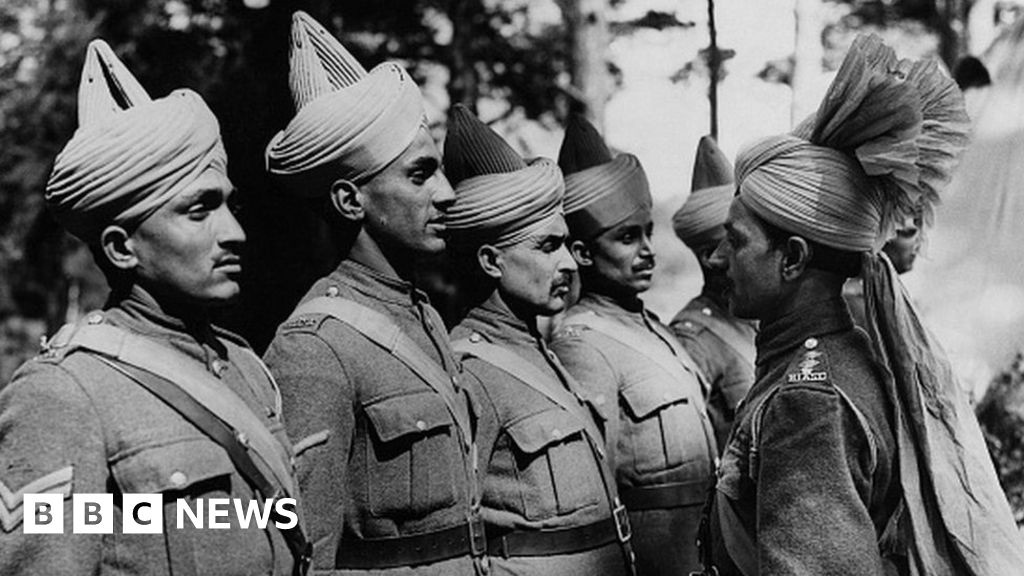
What about Britain’s undeniable effort to defeat Nazi Germany? There is no question regarding the courage and determination of the English people facing the Nazi blitz, but they were hardly standing alone. Gary Younge, sociology professor at the University of Manchester, writes that millions of nonwhite people from the far flung territories of the British empire, volunteered to fight for Britain.

Millions from India, (and the Indian subcontinent), sub-Saharan Africa, Jamaica, the Caribbean nations, Kenya, North African Arab-speaking nationalities – the British fight against fascism was multicultural. They have never received their VE Day, and their contribution has been written out of the history books.

Indian soldiers in World War 2 – image courtesy of the BBC

While Europeans were ecstatically celebrating their newly-won freedom on VE Day 1945, another scenario unfolded in the former French colony of Algeria. France had been occupied by Nazi Germany, and it had signed, along with the other Allied powers, the Atlantic Charter, a document that stipulated that occupied nations in Europe had the right to self-determination.

Well, the Algerians for one, decided that the principle of self-determination applies to them. Protesting peacefully, they were met with French gunfire. 45 000 Algerian were killed over the course of May and June. The French army, backed up by armed French settlers, launched a campaign of terrifying violence against the Algerians, using low level bombings, massacres and torture of anti colonial Algerians.

Clearly, the lauded principle of self determination did not apply to the darker skinned nationalities of the French and British empires. As we all now know, the former French territory of Vietnam waged a stubborn battle for independence after 1945. Where the French failed, the Americans stepped in.

April 30 was the 50th anniversary of the liberation of Saigon from American occupation. A hard fought campaign of resistance to colonial rule, the Vietnamese paid the price for American unwillingness to learn the lessons of colonial history.

Actually, in a way, the United States did learn from history. Closing its doors to European Jewish refugees during the war, Washington and Ottawa opened their doors to provide sanctuary for fleeing Nazi war criminals.

How about, this time around, we remember those who have been forgotten amidst the manufactured nostalgia surrounding World War 2. The prisoners of Buchenwald concentration camp were overjoyed to see American troops approaching their location in April 1945. The American soldiers were confronted by scenes of unimaginable horror and cruelty. But it would be a mistake to say that US forces liberated Buchenwald.

It was the prisoners who liberated themselves in Buchenwald. Forming underground action committees, and taking matters into their own hands, they bravely rose up and disarmed their fascist captors. Their heroism and collective spirit, even in such an inhumane and horrific place, could not be extinguished.

Gary Younge provides a cautionary observation for our times. It would be a perverse irony if the ideological descendants of ultranationalist and fascist parties, currently polling strongly across European nations, were to regain power through the ballot box 80 years after being defeated on the battlefield.

When elite sportspeople are exceptional on the field, but lousy human beings, we can call them out but still admire their prowess

What are we to do when an elite sport player, musician or artist – outstanding in their particular field – turns out to be an obnoxious a*sehole in life?

A few years back, I wrote about the legendary chess player the late Bobby Fischer (1943 – 2008). A child prodigy at chess, he defeated his Soviet counterpart in the 1950s, thus earning his place in the pantheon of chess greats. However, as a person, he turned out to be a bigot, contemptuously sneering at anyone who disagreed with him.

Should we continue to admire a person who, while outstanding as a sportsperson or musician, is an obnoxious lout in life?

Let’s begin with baseball. I tried baseball in high school, and was never any good at it. I probably hit only 20 percent of the pitches I faced. Hitting a home run was a rarity. To top it off, I got more interested in squash, and so my incipient baseball career came to an end before it even started.

Baseball is not that big in Australia, in comparison to the Major Leagues in the United States. I never fully understood all the statistics of baseball playing – and I still do not. However, I can appreciate the ability of fans to accumulated vast and complex baseball data sets in their minds. I also think that elite baseball players are worthy of admiration.

Ty Cobb (1886 – 1961) was an exceptional baseball player, the absolute greatest of his generation. His baseball achievements hit record levels, and remained so for decades.

His approach to the game was one of tactical aggression, unafraid to confront his opponents absolutely head-on. Undeterred by threats from fans, he pursued baseball with an unmatched intensity, stealing bases, a steely-eyed gaze, anticipating his opponents’ moves and countering them. He was able to think quickly and decisively under pressure. Fearless and strong, he would deliberately crash into the opposing fielders at the bases, sparking numerous confrontations that became a hallmark of his career.

He was also an antisemite and obnoxious person, described by his friends and colleagues as a ‘son of a b*tch.’ Known for a hair-trigger temper, he was abusive and obnoxious to waiters, porters, hotel staff, his intimate partners and certainly towards other baseball players. Loudly and frequently disparaging his slightly younger contemporary, George ‘Babe’ Ruth, Cobb reserved a special hatred for Ruth’s superb hitting and sporting abilities.

Nicknamed the Bambino, Babe Ruth was a portly, stocky man, who grew up in relative poverty. Attending a reformatory school, nothing in his academic records suggested that he would amount to anything out of the ordinary. Preferring drinking and carousing to baseball training, there was no indication yet of his sporting abilities.

Yet, in his first season as a professional base baller, in 1920, Ruth scored an amazing 54 home runs for the New York Yankees. Ruth displayed a remarkable intelligence and resilience on the baseball field. Making decisions under intense pressure, he worked out the tactics of his opponents and decided how to outsmart them.

Elite sportspeople can be both physically adept, and intelligent in their field. Ruth confounded the stereotype of ‘great at sport, dumbo at academics.’ We have all confronted the ‘sports jock’ archetype – excelling in football, for instance, but barely passing their school subjects. In fact, to be an elite competitor, you need not just physical strength, but mental agility and flexibility.

Let’s change tack here….why am I talking about this particular subject now? The topic above – appreciating sport or music produced by scoundrels – has resurfaced in recent days.

American rapper and musician Kanye West (or Ye as he prefers to be know) is no stranger to controversy. A talented rapper with a global following, his gradual descent into mental health problems is no secret. His political deterioration into a MAGA-aligned far rightist has been the subject of analysis in the past. I have written about his antisemitic and ignorant recycling of conspiratorial misinformation previously.

Earlier this month, West released a single called ‘Heil Hitler’ from his forthcoming album. Praising the Nazi leader and architect of the Holocaust, West’s song is a mishmash of antisemitic outbursts and juvenile profanities. Identifying himself as a fellow traveler of Nazi ideology, West has been dropped by major music companies. His song, while also dropped from streaming platforms, nevertheless remains in circulation through AI-generated versions.

The song’s cover illustration resembles a swastika. The song ends with excerpts from a speech by Hitler. West is increasingly resembling an emotionally and mentally unhinged person. His narcissistic selfishness was previously excused on the grounds that he is a brilliant musician. His legions of fans either ignored or rationalised his outbursts.

However, West has now chosen to occupy a position in the foul cesspit of the MAGA cult’s ultra-libertarian and fanatical ‘America First’ nationalism. Trump, Musk, Vance, and the swamp of fascistic social media influencers have taken their toll on West, and now they are hailing their new musical recruit to their ideology.

It is not everyday that a black man, and an influential one at that, sings the same tune as MAGA – the modern day updated version of the Klan. It is only a small step from white hoods to red MAGA hats.

West needs help with his mental health issues, plus an extensive education in the history of racism, the American civil war, the Holocaust, and settler colonialism.

We would do well to remember, and learn from, the example of Jackie Robinson (1919 – 1972). An African American baseball champion who broke through the colour line, he maintained his integrity while never backing down against bigotry. Today’s American MAGA administration would have kept Robinson out of the Major Leagues, given the chance.

The Great Gatsby turns 100, the cutting of museums and libraries, and excluding the public from education

This year marks the 100th anniversary of The Great Gatsby, a classic American novel. Taught in high schools and universities across the Anglophone nations, its message of financial opulence hiding dark secrets is still relevant in Trump’s United States.

There were numerous exhibitions and commemorative activities held in April this year, celebrating the publication of The Great Gatsby one hundred years ago. There are multiple themes and leitmotifs in that book, and it deserves to be hailed as the great American novel. F Scott Fitzgerald, the author, already had two commercially successful novels under his belt. The Great Gatsby, however, was not a financial success initially.

The exhibitions and literary events commemorating the book come at a difficult time for writers, libraries and museums in the US today. The Trump administration, under the guise of saving money, has issued numerous executive orders cutting the federal government’s funding of public libraries, museums and educational institutions. Trump himself has been compared to Gatsby, a nouveau riche hustler who equates financial success with possessing an ethical compass.

The main character of the novel, Jay Gatsby, is an enormously wealthy man. He hosts lavish cocktail parties, sumptuous gatherings and social events at his mansion at West Egg, New York. Beneath the glitz and glamour, there is a dark story; Gatsby, originating from an impoverished background, made his wealth through bootlegging and other criminal activities. Desiring nothing else than the love of the rich and already married Daisy Buchanan, Gatsby longs to be accepted by ‘old’ money families.

Indeed, if there is an Australian counterpart to Gatsby, it is convicted criminal and former NSW politician Eddie Obeid. The latter used his position and connections to amass a fortune in property development and real estate speculation. Charged and convicted of corruption and financial misconduct, he made a statement during the trial that indicates his personality.

During one of many heated exchanges with the prosecuting lawyer, Obeid remarked “I’ve spent more money than you have made in your entire lifetime.” He said that statement with pride, as if it is an accomplishment. The parallels with the Trumpian obsession with wealth are apparent. Nothing else matters except financial accumulation.

Obeid’s sneering remark reminded me of Jay Gatsby, the man for whom wealth is the ultimate measure of success. Reminds me of Trump for that matter. F Scott Fitzgerald, when asked why he wrote the novel, stated:

The idea that we’re the greatest people in the world because we have the most money in the world is ridiculous. Wait until this wave of prosperity is over! Wait ten or fifteen years! Wait until the next war in the Pacific, or against some European combination!

Indeed, Jonah Raskin, in his article examining the Gatsby novel, states that class consciousness comes through in this book by Fitzgerald. The novel is set in the Roaring Twenties, when success seemed unstoppable, Fitzgerald wrote a kind of warning for his fellow Americans. Seduced by the seeming and superficial allure of capitalism, he was indicating that there was an emptiness and vacuity at the heart of this system.

There is one criticism that Raskin makes of the book – the near total absence of working class characters. Sure, there are servants, cleaners, the chatty motor mechanic. However, the great mass of workers, without whom any economic success would be impossible, are conspicuously absent in Fitzgerald’s tale.

Earlier, I alluded to the Trump administration’s sustained attacks on public libraries and museums. The executive order to gut funding from the Institute of Museum and Library Services (IMLS) may not appear to be that harmful at first glance. The IMLS is responsible for funding and maintaining the thousands of libraries and museums across the nation.

Formed in 1996 out of a merger of existing government departments, the IMLS has had legislative bipartisan support throughout its existence until today. This institution, while handing out grants, is not just a funding body. It helps poor and isolated rural and urban working class communities of diverse backgrounds to access books, audiovisual materials, internet connections, educational presentations and adult education courses.

The US Congress allocated $266.7 million for the IMLS in the 2024 fiscal year. That is quite a chunk of money, to be sure. However, that figure constitutes 0.003 percent of the federal budget. Cutting that amount would save 75 cents per person. In contrast, the US military budget for fiscal year 2024 was $842 billion.

Cutting the financial support for the IMLS will mean the closure of educational programs for rural communities, the stopping of internet access and drinking water for isolated communities in the largely rural state of New Mexico, and the elimination of educational avenues for young people. In fact, it will be harder for students to come by a copy of The Great Gatsby, which is still in demand 100 years after its publication.

I have not touched upon all the knowledge capital that will be lost should museums go under. They are a trusted and easily accessible venue of scientific knowledge. A treasure trove of scientific information and communication will be gutted should the IMLS close its doors.

Just a brief note here regarding the frontal assault by the MAGA cult on books that the Trump administration deems to fall within the purview of Diversity, Equality and Inclusion (DEI). While we are quick to point an accusatory finger at communist or socialist governments that we feel are censoring books not aligned with official political ideology, let’s take a brief look at the free-market fundamentalism sweeping the US.

The US military, in line with Trump’s directives to remove books which promote DEI, one book that has been purged is Memorializing the Holocaust by Professor Janet Jacobs. Is this book so frightening, its subject matter so disturbing, that future US soldiers do not have the courage or resilience to read it? Perhaps the hyper masculine MAGA cult is too weak and sensitive (snowflakes perhaps?) to handle the difficult issues pertaining to the Holocaust.

Libraries and museums are not just something nice to have, but are part and parcel of what an educated and informed citizenry require. I think that is what today’s Gatsbys, the financial oligarchs of the MAGA cult, find absolutely terrifying.

Technical writing, social skills, AI and reading the room

Technical writing, the job which I have performed over the last 30 years, has a core skill. Taking complex information, for instance about a software platform, and writing clear and concise instructions for the customer on how to use it, is a core objective.

Software developers, with all due respect, produce code. While they can write documentation, their perspective is necessarily a coding one. The customer does not want coding lessons, they want to use the software to achieve their goals.

This is where the technical writer steps in, and extracts information from software developers, project managers and subject matter experts. Collecting and translating all this information into instructional material is the key objective of the technical writer. What am I leading up to?

Social skills are just as important as writing and communication skills for a technical writer. We have to deal with people; managers, office staff, software geeks, hardware engineers, salespeople – all can be stakeholders in a project. As a technical writer, it is our job to interview people for their expertise. Does a technical writer know everything about obscure and complex topics? Of course not.

Now that I am over 50, and have a resume as lengthy as War and Peace, there are skills which I have not included on my resume. One of those topics is emotional intelligence.

I have gone through all the stresses and storms of project delivery, attended thousands of hours of meetings, delivered training courses, handled people’s personal problems, been in companies that have fallen into bankruptcy and receivership, trained up new staff, and dealt with all sorts of sociopathic personalities in the workplace.

I worked for a company that produced geographic information systems (GIS). Think Google Maps, and you get the idea. There was a team of developers, headed by a senior software engineer. This person was older than me – at the time I was in my mid-twenties, and they were in their mid-forties. They had a reputation of being cranky, cantankerous and difficult to work with.

This person, whom I will call ‘Joe’ (not their real name) could be positively obnoxious to the junior developers and business analysts. I had to approach Joe, and set up a cordial working relationship that them – after all, they were the senior subject matter experts on the GIS platform I was documenting.

How to solve this problem?

I waited until Joe was in a good mood (or at least, not cranky), and approached him after work. I patiently explained my job requirements, and said that I never treat anyone as an ‘enemy’, but as a collaborator on a project. I would require the benefit of his expertise, because clear documentation for the customer reduced the amount of unnecessary support calls and burden on the developers.

From that day onwards, Joe was polite and cooperative with me. He never raised his voice, and was always willing to answer my questions. He was still obnoxious to his staff.

Many months later, I learned the reason for his behaviour; he saw that the junior developers did not possess the basic skill set he expected of graduates in computer programming. His frustration with their apparent lack of basic knowledge would boil over in the workplace.

Years later, after I had finished on that project and moved on to other jobs, I was sitting in the food court when I felt a tap on my shoulder. I turned around and was pleasantly surprised – it was Joe saying hello. Here was this grumpy, cranky person standing there being friendly to me. I do not know what happened to Joe after that, but I hope he is okay.

What is my point? AI cannot read the room. Yes, it is wonderful technology, but it cannot replace the social skill capital accumulated over years of experience.

Reading the room, and navigating the intricacies of social interactions is a skill developed over time. Lived experience is not something you can describe to AI. Oh yes, I can see numerous copywriting jobs which involve creating text for AI engines, which is basically a method of getting writers to train their automated replacements.

Synthetic intelligence, which is what AI has achieved, prompts us to revisit debates about self-awareness and consciousness. These topics are nothing new. We all know that good ol’ Rene Descartes (1596 – 1650), preeminent philosopher, scientist and mathematician created the famous statement ‘I think, therefore I am’.

That is all well and good, however, he was not the first to explore the topic of human self-awareness. Centuries before him, Islamic scientist, philosopher and polymath Ibn Sina (westernised as Avicenna 980 – 1037), theorised the flying man thought experiment.

Let’s suppose that god (the monotheistic one, not the hundreds of other creator deities), created a man instantaneously. This man has no memories or experiences. His limbs are outstretched, so he cannot feel his own body with his hands. His eyes are covered, his hearing is blocked, and he is floating in mid-air. Would he be conscious of himself? Avicenna said yes. He was working towards a solution for what we today call the mind-body problem.

The world of social experience cannot be replicated or replaced by AI. The latter certainly helps with monotonous tasks, alleviating the drudgery of IT. However, AI is not a project manager, or a socially skilled entity, capable of bringing multiple stakeholders together for a common project.

Indeed, we are now, in the era of Big Tech, dominated by an attentional oligarchy. Our attention spans have been commoditised by the tech giants. Our banking, health data, romantic searches, political questions, music preferences – are all part and parcel of big data. Surveillance capitalism is a marketing panopticon which monitors our tastes and habits, and converts them into corporate profitability.

Now, the big tech corporations want permission to sell and trade your data.

My question for you is; why are we allowing the billionaires to decide what makes us human? Surely our common humanity is something worth fighting for?

The Warsaw ghetto, the open-air prison of Gaza, and the statelet of Somaliland

Eleven years ago, I wrote a long article drawing comparisons between the Warsaw ghetto of the 1940s with the open-air prison of Gaza in current times. The similarities between the different occupations, and the response of the entrapped Palestinians in Gaza with their Jewish counterparts in the Warsaw Ghetto, is not just a figment of my imagination.

I did not invent this for rhetorical purposes, or as a kind of literary flourish designed to provoke emotional reactions. Any kind of comparison between the Warsaw Ghetto and Gazan Palestinians is bound to provoke a furious overreaction from Zionism’s supporters. While I have changed my mind about lots of issues in the intervening years since 2014, I still believe that the parallels between those two ghettoised populations, and the tactics used by the respective occupiers, remains a valid exercise.

As Michelle Weinroth stated, we still have to make the Jewish Ghetto comparison. She is a member of Independent Jewish Voices in Canada.

No, this exercise is not aimed at earning more likes or dislikes on social media. Your feelings do not matter to me. It is one thing to be sensitive to the plight of others, it is quite another to deploy ‘hurt feelings’ as a rhetorical distraction, derailing conversations about the genocidal violence directed at the Palestinians. I do not care about placating manufactured anxieties.

The Warsaw Ghetto uprising, in 1943, was the largest act of armed resistance by Jewish groups against the Nazi occupation. Since October of 1940, Warsaw’s Polish Jewish population were forcibly confined to a ghetto, given starvation rations, and compelled to live in unsanitary and squalid conditions. Hundreds of thousands died of malnutrition and disease.

Multiple underground Jewish organisations formed a coordinated resistance committee, and began preparations for an uprising. Starting in April 1943, the outgunned and outnumbered Jewish resistance fighters courageously fought against the more powerful and mechanised German army. They waged a guerrilla type campaign, for as long as they could hold out.

The Nazis eventually razed the entire ghetto, street by street and building by building. Tanks, aerial bombardment, flame throwers – all kinds of weapons were used against the Jews of the Warsaw Ghetto. By May 1943, the armed resistance was crushed.

While the uprising was ultimately defeated by overwhelming force, the Jewish fighters are hailed as heroes today. But that lionisation of Jewish resistance was not always the case.

Poland in the interwar years was a deeply antisemitic society, and statements denouncing the Jews as vermin, bloodsuckers and parasites was not uncommon. While the Nazi army was systematically destroying the Warsaw Ghetto, Polish Catholics outside the ghetto cheered on the Germans, maintaining a festive atmosphere. Music, dances and merry-go-rounds from outside the ghetto accompanied the screams of anguish and horror from within.

Dehumanising the Palestinians, and Arabs more generally, has a long ideological pedigree among Zionist leaders. Since 1948, the Israeli authorities have cynically manipulated the trauma of the Holocaust, demonising Palestinians and the wider Arab society as modern day antisemites and equivalents of Nazis.

As the Israeli military uses mass starvation as a weapon of war, bombing hospitals and schools, and forcibly displacing millions of Gazan Palestinians, one cannot fail to notice the striking parallels with the suffering inflicted on the Warsaw ghetto. Much like the celebrating Poles of Warsaw, Israelis the town of Sderot, in 2014, danced and cheered while the Israeli military hit Gaza with missiles and bombs.

Cheering for Somaliland in 1991

I remember seeing on the news, in 1991, the crowds of cheering Somalis as they celebrated their nation’s Declaration of Independence. Somaliland was politically and economically separated from the main united Somalia, and the crowds were jumping with joy at the flag-raising ceremony for their new nation.

I remember thinking, gee, my fellow Australians cheer loudly only for the rugby league or AFL. The celebratory crowds, jumping with joy in their new homeland, are cheering for something important.

Another aspect of the new Somaliland made an impression on me at the time – the clear and distinct inclusion of the Shahada on the new nation’s flag. What is the Shahada?

The Islamic oath, which declares “I bear witness that there is no god but Allah, and I bear witness that Muhammad is the Messenger of God”. That text is on the top horizontal stripe of the Somaliland flag.

Weren’t we supposed to be fighting the Muslim enemy, the existentially threatening fanatics determined to bring down our way of life? Why are we in the allegedly ‘good’ West covering the emergence of an Islamist statelet positively?

To date, Somaliland remains unrecognised by the international community.

Why am I talking about Somaliland? That statelet is the proposed site of a projected Palestinian concentration camp. Forcibly relocating the entire Palestinian population of Gaza is a long term goal of West Jerusalem and its American backers. The Somaliland proposal will create a new ghetto, reminiscent of Warsaw, by using that territory as a dumping ground for the unwanted Palestinians.

Scratch beneath the surface of the Somaliland flag, and you will find the symbol of the real powerbroker in that statelet, the Union Jack.

Since the early 1990s, Britain has ensured that its economic, political and cultural resources gain unfettered access to Somaliland. The latter is basically an economic colony of London, even though it maintains formal political independence. The Somaliland military, intelligence and police services are trained by, and heavily integrated with, Britain.

Located on the strategically important Red Sea coast, Somaliland is in close proximity to Yemen. The Ansar Allah forces, commonly called Houthis, are waging a military campaign against Israeli shipping. Washington and London have sounded out the Somaliland government about the plausibility of using the Somaliland statelet as an open-air prison for millions of forcibly displaced Palestinians.

The US administration of Donald Trump has loudly stated its intention to facilitate such a mass deportation, fantasising about turning Gaza into a Mar-a-Lago-type resort complex.

Mass deportation requires dutiful subcontractors, such as Somaliland, to perform their role in the repression of the imperialist empire’s unwanted people. Such deplorable schemes as the proposed ghettoisation of Palestinians are bound to fail, and generate resistance. Somaliland’s own population has repeatedly risen up against the repressive state apparatus in that statelet. Shining a spotlight on the parallels between the Warsaw Ghetto and Gaza equips us with the resources to combat the sinister intrigues of empire.